



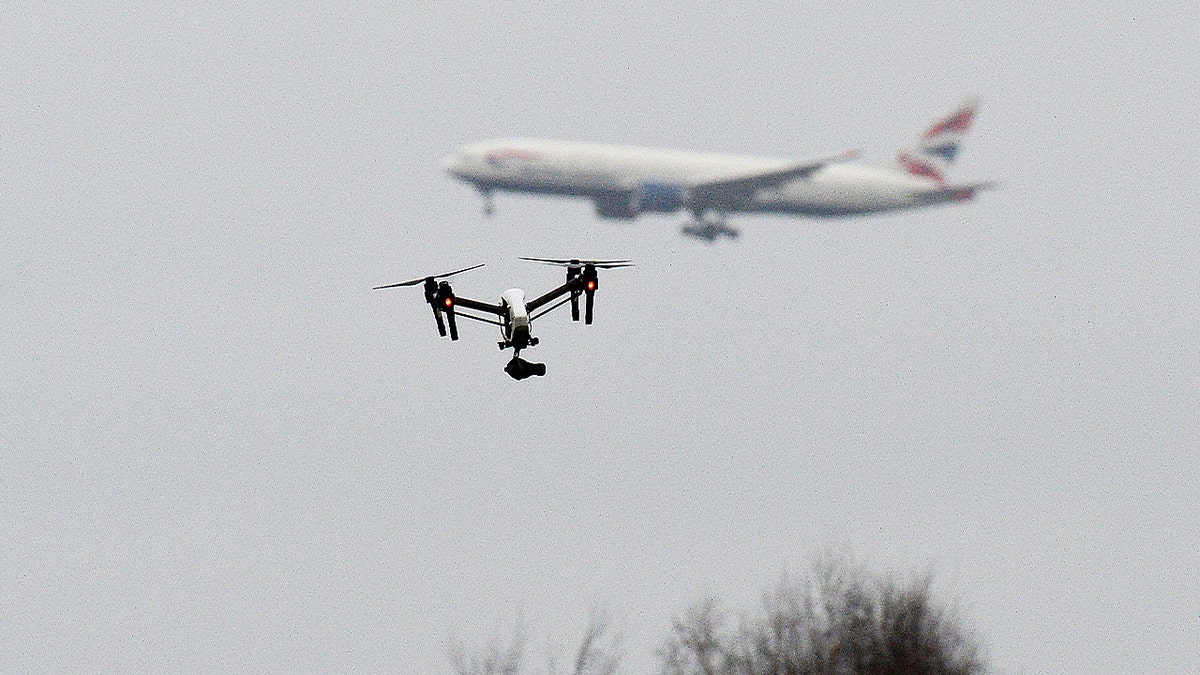
Recent drone incursions over some of America’s most sensitive military installations reveal a troubling reality: Even high-priority hardened sites are no longer immune to advanced drones. Protecting these bases is essential – but if adversaries can penetrate them, it signals that the civilian infrastructure we rely on every day is far more vulnerable than we are willing to admit.
Cheap, commercially accessible drones are reshaping conflicts abroad while exposing this dangerous truth at home. America’s greatest vulnerability is no longer limited to its borders. It is embedded in the infrastructure that underpins everyday life: airports, energy networks, data centers and ports. This is America’s soft underbelly, and it’s being exposed more and more.
We write from two perspectives, shaped by this threat. One of us has worked in aerospace and defense for forty years and now runs a company that builds counter-drone systems, witnessing firsthand how quickly these technologies are evolving and how creatively they are being used. The other served in Congress on the House Intelligence Committee and the Defense Appropriations Subcommittee, helping shape policies to address emerging threats before they reach U.S. soil.
CHAD WOLF: CHINA’S AI MOCKERY SHOWS THE BATTLE FOR AMERICA IS ON
What we see is not theoretical. It is a clear and accelerating trend.
Cheap drones now surveil targets, deliver contraband and transport explosive payloads with precision. They are adaptable, hard to detect and easy to scale. Just as important, they lower the barrier to entry. Opportunities once reserved for nation states are now within the reach of terrorists, sleeper cells, criminal groups and individuals.
That reality should change the way we think about homeland security.
The United States has made extraordinary investments to deter high-value threats. Our military remains the most capable in the world with unparalleled global reach, from aircraft carrier strike groups to next-generation aircraft and missile defense systems.
IRAN NETWORKS SUFFER LOSSES DURING AIR RAIDS, SHOWING DIGITAL EVOLUTION OF CONFLICTS
But those systems are built for a different layer of the threat environment.
U.S. air defenses are designed to detect and defeat missiles and aircraft, not small drones flying close to the ground. That gap is now one of the most exposed layers in our national security architecture.
Complicating the challenge is the legal environment. Much of the airspace where drones operate overlaps with civilian jurisdictions, where countermeasures are strictly limited. In many cases, federal law limits who can detect, track or disable a drone, even in sensitive areas.
DAVID MARCUS: WHY DO WE LET FOREIGN ENEMIES USE X PAYOFFS TO WAGE WAR AGAINST US?
In today’s environment, it is often easier to purchase and operate a drone than to legally stop one. This is not just a military problem. It’s a domestic one. Across the country, critical infrastructure is operating with limited protection against low-altitude threats. At the same time, the domestic drone ecosystem is large, growing and heavily dependent on foreign-produced hardware.
This creates a difficult reality for infrastructure managers. Airports, ports and energy facilities must maintain security and continuity, but most do not have the authority to act against a drone threat.
A drone doesn’t have to destroy a facility to have an impact. It only needs to disrupt one. A temporary closure of a port, airport or electricity station can impact supply chains, economic activity and public confidence.
Recent incidents on American soil underscore both the urgency of the threat and the gaps that remain. Unauthorized drones invaded the airspace above Barksdale Air Force Base, causing operational disruptions. Around the same time, US Northern Command confirmed drone incursions over another strategic installation during the opening hours of Operation Epic Fury.
If this can happen at sensitive military installations, it should change the way we think about the civilian infrastructure that was never designed for this threat.
Washington is beginning to respond, albeit unevenly. The Trump administration created Joint Interagency Task Force 401 to bring together the Departments of War, Homeland Security and Justice and other agencies under a single operational framework for counter-drone efforts. Congress also expanded counter-UAS authorities in the FY2026 National Defense Authorization Act, creating a path for broader deployment of defensive technologies.
These are necessary steps, but they are not sufficient. Drone technology is developing faster than the legal frameworks required to deploy counter-UAS technology on a large scale.
CLICK HERE FOR MORE FOX NEWS ADVICE
There is no one solution to defeat every drone threat. Effective defense requires a layered approach that combines detection, tracking, identification and mitigation. Within that framework, radio frequency-based systems provide a practical foundation: cost-effective, capable and scalable.
More broadly, the United States needs a change in mindset. Counter-drone capability should not be treated as a niche tool reserved for war zones. It should be understood more as cybersecurity: an essential, always-on layer built into critical systems.
Major events will always require increased security, but the greater risk lies in persistent targets: the infrastructure that powers the economy and supports daily life. These systems require continuous protection against an evolving threat.
CLICK HERE TO DOWNLOAD THE FOX NEWS APP
Other countries are investing accordingly. The United States has the technology and ability to respond. What is needed now is urgency. The threat is not far away. It’s not hypothetical. And it won’t fade.
Our soft underbelly is visible. We should not wait for an attack on American soil to make that clear.
Steve Haro is CEO of WhiteFox Defense Technologies, an American anti-drone company.