



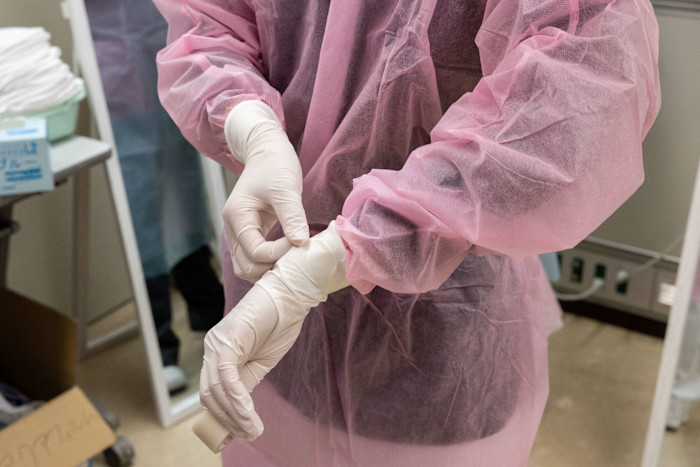
Japanese Prime Minister Sanae Takaichi plans to release 50 million medical gloves from pandemic reserves, as concerns grow across Asia about shortages of healthcare supplies due to the war in the Middle East.
Doctors in Japan have warned that disruptions to the supply of oil and naphtha from the Gulf could lead to serious shortages of medical supplies within two months, possibly even forcing the closure of cash-strapped healthcare facilities that cannot afford the skyrocketing prices.
Concerns over medical supplies underscore the growing international impact of the near closure of the crucial Strait of Hormuz supply route since the start of the US-Israeli war against Iran. The Gulf is a major supplier to Asia of oil and naphtha, a raw material used to produce the petrochemicals needed to produce many medical goods.
“As materials become increasingly difficult to obtain, necessary and good medical care becomes increasingly difficult to provide,” said Hiromichi Ito, a doctor who runs a clinic in Tokyo. “If this continues, there are concerns that we may no longer be able to provide the same high-quality medical care as before.”
Japanese doctors said the difficulty in obtaining supplies could mean they have to refuse to give some patients injections, intravenous drops and other treatments within two months.
Distributors of medical products in Japan have already announced purchasing restrictions to prevent hoarding, amid concerns about a pandemic rush to secure medical gloves, syringe packs and dialysis tubing.
Takaichi announced plans late Thursday to begin releasing about a tenth of the nearly 500 million medical gloves the government has stockpiled for use in a global pandemic starting next month.
“We have heard from local practices and dental clinics that they are concerned about supplies,” national broadcaster NHK quoted Takaichi as saying.
Ito said it was becoming increasingly difficult for his Tokyo clinic to obtain gloves and IVs and that when they were available, they were too expensive to justify purchasing given what patients could be charged under health care system regulations.
The clinic’s current supplies would run out in about two months. If they did, the country might not be able to admit patients with heat stroke during Japan’s sultry summer, forcing them to go to major hospitals for treatment.
Two government officials whose ministries have come under pressure from patient groups to be more transparent about the threat of shortages of key medical equipment said public alarm was steadily growing.
Japanese Health Minister Kenichiro Ueno said last week that there were no immediate supply shortages, but “the future situation remains uncertain.”
Nobuharu Yamamoto, a doctor who runs a clinic in Fukuoka Prefecture in southwestern Japan, said his supplies such as syringes, gloves and catheters were quickly running out and could run out in a month or two.
“If we can’t get those items, we’re in trouble. Things that we used to be able to order regularly are suddenly out of stock and now we often don’t know when new stock will come in,” he said, adding that the clinic’s operating costs had also increased due to rising energy prices.
At a recent meeting of private doctors, Yamamoto said he had discussed the difficulty of securing even simple items such as gloves. “Everyone has difficulty with this,” he says.
On Wednesday, Takaichi unveiled a $10 billion aid package to secure crude oil supplies for Southeast Asian countries that produce medical products.
Resource-poor Japan has made substantial preparations for crude oil supply disruptions, including building more than 250 days’ worth of stockpiles. But these supplies do little to address dependence on products made using petrochemicals in poorer Asian countries that cannot get crude oil or naphtha from the Gulf.

Other Asian countries have also become concerned about the supply of products for medical use. Authorities in South Korea have warned against price fixing and hoarding and this week announced a ban on stockpiling syringes and needles.
Ong Ye Kung, Singapore’s health minister, said this month that the country must be alert to any disruption to the flow of petrochemicals needed to produce gloves and syringes, as well as chemicals used to make medicines.
“The global supply chain is not actually a chain, but it is a very complicated web and we need to keep an eye on those knock-on effects downstream,” Ong said.
Japan is in a particularly weak position, medical specialists say, as regulations prevent hospitals and clinics from charging higher fees to cover the extra costs of consumables that have in many cases doubled in price.
Masahiro Kami, chairman of the Medical Governance Research Institute, said hospitals were already reeling from the impact of low prices, inflation and the weak yen, which have driven up costs for the import-dependent healthcare system.
A further increase in costs could cause “many” hospitals to close permanently, Kami said.
Askul, a major Japanese distributor, said Wednesday it is restricting purchases of latex gloves and medical tape to avoid shortages caused by customers stockpiling.
Some believe Japan has more time before the real crisis hits.
Yukio Aoki, an adviser at the Japan Association of Health Industry Distributors, said supplies have expanded following the Covid-19 pandemic.
“We have received many messages from manufacturers saying that production may be disrupted in the future and therefore they may impose shipping restrictions,” he said. “While we have relatively ample reserves and inventory, this could become very serious if the situation continues for longer – longer than about six months.”
