



For decades, much of Southeast Asia has tried to thwart China’s economic miracle — and with considerable success. But the size of China’s manufacturing sector is so vast that the region is now wondering whether its hopes of developing its own globally competitive industry will be shattered.
Southeast Asia is not so much facing a “China shock” as a “China cramp,” says Arvind Subramanian, former chief economic adviser to Indian Prime Minister Narendra Modi. Beijing, he warns, risks stifling the region’s long-term ambitions through excessive exports of low- and high-tech goods.
“It squeezes out space for all developing countries that are poorer than themselves in these low-skilled sectors,” he told an IMF conference in Bangkok in March. “So the ‘Asia model’ that China, Korea and Taiwan benefited from is now being pushed further and further away.”
The concern for regional officials is that this trend could end the so-called “flying geese” paradigm. This is the idea, first formulated in Japan in the 1930s, that Asia’s less advanced but cheaper economies can quickly follow a more developed country up the industrial value chain, as the leader moves into increasingly sophisticated manufacturing and services.
China’s market dominance in electric vehicles, solar panels and computer technologies is de facto preventing Southeast Asian economies from moving up the manufacturing value chain. At the same time, increasing exports of cheap products, from shoes to plastic, threaten to undermine their industrial base.
“Because of its size, you could say China encompasses a whole flock of geese,” said Mark Williams, chief Asia economist at consultancy Capital Economics.
“The question is whether the fifty-year pattern in which countries like Taiwan and Japan became rich was just a window in time – a window that is now closing.”
At the bottom of the manufacturing value chain, in an industrial estate on the outskirts of Kuala Lumpur, an abandoned-looking factory is a testament to the impact of transferring Chinese surplus goods to its neighbors.
For three decades, MPI Polyester Industries was a major Malaysian producer of polyethylene terephthalate (PET). At its peak, it produced 38,000 tons a year of the lightweight plastic used to make beverage bottles and food containers.
But in January the manufacturer shuttered its plastics business, blaming stiff competition from foreign rivals. “The margins are just not there anymore because we are being undermined by Chinese imports,” said Mok Chee Kong, marketing manager at MPI.

The story of MPI’s demise – which occurred despite the Malaysian government’s imposition of anti-dumping duties on Chinese plastics last year – is becoming a familiar one.
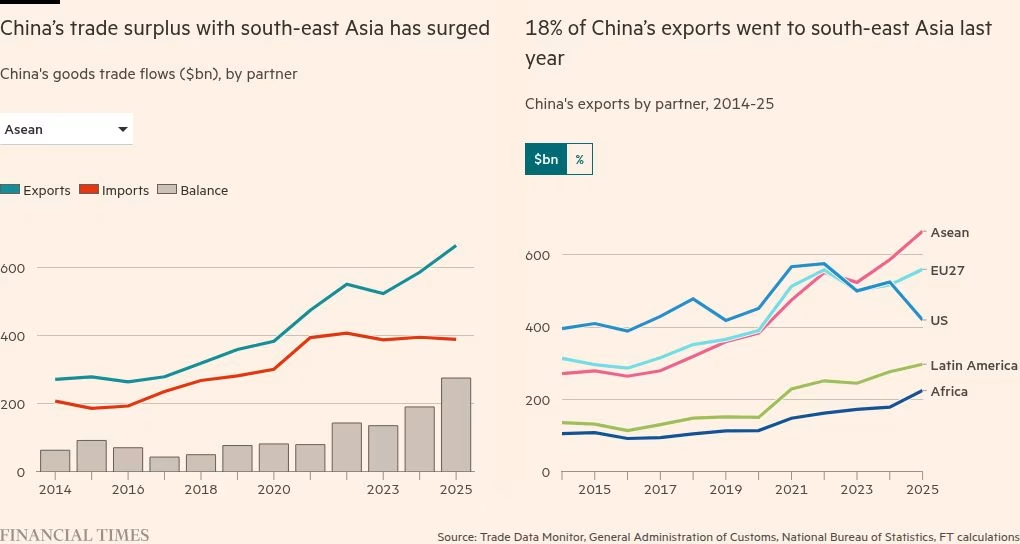
China’s trade surplus with the 11-nation Asean bloc reached a record $276 billion in 2025 – a 45 percent increase from the previous year – with strong growth in intermediate goods including electronics and capital goods such as machinery used by manufacturers.
Labor-intensive production sectors such as shoes and clothing have been particularly affected. About 60 factories in Indonesia will close between 2022 and 2025, according to the Indonesian Textile Association.
The biggest victim was Sri Rejeki Isman (Sritex), a company that once supplied clothing to Uniqlo and Walmart, but closed its factories last year and laid off more than 10,000 workers. The textile association estimates that 250,000 jobs have been lost in the sector in the past four years.
“The amount of textiles and clothing from China flooding the Indonesian market is on a very large scale and is estimated at thousands of tonnes per year,” ITA’s executive director Danang Girindrawardana told the FT.

Indonesian Finance Minister Purbaya Yudhi Sadewa said in March that Jakarta was considering measures to curb the growing dominance of Chinese products on the country’s e-commerce platforms.
“If this goes ahead without intervention, it would be like handing over our domestic market directly to China,” Purbaya said.
At the other end of the value chain, Chinese exports of electric vehicles, batteries and solar panels to members of the Association of Southeast Asian Nations rose by more than 50 percent last year to almost $22 billion.
Vietnam imported $84 billion worth of electrical machinery and electronics from China last year, an increase of 43 percent, according to the Asia Society Policy Institute (ASPI) think tank.
The China Shock 2.0

This is the final article in a series on the economic consequences of China’s record trade surplus for the rest of the world
Part 1: High-quality Chinese products are flooding the world
Part 2: Europe’s ’embrace or repel’ China dilemma
Part 3: ‘China squeeze’ in Southeast Asia
Bonus: Is China shock 2.0 really shocking?
According to Shay Wester, director of Asian economic affairs at ASPI, ASEAN countries are simultaneously becoming dependent on China for both industrial inputs for manufacturing and final products such as electric vehicles and solar panels.
Vietnam, which has become the base for many manufacturers moving from China, imports at least half of its raw materials from its northern neighbor. Cambodia is also heavily dependent on Beijing, importing about 60 percent of the raw materials for its crucial garment industry from China.
“These inputs help make Asean exports competitive in markets such as the United States and Europe. On the other hand, Chinese finished products are flooding domestic markets in a range of sectors, undermining local producers,” Wester said.
The threat posed by China’s growing market share at both ends of the value chain was a key focus at an IMF conference on “Asia 2050” in Bangkok in March.
Southeast Asia faces a difficult balancing act in dealing with both the threat and opportunities presented by China. “It’s not black and white,” said Trissia Wijaya, a McKenzie researcher at the University of Melbourne, as China’s capital and technology base remained a key driver of industrial development. “There is always input from China into the Southeast Asian economy, even if it is not without flaws.”

Some Asean members have tried to protect their markets from what they say is the dumping of Chinese goods, but the region has often struggled to respond effectively for fear of angering Beijing.
Liew Chin Tong, Malaysia’s Deputy Finance Minister, has warned that Asian countries that have long relied on the US as their export destination of “first and last resort” now risk crashing each other’s markets, “resulting in cutthroat price wars, involution and de-industrialization of other Asian economies.”
“To prevent this, China and all other Asian economies will need to open themselves to frank discussions about managing or even curtailing production capacity at home and offering voluntary export curbs,” Liew wrote in December.
China rejects allegations of widespread product dumping. In an article in the official China Daily last year, researchers at a Commerce Ministry think tank said the country’s exporters were “creating rich cross-border production and supply systems that are helping Southeast Asia accelerate transformation and modernization.”
The problem for Asean governments is that while Chinese investments bring short-term benefits to the region, they also reduce incentives for longer-term investments in homegrown technology, workforce training and structural reforms to move them up the value chain.
The challenges that led to the closure of MPI Polyester’s plastics factory are clearly revealed in Zhangmutou, one of China’s largest plastics trading centers, located in the southern manufacturing city of Dongguan.
Despite the enormous needs of Dongguan producers, local supply far exceeds demand, thanks to a combination of US President Donald Trump’s tariffs affecting trade with the US and a weakening of the Chinese economy following a real estate market crisis.
“How wonderful [China’s] However, domestic demand is never enough,” said Xia Yongfu, director of Dongguan Aohua Plastic Trading.

Xia added that while there was some demand from Southeast Asian companies, the majority of his customers in the region were Chinese businesspeople who had opened factories there.
Huang Yongxin, director of Yuanxin Lianhe Plastics Manufacturing, another Dongguan company, admitted that the system did nothing to boost Vietnam’s industrial development, either by creating new production processes or by cultivating workers’ skills.
“Vietnam can never match China’s production chain. Many of Vietnam’s senior engineers are recruited from China and travel back and forth by plane every week,” he said, adding that new plastic formulations could be made much more easily in China.
ASPI’s Wester said there are already signs that China’s dominance is likely to deepen in the long term as technology becomes increasingly important to the production of both goods and services.
“Digital infrastructure is an area to watch as Chinese companies invest heavily in data centers in Southeast Asia,” Wester said. “[These] companies export not just products, but entire technology and industrial ecosystems.”
Data visualization by Haohsiang Ko in Hong Kong
