



Stay informed with free updates
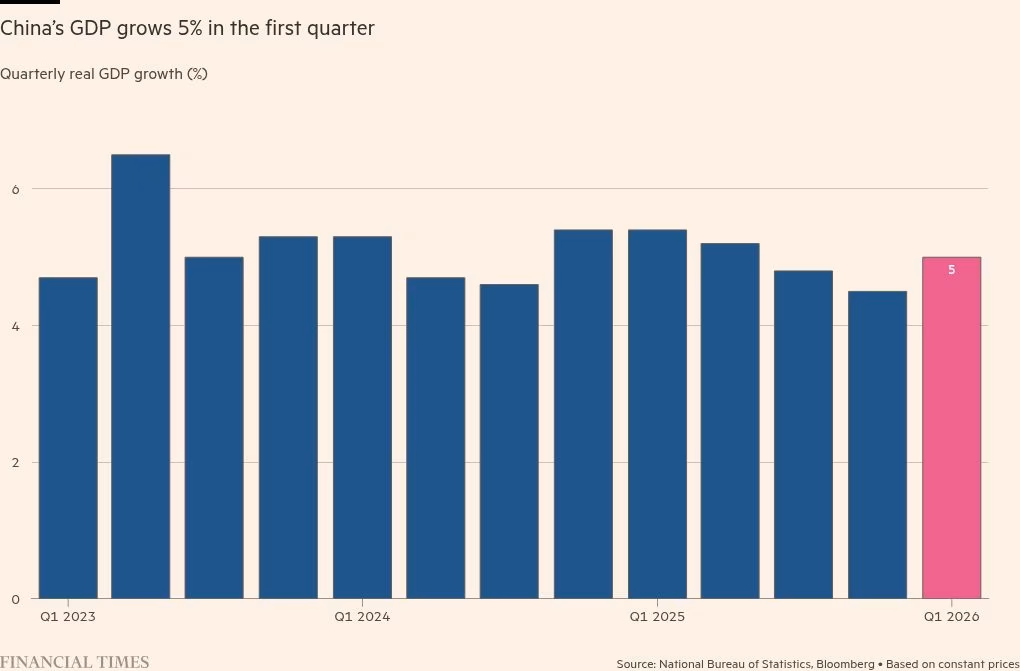
China’s push for high-tech manufacturing has helped the economy, which registered 5 percent annual GDP growth in the first quarter as the country braces for the fallout from the war with Iran.
The growth rate exceeded expectations of analysts polled by Bloomberg of 4.8 percent and the previous quarter’s growth of 4.5 percent. It was also at the high end of the government’s target for this year of 4.5 to 5 percent. Exports, high-tech production and fiscal stimulus offset the still weak domestic economy.
The strong start to the year comes as China’s economy is expected to take a hit from the war in Iran and rising energy prices, which will ease long-running deflationary pressures but compress the already tight margins of the hyper-competitive industrial sector.
“As a large country that is deeply integrated into the world economy, China will definitely be affected to some extent,” Mao Shengyong, the deputy commissioner of the National Bureau of Statistics, said of the energy shock.
“We should still have the conditions in place to maintain a relatively fast growth rate for some time to come.”
President Xi Jinping is expected to meet his US counterpart Donald Trump in Beijing in mid-May for talks, hoping the two countries will continue a one-year trade truce.
The expansion in the first three months was partly driven by better-than-expected industrial production, which rose 5.7 percent year-on-year in March, compared to analysts’ forecasts of 5.3 percent.
Retail sales growth, seen as an indicator of consumer confidence, was weaker than expected at 1.7 percent, compared with analysts’ forecasts of 2.4 percent in March.
“The national economy is off to a good start,” the NBS said in a statement about the figures. “Industrial production growth accelerated, with rapid growth in the equipment manufacturing and high-tech manufacturing sectors.”
The agency said equipment production rose 8.9 percent year-on-year in the first quarter, while high-tech production rose 12.5 percent, with 3D printing equipment, lithium-ion batteries and industrial robots rising 54 percent, 40.8 percent and 33.2 percent, respectively.
Fixed asset investment continued to recover from last year’s declines, rising 1.7 percent in the first quarter, while real estate investment fell sharply again, down 11.2 percent from the same period a year earlier.

Capital Economics said that, according to the China Activity Indicator, an alternative measure of GDP growth, the economy grew just 3 percent on an annual basis in January and February and probably slightly less in March.
“The big picture is that all the acceleration in GDP growth in the first quarter came from construction and manufacturing,” Zichun Huang of Capital Economics said in a note. “And while there has been some tentative improvement in domestic demand growth, exports have been the main source of strength.”
Huang said the war in Iran would reinforce this trend. While fuel prices would dampen domestic demand, they would boost demand for Chinese green technology exports.
“The result is that while the Chinese economy is holding up well, it is becoming increasingly dependent on external demand,” Huang said.
Junyu Tan, regional economist for North Asia at Coface, said that “the solid start to the year, thanks to strong export performance, suggests that the direct impact of the conflict in the Middle East remains limited for the time being.”
But Tan said the recovery in investment could lose momentum as budget support faded and consumption growth weakened in the absence of subsidies on consumer goods purchases that boosted it last year.
The drop in home prices in March indicated “still cautious buyer sentiment and ample existing supply,” said Yuhan Zhang, chief economist at the China Center at the Conference Board.
He said the growth in fixed asset investment was aimed at “new high-quality productive forces and upgrading infrastructure.”
New high-quality productive services is the government’s terminology for investments in advanced industry, such as electric vehicles and green energy.
