



The IMF’s dirty secret is that its employees love nothing more than a good old crisis. For all the sage advice about sound economic management, solving a global mess is more interesting; lending to distressed countries provides the IMF with the financing it needs to function; and difficult times make the fund relevant.
So it was with verve in her step that director Kristalina Georgieva opened the IMF spring meetings by saying: “as a firefighter, we are there for you when the crisis strikes”. She enjoyed giving advice to the world so much that she found time to express a few words of sympathy to the central bankers. “It’s not easy to be a central banker these days,” she said. “Why? Because [the situation] is bad or very bad. So send them some love.”
Where the IMF really adds value is in its global reach and, this time, in its analysis of the diversity of likely outcomes for emerging economies. This is consistent with what I was told by Maurice Obstfeld, senior fellow at the Peterson Institute and former chief economist of the IMF.
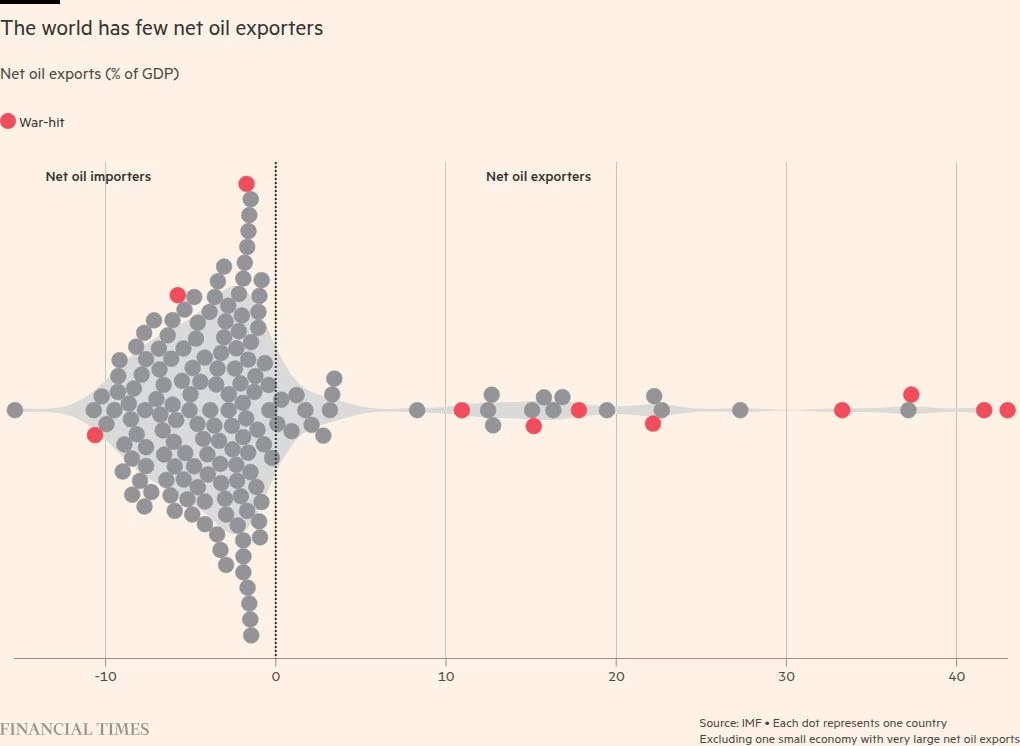
The IMF chart below shows countries by their net export position in oil and other liquid fuels. The vast majority are small net oil importers and will therefore have to reduce demand to meet lower supply or pay more for their imports. But what is often forgotten is that some of the major oil exporters in the Gulf are also being hit hard because they cannot export as normal.
Despite the variety of impacts, Obstfeld said emerging and developing economies would be hit harder than advanced economies, especially if their currencies fell against the dollar. This is because they cannot easily cut back on other non-essential expenses when necessities such as energy become more expensive.
This is made worse if richer economies simply pay more or protect their populations from price increases by borrowing and subsidizing energy, as this causes supply shortages in poorer countries, such as those recently seen in India for cooking gas and liquefied petroleum gas. The IMF obviously does not like broad support packages. But such measures are expanding rapidly, as the graph below shows.

Governments of emerging economies have less budgetary space to provide subsidies because their public finances have become less sustainable over the past twenty years. This is the result of historic debt relief that improved their starting position in the early 2000s, more borrowing in good times and greater availability of financing.
As global interest rates have risen, interest payments on debt as a share of tax revenues have tripled for the poorest developing countries, while continuing to rise for emerging and middle-income countries. In contrast, advanced economies, with the exception of the US, have enjoyed a decline in the burden of interest payments on debt.

The result is that it is difficult to be a developing economy in an energy crisis.
But some will be hit much harder than others. Another way to display the IMF’s net oil exporter graph is to group each country by geographic location and credit rating. The worst affected countries will be those with low or no creditworthiness, which are also largely dependent on oil imports. These are typically small developing island economies and sub-Saharan countries, as shown in the bottom left corner of the graph below.

This is one reason why Georgieva thought there would be demand for IMF loans in Washington this week, and why the fund will play a key role in the global economy this year. In fact, the poorest countries most exposed to the oil shock are already the most likely to benefit from an IMF program.

The rest of the world should broadly be happy that the IMF is ready to help ease the emergency for poorer economies. Rich countries make money from IMF loans because very few countries cannot pay off their IMF loans. And that financing helps isolate the shock and prevent regional and global spillovers.
It’s no surprise that the financial markets have already taken notice. The spread in emerging markets between government bonds and US government bonds has increased from 2.2 percentage points before the war with Iran to 2.6 percent in early April, before the recent ceasefire.
This limited increase in financing costs is reasonable given the heterogeneity of economic conditions in emerging economies, but for many of the more vulnerable countries the increase in risk premia will be much larger. This will be the beginning of a very difficult period for them.

What I’ve read and watched
One last graph
Annual consumer price inflation in the US rose to 3.3 percent in March, driven by very large increases in gasoline and diesel prices at the gas pumps. Core inflation, excluding energy and food, was more stable, rising from 2.5 percent in February to an annual level of 2.6 percent in March.
Bee Monetary policy radarwe wanted to go a little deeper than the simple split between head and core, so borrowed ECB analysis for the Eurozone and applied to the US. We derived an index of the energy-intensive elements of US core inflation. This is a relatively small part of the CPI, but includes things like airline tickets, laundry services and car costs.
Energy-intensive US core inflation rose from 2.1 percent in February to 3.1 percent in March. As always, the question will be whether other parts of core inflation converge towards the rate for energy-intensive goods and services. That would worry the Federal Reserve. The much more optimistic outcome would be if core inflation in energy-intensive goods and services is only temporarily high and does not contaminate the broader economy.

Central Banks is published by Harvey Nriapia
