



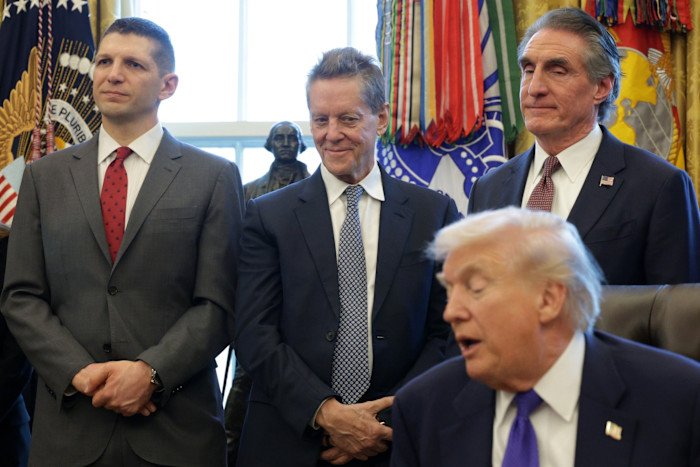
Standing in the Oval Office in February for the launch of “Project Vault,” mining billionaire Robert Friedland told Donald Trump that America’s $12 billion mineral supply would be nothing short of transformational.
“I’m telling you on behalf of all the miners I know: they are excited about the breakthroughs that have been made here,” he said. “This is the first government, with your support, where we have hope.”
However, some mining companies are quietly concerned about the venture, warning it risks disruptions and a “huge overhang” in commodity markets.
Their concerns come at a time when the war in Iran has highlighted the vulnerabilities in broader natural resource supply chains and the ease with which the industry can be disrupted by geopolitical events.
The strategic mineral reserve, the largest in the US for civilian purposes, has sharply divided opinion within the mining community on which it depends.
The program, led by the U.S. Export-Import Bank, aims to counter Chinese dominance of supply chains by building a stockpile of 60 crucial minerals that manufacturers must pay for.
It will operate on a demand-driven model based on the needs of end users such as carmakers, a person with knowledge of the plans said. He added that manufacturers who join Vault will set a price for specific metals that they will pay when they take them out of inventory.
“The free market works for a reason, and I always worry about interventions,” said Randy Smallwood, chairman of Wheaton Precious Metals, one of the world’s largest companies that buy gold and silver.
Stockpiling programs are “not based on sound economic principles, but on protectionism,” he added. “I think governments are so inefficient when it comes to managing them.”
Iván Arriagada, CEO of Antofagasta, told the FT that stockpiling “brings some distortions in the market”, something the Chilean copper miner had to “look at carefully”. Chile is the largest supplier of the metal to the US.
With copper prices recently reaching record levels, additional demand from stockpiling could push prices up further.

Anglo-American CEO Duncan Wanblad is also cautious. “Such mechanisms can create overhang and distort commodity markets, so it will be important to understand the details,” he said.
Another mining executive told the FT that the Vault was likely to drive up prices and create a “hoarding” mentality, and that nationalist trade policies that erected barriers to free trade could weigh on global development.
Traders and executives warned that the efforts would likely put the U.S. in direct competition for the metals with other countries, especially some with small markets such as germanium, which is scarce outside China.
The US is not alone in wanting to stockpile minerals; the EU and Australia, among others, have announced their intention to build up national reserves to protect domestic industries.
While details on how Vault will work are scarce, companies including Lockheed Martin, General Motors, Alphabet’s Google and battery maker Clarios have signed up, requiring them to pay a fee to participate.

Trade groups will purchase the metals that will be stored in the U.S. so manufacturers can use them during supply shocks or emergencies.
While a defense stockpile for national security was established in 1939, “the U.S. has never had an economic security stockpile,” said Gracelin Baskaran, director of the critical minerals security program at the Center for Strategic and International Studies think tank.
“The beauty of the Project Vault model is that it is more fiscally sustainable: companies pay for it,” she said. The war in Iran underscored the importance of securing mineral supply chains, and “Vault only works if those materials are kept domestically and can be delivered quickly,” she added.
But one trader said brand name manufacturers were often unaware of the precise and complex specifications of each metal their suppliers needed, a supply chain that some were now trying to better understand.
The trading houses that will purchase the equipment are Mercuria, Traxys, Hartree Partners and Glencore – of which CEO Gary Nagle has become an enthusiastic supporter.
“It is a great opportunity for us to help the US government properly design and implement this project,” he said on a call with reporters. “We are very happy to be part of it.”

Details about how Project Vault will work are still being finalized, so no purchases have been made, a person familiar with the matter said.
For mining executives, the stockpile plan is the latest in a series of policies that have made Washington an unlikely hub for the industry, and many say they are spending more time in the U.S. capital as a result.
“We’re all running around Washington trying to advocate for what we’re advocating for,” Nagle said. “Every mining company is trying to get on the radar in the US.”
One of the companies that took center stage was Friedland’s Ivanhoe mines. Just a day after Project Vault was announced, it emerged that the Kipushi zinc mine in the Democratic Republic of Congo, which produces gallium and germanium as by-products, was in talks with trading partners Mercuria and Gécamines to supply minerals to the program.
Since the start of Trump’s second term as president in January 2024, his administration has taken direct stakes in several mining companies, announced a multi-billion dollar mining fund and forged crucial mineral partnerships with key producing countries.
Many of these have been welcomed by the industry, but some worry that in an industry where free trade is a near-sacred virtue, the stockpiling program may go too far.
“A much better approach would be to open up the permits,” Smallwood said. “When I look at North America – assuming friendly relations between the US and Canada – there is absolutely no reason why we should leave this continent… We have everything we need here.”
