



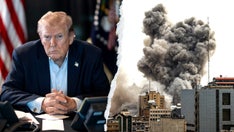
The reason why a state goes to war – its Casus Belli – is an essential part of its campaign. Wars with a strong regiobelli, such as the Civil War and World War II, tend to be more popular and consistently have more victories than wars with weak justifications—Vietnam and Iraq, for example. The Trump administration’s reasons for initiating Operation Epic Fury are under attack from both the isolationist right and the progressive left in the United States. They claim that the war in Iran is unnecessary, unfounded and even illegal. It serves Israel’s interests more than America’s, some say. Refuting these arguments will therefore be crucial for the success of the operation.
Criticism of the war falls into three categories. The first attacks the objectives of the war. While admitting that the Iranian regime is atrocious and ideally should be overthrown, opponents insist that the Islamic Republic has never really threatened America. They recall that Trump himself admits that Iran’s main nuclear facilities were destroyed last summer, while its ballistic missiles cannot yet reach Europe, let alone the United States. By comparison, North Korea poses a much greater threat to the United States, yet no one is advocating bombing Pyongyang. And while government officials have occasionally cited regime change as Epic Fury’s desired outcome, no regime has ever been toppled by airpower alone.
Strategically, the war will deplete U.S. arsenals, critics warn, and embolden Russia to redouble its aggression against Ukraine and allow China to attack Taiwan. The White House has never clearly identified the war’s objectives, opponents argue, or formulated a day-after plan. As such, the war could result in the rise of an even more radical leadership in Iran. The Middle East, meanwhile, will be destabilized.
Finally, the White House is acting unconstitutionally on a legal level by not asking Congress for authorization for the war – so the critics argue. Some go further by claiming that the attack on Iran is criminal. “A preemptive strike, in which the powerful strike the weaker state,” wrote David Sanger of The New York Times, “is considered illegal.”
Although seemingly convincing, none of these arguments can withstand serious scrutiny. No, Iran does not pose an immediate threat to American security, any more than Nazi Germany did to Britain in the 1930s. But, as Churchill foresaw, if left unchecked, Germany’s rapid military build-up would soon endanger Britain, which in fact it did. In this sense, North Korea represents the perfect cautionary example. Would war critics prefer that the United States wait until Iran has the bomb and long-range missiles capable of hitting American targets? Precisely for that reason, no one recommends an attack on Pyongyang. And while North Korea’s organizing principle is regime survival and food to feed its starving population, Iran’s is regional and ultimately global domination. The North Korean threat to America pales in comparison to that of a nuclear-armed and ballistically equipped Iran.
It is true that no regime has ever been toppled by air power, but a sustained bombing campaign with jets and sea-to-surface missiles could seriously degrade the Iranian government and facilitate a successful popular uprising. Such an approach worked well in Serbia, where in 1999 US and allied aerial bombardments forced the withdrawal of Slobodan Milošević’s forces from Kosovo and directly contributed to the collapse of his government the following year.
CLICK HERE FOR MORE FOX NEWS ADVICE
Far from emptying America’s arsenals, the war is already accelerating U.S. production of a wide range of munitions, especially anti-missile interceptors. And rather than being encouraged by the U.S. military’s munitions spending, Russia and China are likely to be deterred by the display of American skill and determination. After depriving China of its rich source of energy from Venezuela, Trump could also deny China its vital flow of Iranian oil.
REP BRIAN MAST: Democrats don’t want war powers, they want to wave a white flag
According to military philosopher Carl Von Clausewitz, war is always defined by uncertainty. The government certainly could have better clarified its objectives before launching its attack, but determining the exact outcome at this stage of the campaign is pointless. Suffice it to say, as the White House has already done, that the military action could help create the conditions under which the Iranian people can regain their freedom. In addition, Operation Epic Fury aims to eliminate the most serious Iranian threats now and in the future. And when it comes to destabilizing the Middle East – the critics’ most ridiculous claim – Iran has been the main source of violence in the region for almost half a century. Neutralizing that source will provide game-changing opportunities for achieving security and peace, from the Mediterranean to the Persian Gulf and beyond.
The debate over each president’s right to go to war is hardly new and will not be settled in this conflict. In any case, Congress will now vote against restricting that right. And regardless of its constitutionality, the war in Iran is in no way illegal. According to international law expert Natasha Hausdorff, the relative strength and weakness of the warring parties are completely irrelevant. “Under real international law,” she writes, “Israeli-American attacks are lawful if they continue to comply with the laws of armed conflict of necessity, distinction, proportionality and precaution.” The indicators are that these principles are being applied now, as before.”
CLICK HERE TO DOWNLOAD THE FOX NEWS APP
The arguments against the war are weak at best and are further weakened by their refusal to acknowledge the much stronger arguments in favor of it. This starts with the irrefutable fact that the Islamic Republic started this war 47 years ago by occupying the American embassy in Tehran and holding 52 Americans hostage for hundreds of days. Iran started the war by torturing and executing Americans in Lebanon in the 1980s, by blowing up the Navy barracks and U.S. embassy in Beirut, and by killing American soldiers during the Iraq War. The Ayatollahs started the war when their terrorist allies launched hundreds of drone and missile attacks on US bases and ships throughout the region. All along, Iranian drug traffickers, in collaboration with South American cartels, have flooded the United States with deadly narcotics. Iranian assassins have targeted the Saudi and Israeli ambassadors in Washington, senior US officials and, allegedly, the president.
The Iranian regime began this war by openly and fervently promising every day since coming to power to destroy the United States and by diligently developing the weapons to do so. While Israel certainly has an interest in defending itself against Iranian attacks, that interest is consistent with and not superior to that of America, which is independent and critical. In what logical universe, a clear-thinking person might ask, does the United States not have a clear winston against Iran?
