



Stay informed with free updates
Reliance on Chinese green technology makes European countries vulnerable to national security risks including cyber attacks, trade restrictions and espionage, new research warns.
A report co-authored by Michael Collins, former deputy head of national security strategy at the UK Cabinet Office, said European governments are failing to fully consider such risks as they roll out Chinese green technology in an effort to secure energy supplies and tackle climate change.
After the war with Iran triggered the second energy shock in just five years, many European politicians, including EU Energy Commissioner Dan Jørgensen, argued that renewable energy sources are safer than fossil fuels because they are not subject to the same price volatility and supply chain disruptions.
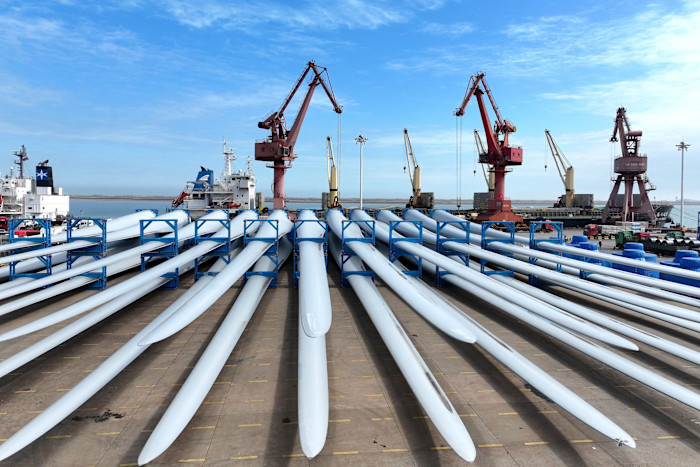
But China dominates green technology, producing about 90 percent of the world’s solar modules, more than 80 percent of its wind turbines and 80 percent of its battery cells, and also controls broader supply chains for rare earths and semiconductor materials.
Collins said countries risk “sleepwalking into a scenario where you’re suddenly confronted with a major national security problem.”
Countries should “continue the transition” away from fossil fuels but be “aware of the risks” and diversify supply chains where possible, he said. “We do not want to replace one set of dependencies on fossil fuel imports with a dependency on Chinese low-carbon technology.”
The report, co-authored by Michal Meidan, director of the China Energy Program at the Oxford Institute for Energy Studies and based on interviews with energy and national security experts, identified eight separate risks associated with an over-reliance on Chinese green technology.
One of the biggest was supply chain disruption, said the authors, who argued that China was likely to limit the supply of low-carbon technology and components. Beijing has increasingly used export controls in recent years to increase its control over global supply chains.
An underappreciated risk was that the US could demand Europe remove Chinese technology from its energy systems – or face tariffs, sanctions or reduced security obligations, the report said. It noted that Britain banned Chinese telecoms equipment maker Huawei from supplying kits for the UK’s 5G mobile phone networks, following intense pressure from the US.
Other risks include a large-scale disruptive attack where so-called kill switches could be used to remotely disable solar panels, wind turbines and other technology, the authors said.
While they said China’s “cyber actors almost certainly have the ability to remotely access Chinese-manufactured or operated smart hardware or software,” they said the risk of such an event was “highly unlikely.”
The report, commissioned by Loom, a nonprofit organization that focuses on economic, environmental and national security issues, flags inverters – which connect renewable energy projects to the electric grid – as an area of vulnerability.
Chinese officials dismiss concerns about their country’s dependence on green technology, saying Beijing has no intention of using it for political advantage and that cheap turbines, solar panels and other renewable energy products reduce the much greater risk posed by high carbon emissions.
In 2023, the FT reported that the National Cyber Security Centre, a branch of the intelligence agency GCHQ, advised Britain’s National Grid to remove components supplied by a Chinese state-backed company from the UK electricity transmission network over cyber security fears.
British security services have also been investigating China’s wider role in the country’s energy system.
Joss Garman, executive director of Loom, said the recent shocks in fossil fuel prices “should accelerate Europe’s energy transition, but new dangers arise because the cheapest route so overwhelmingly passes through China.”
Last month, Britain rejected plans for a Chinese wind turbine factory in Scotland on national security grounds. An Italian auction last year required modules and inverters for new solar projects to be non-Chinese.
However, Collins argued that there was a “fundamental difference” between the risks of low-carbon, electron-based technologies and fossil fuels. “If you get into a fight with China, once you already have all your low-carbon features in place, your economy is not going to collapse in a few days, which is what we see with fossil fuels,” he said.
