



Stay informed with free updates
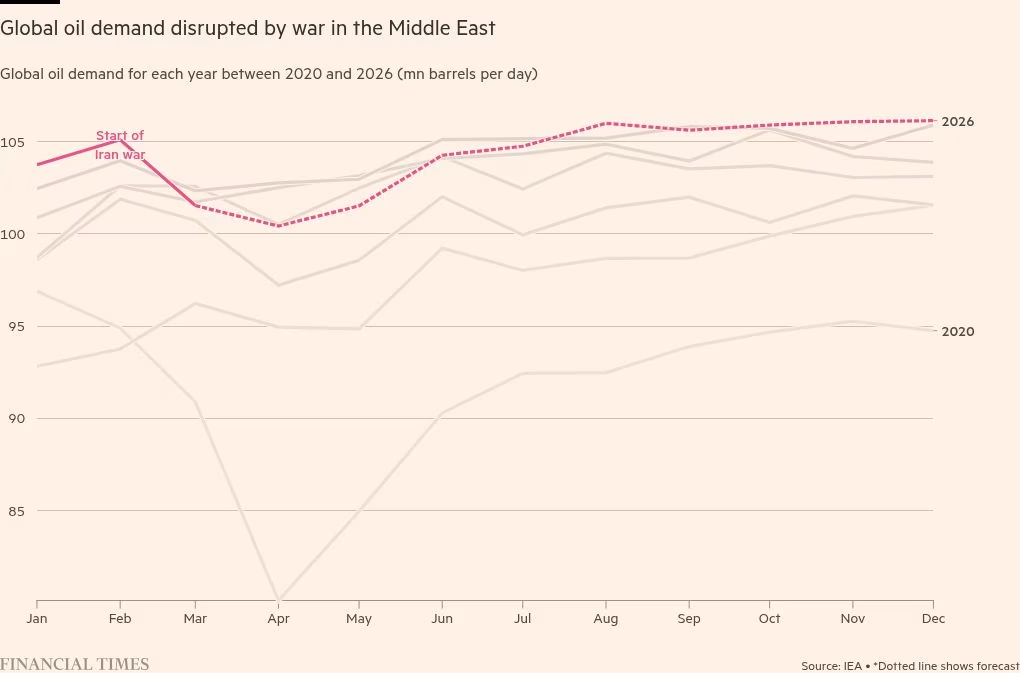
Global oil demand has plummeted since the start of the Iran war, the International Energy Agency said on Tuesday, marking the steepest quarterly decline outside the Covid-19 pandemic since before the global financial crisis.
The IEA, the world’s oil watchdog, said rising prices, supply shortages and the near-total loss of air traffic in the Middle East had led to a drop in demand that was almost unprecedented in its speed and severity.
Global oil demand fell 3.4 percent in March and is expected to fall another 1.1 percent in April to 100.4 million barrels per day, the lowest in more than three years, the IEA said.
While significant uncertainty remains over the annual outlook for the global oil balance, with much depending on whether the Strait of Hormuz will reopen, demand is now expected to decline for 2026 as a whole, according to the IEA.
That would be the first annual decline, excluding the pandemic, since the global economy stalled in 2009 during the biggest economic recession since the Great Depression following the financial crash.
The IEA said that while the initial drop in demand was focused on the Middle East and Asia, the two regions most directly affected by the sharp drop in cross-strait supply, Western countries should brace for the expansion of shortages.
“Demand destruction will spread as shortages and higher prices persist,” the IEA said in its monthly report.
Shipping through the crucial Strait of Hormuz, which usually carries a fifth of the world’s oil supplies, has come to a standstill since the war broke out in late February.
While lower demand is helping to offset some of the lost supply due to the war in the Middle East, the short-term shortage in the market is extreme, with approximately 13 million barrels per day of oil production at a standstill due to the conflict.
The IEA has helped coordinate a record release of 400 million barrels of strategic oil reserves to help offset lost Gulf production, while additional commercially held barrels have been sold.
More than 205 million barrels – the equivalent of roughly two days of global oil demand – have been withdrawn from supplies outside the Gulf since the conflict began, the IEA said.
Global oil inventories fell less, by just 85 million barrels, but much of the difference is because oil has piled up in the Gulf and is unable to reach global markets.
According to IEA data, the war with Iran caused global oil deliveries to drop by 800,000 barrels per day in March compared to last year. They are expected to fall by 2.3 million b/d in April, which would be the biggest monthly decline since early 2021.
Iran has been preventing free passage through the strait since February 28 and on Monday the US started its naval blockade, which also restricted Iranian oil sales.
If the war ends relatively quickly – and the straits reopen – the world could still end up with a small surplus of supply versus production in 2026, although this is much lower than predicted before the conflict.
According to the latest IEA estimates, the world will have an average oversupply of less than 500,000 barrels per day by 2026. Just a month ago that figure was 2.4 million barrels per day.
Data visualization by Alan Smith
