



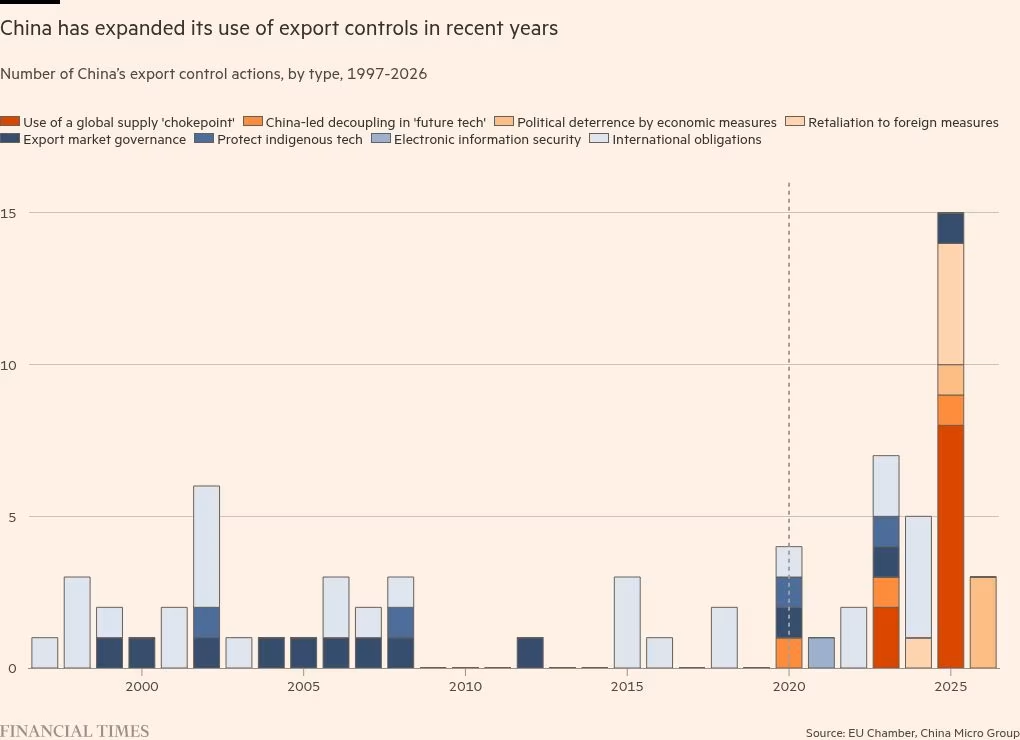
China has almost tripled its use of export controls in the past five years, a report has found. This underlines Beijing’s willingness to leverage its power over supply chains as Xi Jinping prepares for talks next month with US President Donald Trump.
The findings come after Beijing this month unveiled sweeping regulations that will allow authorities to penalize foreign companies for conducting due diligence on their Chinese suppliers and impose exit bans on those who break the rules.
China has announced export restrictions 30 times between 2021 and 2025, the EU Chamber of Commerce in China report shows, compared to just 11 times in the previous five years.
Since 2020, Beijing has turned to “geoeconomic” controls – measures aimed at achieving geopolitical goals, the report said. These include 10 that took advantage of global bottlenecks in supply chains, such as China’s exports of rare earths, and 10 others that sought to coerce other countries through economic measures.
Beijing has stepped up its use of the measures in response to US export restrictions on products such as semiconductors, culminating last year when China used controls on exports of crucial minerals to force Trump to agree to a truce in their trade war.
Jens Eskelund, president of the EU chamber, said China needs some export controls because of “hard security issues” and that its concerns about others weaponizing the trade are understandable, but there is a risk of a “race to the bottom”.
“We really need people to step back, take a rational perspective on this and ask whether this is really in the best interest of everyone,” Eskelund said.
“China has an opportunity right now, given its role in global supply chains, to show the world that while we may have differences with other countries, we are not going to risk global prosperity,” he said.
China’s increasing use of export controls is a demonstration to Trump, who will visit Beijing in mid-May, and other foreign leaders that Beijing is willing to retaliate against attempts to close their markets to Chinese goods or restrict access to key industrial inputs or technology.
China, which posted a record trade surplus of $1.2 trillion last year, depends on net exports to meet its growth targets and offset a weak domestic economy even as it pours public resources into advanced industries to compete with the U.S. for technological supremacy.
China has been building up its legal toolbox of trade countermeasures for years, enacting an export control law in 2020 that regulates dual-use goods, as well as other legislation on foreign investment, trade and countering foreign sanctions.

These build on previous rounds of informal Chinese coercive measures, such as halting rare earth supplies to Japan in 2010 during a territorial dispute and blocking Australian imports after Canberra called for a coronavirus investigation five years ago.
The latest round of checks, the “State Council Regulations on Industrial and Supply Chain Security,” which came into effect on March 31 but was only announced last Tuesday, are among the strongest yet.
The vaguely worded rules, signed by Premier Li Qiang, China’s second-ranked leader, make it illegal to “harm the security of the country’s industrial and supply chains” and raise the specter of exit bans for violators, analysts said.
The 13th article of the regulation threatens action against anyone who “conducts information gathering activities related to industrial and supply chains in China.”
Article 15 gives Chinese authorities sweeping powers to investigate and impose countermeasures against any foreign organization or individual that “interrupts normal transactions” with Chinese counterparties.
“For organizations and individuals that violate the provisions,” ministries may “prohibit or restrict them from leaving the country,” Article 16 says.
Zhan Kai, a Shanghai-based global partner at Chinese law firm Yuanda, said the rules reflect broad efforts to “leverage both the Chinese and American sides in trade negotiations” ahead of Trump’s visit to China, which was postponed until early April.
The measures gave China an opportunity to respond to U.S. regulations, such as a USTR Section 301 investigation recently introduced by Trump to allow for the reimposition of tariffs after its efforts were blocked by the U.S. Supreme Court last year, lawyers said.
They said the new regulations were also likely a response to the U.S. Uyghur Forced Labor Prevention Act, which aims to prevent products forcibly made by ethnic minorities in China’s western Xinjiang region from being sold in the U.S. market.
Trump’s “One Big Beautiful Bill Act” last year also included supply chain restrictions on products from China, lawyers said.
“The Chinese government wants to have a fairly broad toolbox to respond to a range of moves by foreign governments,” said Dai Menghao, trade compliance partner at law firm King & Wood.
James Zimmerman, a partner in Loeb & Loeb’s Beijing office, said the new rules restricting supply chain due diligence are “counterproductive,” allowing sophisticated buyers to apply not only quality control but also internationally recognized labor standards when sourcing.
“When a supplier fails to meet a buyer’s standards and is ultimately shut down, this actually encourages the supplier to raise its standards, which in the long run improves the security of China’s supply chain,” Zimmerman said. “The message is that all buyers are at risk if they choose to enforce core labor standards.”
In a separate statement, the head of the EU chamber, Eskelund, said European companies often have to comply with European directives requiring them to control their supply chains.
“There is a risk that the information to be collected as part of this process could be interpreted as a violation of Chinese law,” he said.
The regulation “increases the risk of doing business in or with China,” he said, calling for more clarity on the new rules.
Data visualization by Haohsiang Ko in Hong Kong
