In one of the wealthiest places on earth, thousands live in tent cities on the streets of Los Angeles, an “atrocity” that even former Democratic President Barack Obama recently acknowledged on a podcast. He decried the moral failure of letting people languish without real help, while noting that downtown encampments are a “losing political strategy.” He demanded policies that “recognize their full humanity” and provide real tools for success.
But this is not just a moral failure, it is a structural failure.
Although Obama did not directly mention Democratic Governor Gavin Newsom, the criticism is landing squarely on his doorstep. After all, Newsom has been at the helm as homelessness in California soared to record highs, even after more than $24 billion has been funneled toward solving the problem since 2019. Newsom’s team claims to have reached an agreement with Obama, touting mental health reforms and encampment clearances, but the reality on the ground tells a different story.
As a California resident who has spent years working directly on the streets to help homeless veterans move into treatment and out of camps, I have seen firsthand that this crisis is not just about housing, but about untreated trauma, addiction, and lack of structured support.
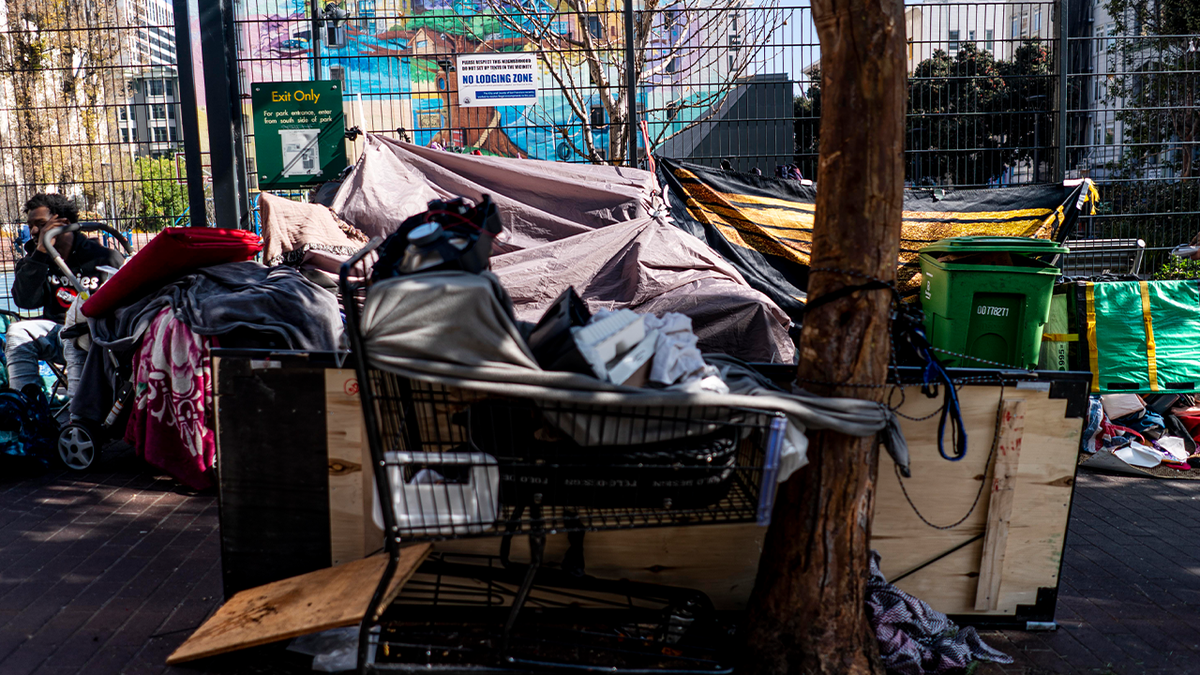
The homeless set up a camp against the gates of Boeddeker Park in the Tenderloin neighborhood of San Francisco, California on Wednesday, January 26, 2022. (Getty Images)
Newsom is cheering about a small decline in unsheltered homelessness by 2025, calling it the largest decline in fifteen years. And while it’s a very small step in the right direction, let’s not break out the champagne. This “progress” comes on the heels of record-breaking homelessness under Newsom’s watch, despite historic spending levels that have created an entire ecosystem built to manage the crisis rather than solve it. This isn’t a victory lap; this is pre-campaign damage control for a system that has become financially dependent on the problem’s existence.
As I explain in my book, “The Race to Save California”, The core of the homelessness problem is not a lack of funding or awareness. After all, with $24 billion in spending and an occupied sidewalk, California has both in spades and is still a disaster. The problem is not scarcity, but the misaligned incentives created by the way money is used and deployed.
Politicians like Newsom obsess over housing shortages because it’s a simpler, clearer “solution” that makes for easy soundbites to flag achievements, even if they don’t actually solve anything. Housing became the preferred “solution,” not because it worked, but because it justified massive spending pipelines.
INTERIOR DEPARTMENT ADOPTS NO-TOLERANCE POLICY FOR HOMELESS CAMPS IN WASHINGTON, DC
Because why bother with the important, messy issues—like addiction recovery, mental health treatment, life skills training, and social reintegration—when they could be channeling billions into construction programs that keep funding flowing long after the ribbon-cutting?
This mentality reflects the now-failing “Housing First” model, which turned homelessness into a housing initiative, and thus into a vehicle for sustainable public spending.
That approach is now starting to change. Under President Donald Trump, HUD Secretary Scott Turner has recognized that homelessness cannot be treated solely as a housing issue. The crisis is not just about shelter, but also about stability. You can’t get out of fentanyl addiction, untreated schizophrenia, or PTSD. Many need treatment, structure and accountability, not handouts and insincere ‘compassion’ that feeds the cycle.
NEWSOM MADE A CATASTROPHIC MISTAKE IN THE CALIFORNIA HOMELESS DISASTER
The homeless veteran population is a good example of what is really needed. There are more than 35,000 homeless veterans across the country every night. It’s a mockery: heroes who were once under fire now sleep in tents because bureaucracy and profit are more important than substantive solutions.
These vets don’t need pity and handouts. They need purpose: leadership opportunities, job training, treatment, and a place in a supportive and interdependent community. Instead, veterans are kept in misery, their potential is squandered, and the crisis drags on while politicians brag about the number of homes built.
CLICK HERE FOR MORE FOX NEWS ADVICE
I have seen firsthand that this crisis is not just about housing, but about untreated trauma, addiction, and lack of structured support.
Frankly, the crisis continues because the financing structure rewards continuation over resolution. When problems worsen, emergency funds flow with minimal oversight, expanding the budgets of politically connected nonprofits, consultants and agencies supported by managing – not ending – homelessness. They know that money moves more slowly as the problem shrinks, while failure often leads to larger future credits.
The real solution? Cost-effective hybrid camps that provide community, structure and transformation at a fraction of the cost of luxury housing, while linking funding to measurable reductions in homelessness. Imagine cafeterias, chapels, laundries, life skills classes and employment opportunities where residents grow through their contributions to the community and their future, and continue to evolve. Because transition without transformation is meaningless.
CLICK HERE TO DOWNLOAD THE FOX NEWS APP
Obama is right: This is an atrocity, and Newsom’s spin on a modest decline does not alter the years-long spending-first approach that prioritized funding streams over functional outcomes. Californians deserve streets free of chaos and our homeless neighbors deserve real support from a system that solves problems, not perpetuates them.
We know the solutions: treatment-oriented intervention, enforcement of existing laws, results-oriented financing. Let us demand them before another “progress report” can be used as campaign propaganda at the expense of human lives. Our country is worth at least that much.
CLICK HERE FOR MORE FROM KATE MONROE
Related article