



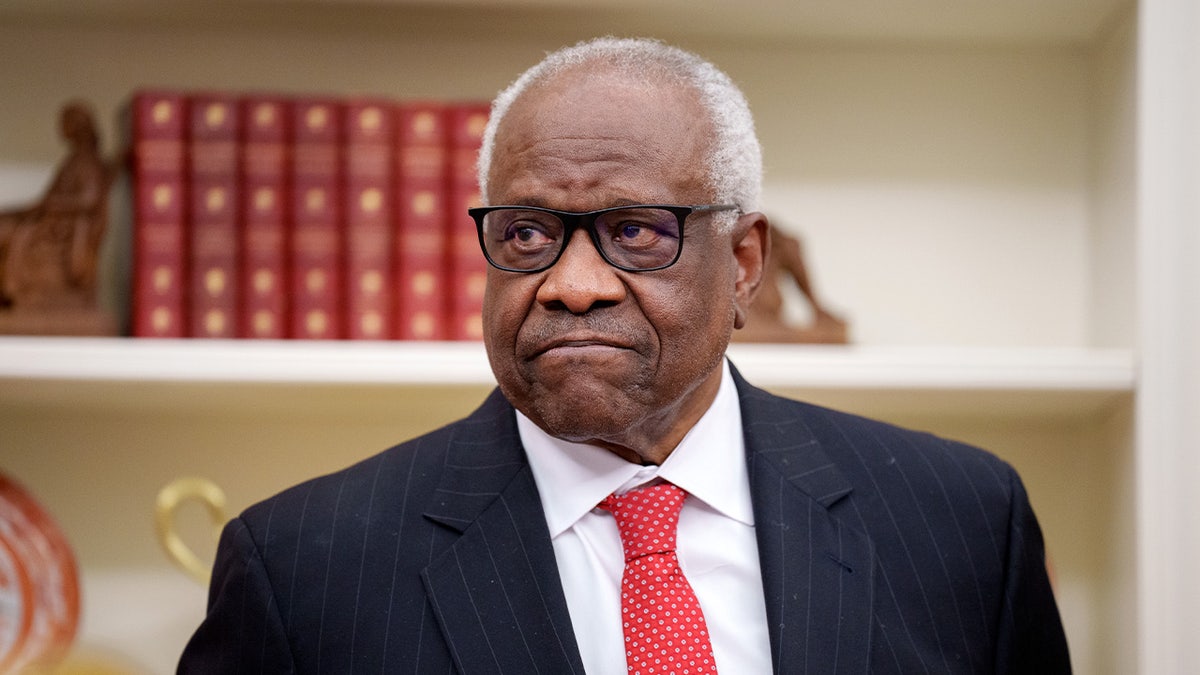
Americans will hear many speeches this year to mark the 250th anniversary of the Declaration of Independence, but it’s hard to imagine anyone topping Justice Clarence Thomas’ speech at the University of Texas at Austin. If you are inclined to believe that the greatness of our founding documents and the ideals enshrined in them still resonate in the hearts of Americans, Judge Thomas’s speech was a clarion call to the conscience, a call to the courage and clarity that animated the American Revolution.
Thomas praised Dean Justin Dyer and UT’s new School of Civic Leadership, saying it was his sincere hope that their work “to revitalize the teaching and research of Western Civilization and the American constitutional tradition will lead the way in reforming our nation’s colleges and universities” — a generous expression of gratitude for those who labor, often anonymously, in the vineyards of civic virtue.
Thomas’s reverence for the Declaration of Independence was palpable as he recounted the audacity of Jefferson’s assertion that “all men are created equal.” He reminded his audience that the Declaration is not a relic—an obscure, esoteric, academic toy to be admired from a distance—but a living testament to the ability of men and women to transcend the ordinary. Its words, Thomas emphasized, are an invitation to courage, echoing through the ages to challenge each new generation to defy tyranny and embrace freedom.
BEFORE 2026 YOU MUST MAKE A RESOLUTION TO KNOW THE REVOLUTION
Judge Thomas drew from a pantheon of heroes: the Founders, whose signatures risked lives and fortunes; the soldiers of Valley Forge, whose endurance was measured not only in freezing nights, but also in the perseverance of hope; and leaders of subsequent eras who refused to surrender constitutional principles to their own advantage. These vignettes, rendered with trademark sonorous solemnity, served as a reminder that the American story is stitched together by acts of courage rarely celebrated and bravery rarely recognized.
Thomas was particularly confronted with the failures of the Supreme Court, most emphatically in his criticism of Plessy v. Ferguson, the 1896 decision “that approved government-enforced racial segregation and validated the Jim Crow South in which I grew up.” He deplored the lack of moral fortitude among those who, instead of upholding the promise of equality, had succumbed to the temptations of opportunism.
“It couldn’t possibly have taken my court sixty years,” Thomas said, “to know that Plessy was a heinous crime.” The specter of Plessy hovered as a warning against abdication of duty – a lesson as relevant today as it was in 1896.
In a manner reminiscent of William F. Buckley’s skepticism toward progressive utopianism, Thomas warned against Wilsonian progressivism. He traced its origins to a philosophy that privileges the plasticity of expert rule over the stubbornness of constitutional constraints. “Progressivism,” Thomas noted, “seeks to replace the fundamental tenets of the Declaration of Independence, and with it our form of government. It states that our rights and our dignity do not come from God, but from the government.” This, he suggested, is the eternal threat to republican freedom: the tempting idea that a well-meaning bureaucracy can replace the wisdom of the Declaration. For Thomas, progressivism is “retrogressive.”
AMERICA’S 250 ORGANIZERS REVEAL BIG PLANS FOR THE COUNTRY’S HISTORIC BIRTHDAY CELEBRATION
Yet the speech was not a lament, but a prescription. Thomas called for daily courage – a renewed commitment not only on ceremonial anniversaries, but also in everyday acts of citizenship and stewardship. It depends on the willingness of every citizen to defend their ideals, speak the truth and resist the easy comforts of silence. There is, Thomas emphasized, a duty to reject complacency and re-embrace the challenge of self-government.
CLICK HERE FOR MORE FOX NEWS ADVICE
As Thomas’ words rained down on the gathered crowd, one sensed the enduring relevance of his message. The principles of the Declaration remain, in his view, both fragile and resilient – fragile when neglected, resilient when nurtured. His praise for Dean Dyer and the School for Civic Leadership was not merely a ceremony; it was a recognition that the cultivation of civil courage is indispensable to the preservation of liberty.
CLICK HERE TO DOWNLOAD THE FOX NEWS APP
Judge Thomas’s speech reminded me of Thomas Jefferson’s assertion that “an informed citizenry is the best defense against tyranny.” The speech in Austin was a call: to honor the boldness of the Founders, to reject the false comforts of progressivism, and to recommit ourselves daily to the ideals from which the nation emerged.
In short, it was a reminder, timely and urgent, that the Declaration of Independence is not just a historical document, but a living promise – a challenge for each of us to reach the heights of courage and principle.
CLICK HERE TO CHARLES “CULLY” STIMSON
