



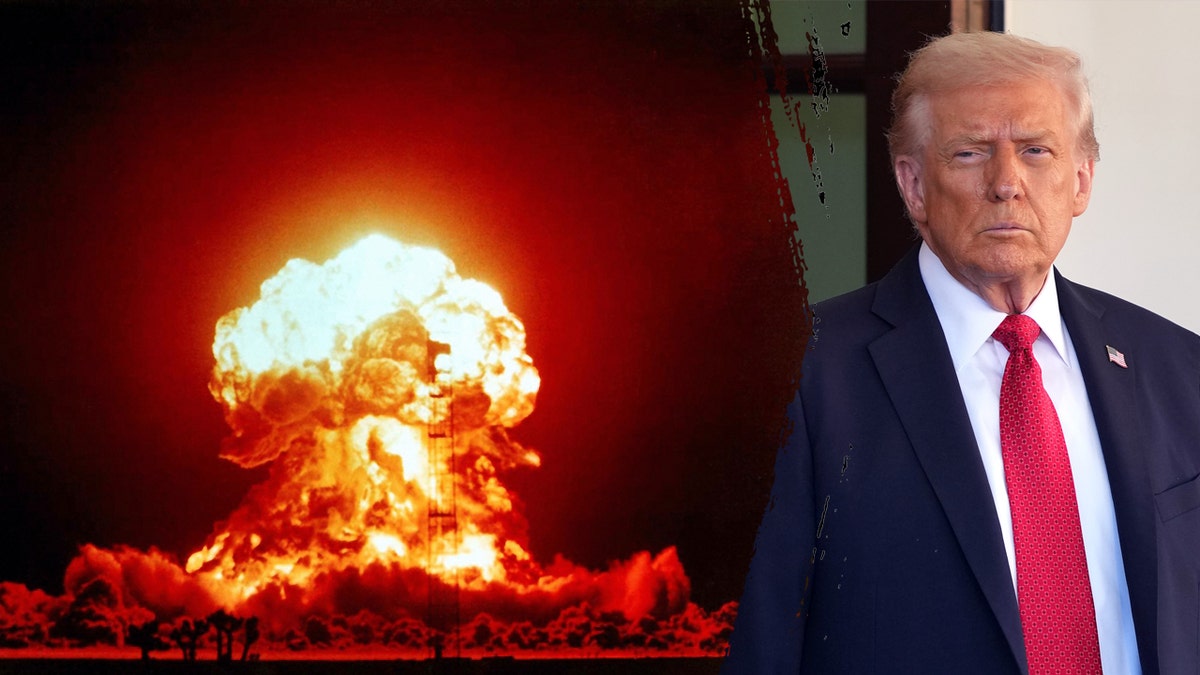
President Donald Trump’s announcement that the United States will resume nuclear weapons testing for the first time in more than three decades has sent shock waves through both Washington and the world’s capitals. He says the move is necessary to “keep pace” with Russia and China, whose programs he says are active, and to ensure the US deterrent remains credible. We will not be outdone, Trump declared, ordering the Pentagon to begin preparations “immediately.”
That statement reverberated around the world. To some, it signals renewed American strength — proof that Washington will no longer rely on self-imposed limitations while adversaries modernize unencumbered.
The rationale: deterrence and equality
Trump’s rationale is based on deterrence. If Russia or China conduct secret or low-yield tests that violate international standards, the U.S., he argues, can appear unconstrained.
NUCLEAR THREATS FROM NORTH KOREA QUIET WARS IN GAZA AND UKRAINE AT UNGA
That logic has value in theory. Yet in practice, there is no publicly verified evidence that Moscow or Beijing have carried out large-scale nuclear explosions in recent years. Both remain, at least politically, bound by the global testing moratorium.
President Trump said he had ordered the War Department to begin testing nuclear weapons immediately on October 29, 2025. (Getty)
America, in turn, has maintained a robust and credible deterrent through its Stockpile Stewardship and Management Program – using advanced supercomputers, materials science and subcritical testing to ensure the reliability of our arsenal since 1992 without detonating a single weapon. However, Russia’s deratification of the Comprehensive Test Ban Treaty (CTBT) in 2023 signals a possible erosion of that restraint.
In short: our nuclear arsenal works. Our delivery systems are being modernized.
TRUMP ORDERS US NUCLEAR WEAPONS TEST TO START ‘IMMEDIATELY’ AFTER RUSSIA TESTS NEW MISSILES
A Brief History: Lessons Written in Fire
To understand what’s at stake, it helps to consider how we got here. The US conducted its first nuclear test – the ‘Trinity’ explosion – on July 16, 1945 in New Mexico. Over the next half century, America conducted more than a thousand nuclear detonations, first in the atmosphere, then underground and underwater. Each test increased our understanding of the bomb’s formidable power and destructive potential, but the toll on the environment and people, from the Pacific Islands to Nevada, was staggering.
By the early 1960s, public outrage and the Cuban Missile Crisis convinced world leaders that unchecked testing was endangering humanity itself. The 1963 Limited Test Ban Treaty banned explosions in the atmosphere, space and underwater. The last US test took place on September 23, 1992, after which Washington joined a global moratorium pending ratification of the CTBT – which still has not been signed by a few key states, including ours. Nevertheless, the standard persisted. For 33 years no country, except North Korea, crossed that line and perhaps South Africa in 1979.
TRUMP RAISES VEIL ON US SUBMARINES IN WARNING SHOT TO KREMLIN IN ‘SMART’ REPOSITION MOVEMENT
That moratorium has been one of the quiet triumphs of post-Cold War diplomacy: a restraint born not of naivete but of wisdom born of horror. It allowed nations to modernize defensively while maintaining the taboo on nuclear explosions, the ultimate line between deterrence and apocalypse.
The risks: moral, strategic and existential
If we resume testing now, there is a risk that that fragile consensus will unravel. Once the US breaks its silence, others will follow. Russia could justify its own tests as reciprocal. China, which is already expanding its arsenal to 600 warheads, is expected to reach about 1,000 warheads by 2030 and may accelerate that program. India and Pakistan could feel emboldened. North Korea would seize the moment to demonstrate ‘parity’. Within a few years, the world could witness a cascade of underground explosions from East Asia to the Middle East. The psychological barrier separating ownership and use would erode.
HOW US SHOULD RESPOND AFTER CHINA REJECTS TRUMP NUCLEAR TALK AND SHOWS NEW WEAPONS ON PARADE
From a moral perspective, this is not a step to take lightly. Theologians and strategists alike have long argued that nuclear weapons pose unique ethical dilemmas.
From a policy perspective, the cost-benefit analysis is equally stark. Resuming testing would erode US moral authority in arms control negotiations, undermine the CTBT and alarm allies who rely on America’s extended deterrent. It would also hand propaganda victories to opponents eager to portray Washington as reckless. The environmental, safety and political costs of reopening testing sites would be significant, and the scientific benefit – according to our own laboratories – minimal.
As the International Campaign to Abolish Nuclear Weapons (ICAN) warns, renewed testing would undermine decades of global norm-building around restraint and open the door to new proliferation.
RUSSIA WANTS TO UPDATE NUCLEAR PROGRAM AGAINST ‘COLOSSAL THREATS’ FROM THE WEST
A Better Path: Lead, Don’t Imitate
Rather than fomenting a new nuclear competition, the US should seize this moment to lead the world to restraint. Trump’s instinct to project strength is understandable; Deterrence remains crucial in a world full of aggressors. But real strength includes moral leadership.
If the president really wants to reassert American primacy, he could do so not by detonating weapons but by convening a global summit of nuclear-weapon states—the U.S., Russia, China, France, the United Kingdom, India, Pakistan, Israel and North Korea—to renew or formalize a universal moratorium on nuclear testing. Such a proposal could leverage the CTBTO’s Article XIV conference mechanism for improved verification and transparency.
Such a summit would achieve three things:
- Restore dialogue between powers that rarely sit at the same table, reducing nuclear tensions.
- Reaffirm deterrence without destruction, update verification mechanisms and transparency measures using modern technology.
- Restore moral leadership and demonstrate that American power is disciplined by conscience and not driven by fear.
CLICK HERE FOR MORE FOX NEWS ADVICE
By proposing such a meeting — perhaps under the auspices of the United Nations or as a U.S.-organized initiative at the Nevada National Security Site — President Trump could turn a provocative decision into a statesmanlike opportunity. He could remind the world that American strength serves peace, not destruction.
Conclusion: the test ahead
CLICK HERE TO DOWNLOAD THE FOX NEWS APP
For decades, humanity has lived in the shadow of weapons too powerful to use. Their silence has been our safety. Breaking that silence risks sparking a new arms race and bringing civilization closer to the abyss. The lesson of history is clear: once the nuclear threshold is crossed, it becomes easier, even in testing, to cross it again.
President Trump has proven that boldness can restore stagnant debates. But courage without wisdom can also destabilize the world we try to defend. The real test before us is not of plutonium or nuclear warheads, but of leadership – whether we will control our power, or allow it to control us again. True leadership requires the courage to combine military preparedness with moral restraint, ensuring that power serves peace rather than pride.
CLICK HERE TO ROBERT MAGINNIS
