



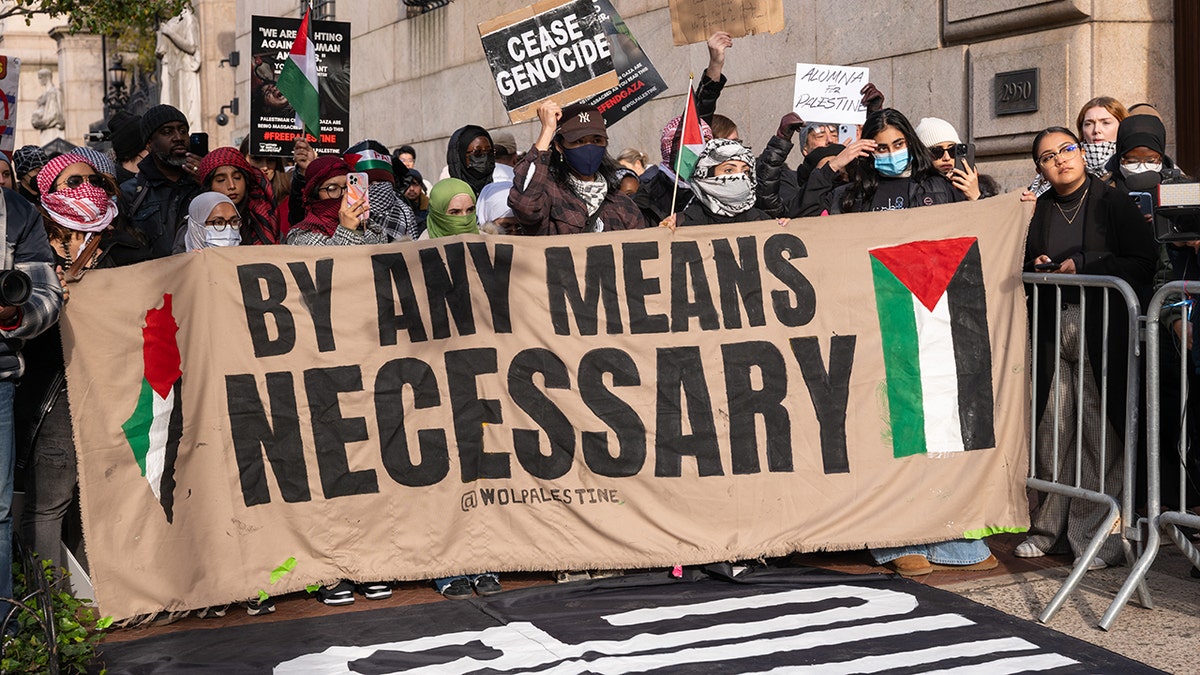
The West is losing its ability to distinguish truth from falsehood, and the consequences are no longer abstract. What we are witnessing is the rise of what I call the “keyboard courtroom,” a digital arena where decontextualized photos and doctored videos pass as “evidence” and where moral judgments are delivered immediately, emotionally, and often incorrectly.
In the courtroom, terrorism is reframed as ‘resistance’, victims are recast as ‘oppressors’ and atrocities are dismissed as propaganda, while unverified claims spread unchecked. Our geostrategic enemies – China, Russia and Iran – are playing an outsized role and spreading divisive falsehoods. And a growing number of Americans, especially younger voters who get most of their news online, are ill-equipped to judge at a basic level the veracity of what they see.
WHEN HATE BECOMES A BUSINESS: THE MONETIZATION OF ANTISEMITISM
Columbia University students participate in an anti-Israel protest. (Spencer Platt/Getty Images)
The results are surprising. For the third time in one week, Jewish businesses and ambulances were targeted in a wave of fire and bombing that took over London – while the government watched the alarming spike in British anti-Semitism with mostly disinterested silence. This closely follows an attack a few weeks ago in Michigan, where a deranged anti-Israel lawyer drove an explosives-laden car into a Jewish school with more than 140 Jewish children inside – an attack that many media outlets justified by noting that the terrorist’s relatives had been killed in an Israeli airstrike.
What they mostly didn’t add was that those same family members were targeted because they were Hezbollah operatives — sworn to the destruction of the Jewish state and its more than seven million Jewish citizens.

Anti-Israel students occupy the center lawn of Columbia University in New York City on April 21, 2024. (Andrew Lichtenstein/Corbis via Getty Images)
None of this moral confusion should surprise us. We saw it on full display on Western campuses and in Western media in the aftermath of the October 7 Hamas pogrom, in which 1,200 Jews were brutally murdered, dozens of Jewish women were raped, and dozens of Jewish children were kidnapped and held hostage for hundreds of days. In a now infamous example, a Yale professor called the carnage of rape and murder “exciting.”
SIGN UP FOR THE NEWSLETTER ON ANTISEMITISM
I’ve spent the past two-plus years trying to understand how we got here, speaking at dozens of colleges, high schools and religious centers across the country. What I have discovered is that the problem is not just prejudice. It’s method. We have lost any semblance of a basic framework for evaluating disputed claims.
There is a gavel on the judge’s bench as people leave the court. (iStock)
However, there is one place where ordinary people still understand this well: the courtroom.
I am constantly amazed at the extent to which twelve complete strangers gather in the jury box, analyze hundreds of pieces of evidence, listen to hours of argument, and then make exactly the right verdict. It’s not because they understand the nuances of patent or antitrust law. That’s because they’ve been given a methodology that has been tested for hundreds of years to help ordinary people apply common sense to complex problems.
We call these scripts ‘jury instructions’. But we might as well call them “truth guides.”
CLICK HERE FOR MORE FOX NEWS ADVICE
Courtrooms aren’t perfect, but they are the best laboratories we have for adjudicating disputed claims because they give ordinary people a way to think about difficult issues. We start with objective evidence: physical evidence taken before the dispute arose, images that can be timestamped and geolocated, statements made by a party against its own interests. We rely on the observations of neutral third parties. If a party lies, we hold it responsible. When the evidence “loses” or refuses to be presented, we draw the appropriate inference. And when the facts go in different directions, we say so and explain why some types of evidence deserve more weight than others.
This is how civilized societies resolve complicated disputes.

A girl raises her hand in a classroom. (Getty Images)
If we want to prepare the next generation of Americans for the information war we are now waging, we must teach them, starting in high school, to separate analysis from advocacy and to mark the clear line between facts and slogans. We must train them to evaluate disputed claims with an open mind, scrupulously adhering to established facts and prevailing rules, and refraining from emotions masquerading as argument, prejudice disguised as certainty, prejudice masquerading as principle.
CLICK HERE TO DOWNLOAD THE FOX NEWS APP
In short, we need to teach them in the courtroom to be more like jurors.
*The views expressed in this article are solely those of the author and not those of the federal judiciary.*
