



Venezuela’s Maduro accuses the US of starting a ‘forever war’
Manhattan Institute fellow Daniel Di Martino, who faces losing his Venezuelan citizenship, discusses Nicolás Maduro’s plan to attack opposition activists and President Donald Trump’s denial that he is considering strikes in the country.
As President Donald Trump warns of “zero tolerance” for narco-states in America’s backyard, China is tightening its grip on Venezuela — a high-risk economic and political gamble that could soon collide with American power.
US defense officials confirmed to Reuters last month that a US aircraft carrier strike group had entered the Southern Command region, which covers the Caribbean and the northern coast of South America, to monitor drug trafficking routes linked to Venezuela’s military leadership.
The Pentagon said the arrival of the USS Gerald R. Ford, carrying more than 4,000 sailors and dozens of tactical aircraft, would “strengthen America’s ability to detect, monitor and disrupt illicit actors and activities.” It added that the mission aims to “degrade and dismantle transnational criminal organizations.”
CHINA CONDEMNS US MILITARY BUILD-UP OFF VENEZUELA COAST AS FOREIGN INVESTMENT IN REGIONAL AFFAIRS
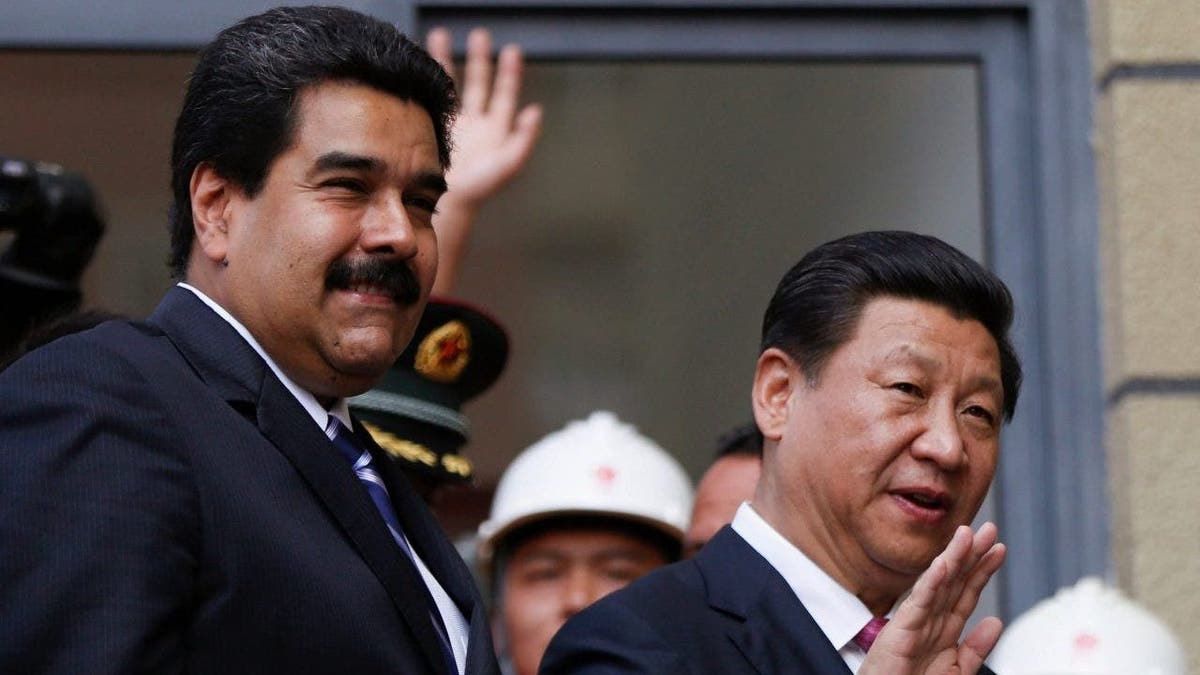
Chinese President Xi Jinping (R) waves next to Venezuelan President Nicolas Maduro during a visit to a housing project in Caracas on July 21, 2014. China will provide Venezuela with a $4 billion credit line under an agreement signed Monday, with the money to be repaid by oil shipments from OPEC member Venezuela. The deal was signed during a 24-hour visit to Venezuela by Xi, who is on a tour of Latin America. (Carlos Garcia Rawlins/Reuters)
Within weeks, Venezuelan officers were training for a guerrilla-style defense against a possible U.S. attack — an acknowledgment, according to Reuters, of “the growing fear in Caracas.”
In light of this impasse, Beijing unveiled a zero-tariff trade deal with Caracas at the Shanghai Expo 2025, announced by Vice Minister of Foreign Trade Coromoto Godoy. Venezuelan officials said the deal covers about 400 tariff categories, eliminating duties on Chinese and Venezuelan goods.
While final implementation details are still pending verification, the goal is clear: Beijing is moving quickly toward a sanctioned economy that Washington has tried to isolate.
“This really looks like China is going to completely take over the Venezuelan economy,” said Gordon Chang, an expert on China’s global trade strategy. “It will decimate Venezuela’s local industry.”
“Venezuela is essentially selling oil to China and very little else,” he said. “China is of course a manufacturer of many items. Venezuelan manufacturing will not experience a renaissance anytime soon – it is going in the opposite direction.”
VENEZUELA MOBILIZES TROOPS AND WEAPONS IN RESPONSE TO US WARSHIP CONSTRUCTION IN THE CARIBBEAN
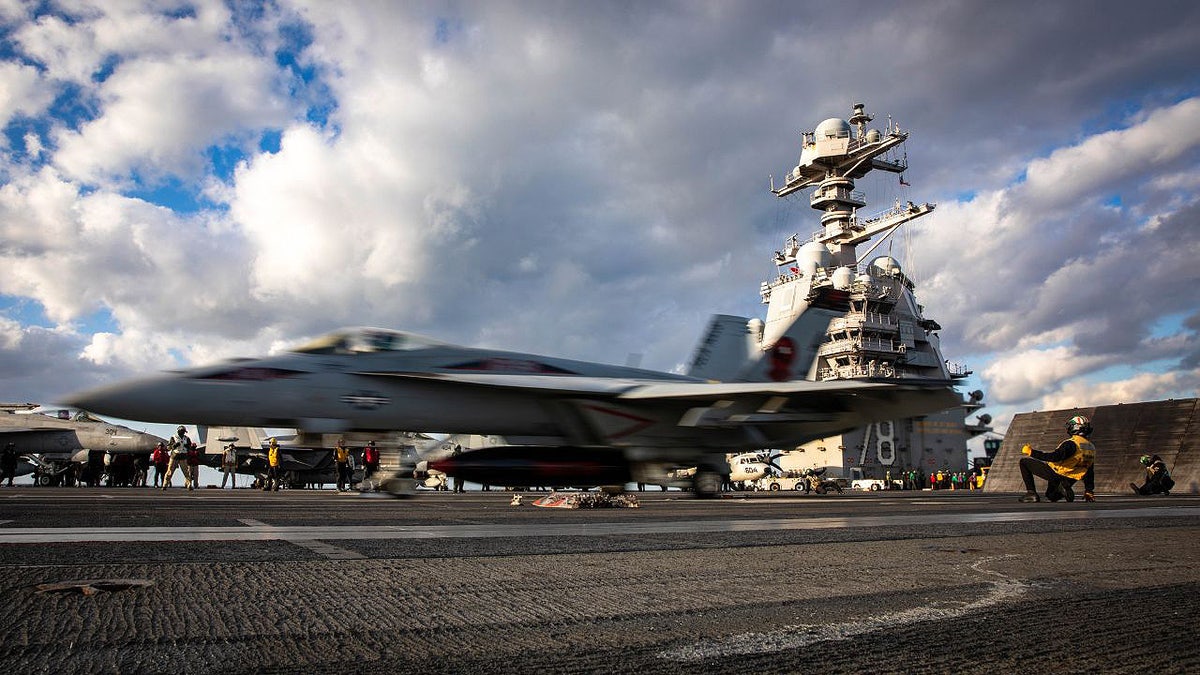
Sailors aboard the world’s largest aircraft carrier, USS Gerald R. Ford (CVN 78), launch a Carrier Air Wing 8 F/A-18E Super Hornet attached to Strike Fighter Squadron 31 from the flight deck, September 26, 2025. (Mariano López)
Chang added that Maduro’s sudden embrace of Beijing stems from fear of Trump’s next move.
“Maduro probably has no choice,” he said. “He realizes he has a problem in the form of Donald J. Trump. There is an American aircraft carrier not far from his shores, and a lot of military assets are coming his way. He needs a friend and he is desperate.”
“For Maduro, the zero tariff pact may provide temporary relief, but it only increases dependency,” Chang added. “I don’t see this trade deal as strengthening Venezuela. I see it strengthening China’s stranglehold on Venezuela.”
US MILITARY BUILD-UP IN THE CARIBBEAN SEES BOMMERERS, MARINES AND WAR BOXES TOGETHER NEAR VENEZUELA
From Beijing’s perspective, the tariff-free pact opens a commercial and strategic door to the Western Hemisphere just as Washington is doubling down on sanctions.
The Council on Foreign Relations estimates that China has provided approximately $60 billion in loans to Venezuela over the past two decades, much of which was repaid through oil shipments – a figure still cited by both Chinese and Venezuelan officials in 2025.
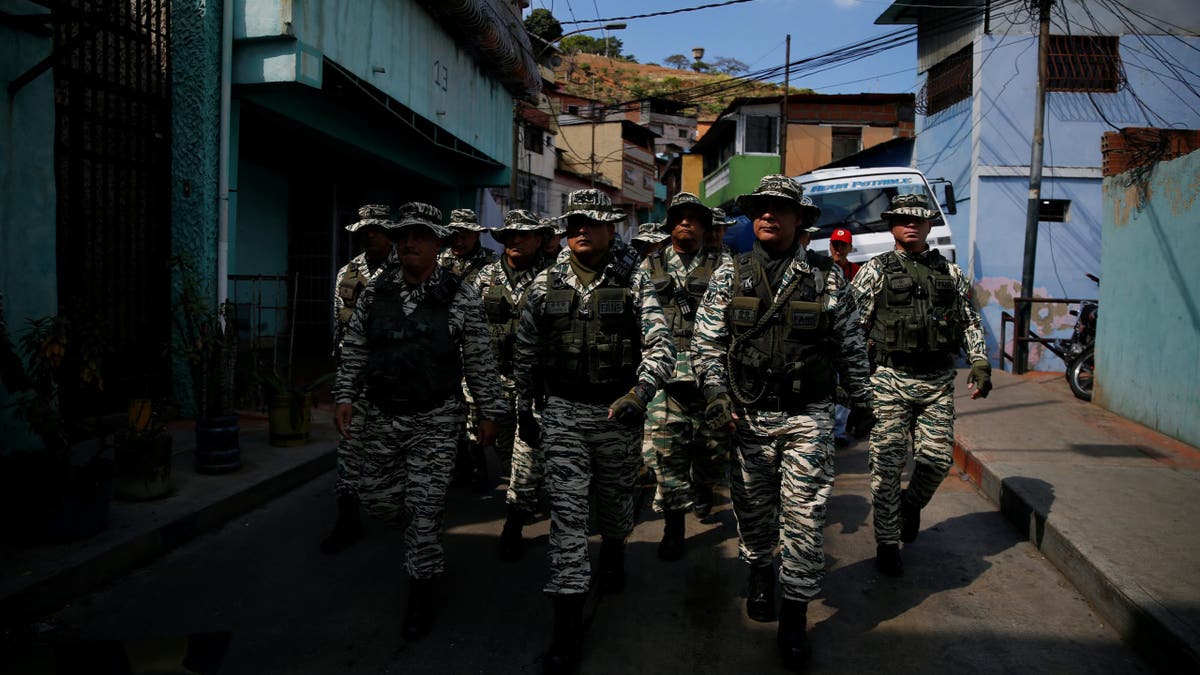
Members of the Bolivarian National Militia patrol a street in the 23 de Enero neighborhood during a military exercise in Caracas, Venezuela, January 23, 2025. (Leonardo Fernandez Viloria/Reuters)
“China has used billions in loans and the establishment of satellite positioning and surveillance facilities to secure strategic control over Venezuela’s natural resources and critical infrastructure,” said Isaias Medina III, an Edward Mason Fellow at Harvard University and a former Venezuelan diplomat at the UN Security Council.
Medina was referring to the El Sombrero satellite ground station in Venezuela’s Guárico province — a joint China-Venezuela project that Western analysts, including a recent Associated Press report, describe as part of a broader space cooperation network that gives Beijing an intelligence base in Latin America.
US STRENGTHENS MILITARY PRESENCE IN THE CARIBBEAN NEAR VENEZUELA AGAINST TRUMP’S EFFORTS TO STOP DRUG TRAFFICKING
Medina said the new pact should be understood as one layer in a broader anti-Western line.
“Under the banner of so-called ’21st century socialism,’ initiated by Hugo Chávez and expanded by Nicolás Maduro, the nation has evolved into a progressive base for regimes openly hostile to the United States and its allies,” he said.
“Iran, Russia, China and Cuba have entrenched themselves in Venezuelan territory and are using the country as a platform for asymmetric warfare, intelligence operations and ideological expansion across Latin America.”
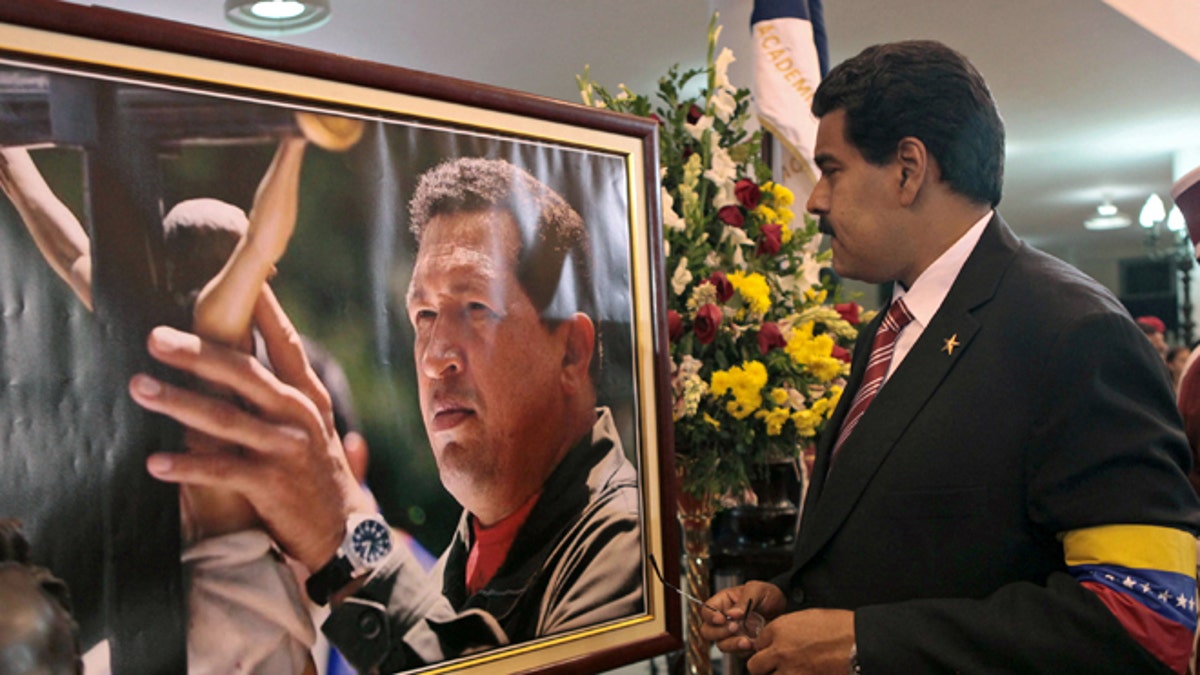
FILE – March 8, 2013 file photo released by the Miraflores news agency: Venezuelan President Nicolas Maduro stands in front of a portrait of late Venezuelan President Hugo Chavez. (AP Photo/Miraflores Press Agency, File)
He noted that “Russia’s military footprint includes more than $12 billion in arms sales and continued defense cooperation and the presence of the Wagner Group in military exercises,” while Cuban military advisors remain embedded in Venezuelan security institutions.
“Iran has exploited this environment to enclose terrorist allies such as Hezbollah and Hamas, using Venezuela as both a financial center and a logistics corridor. These activities extend to former training camps in Syria, where Venezuelan operatives and mercenaries have been indoctrinated in hybrid warfare tactics,” he added. “Iranian interest includes potential drone production and uranium mining.”
“The Maduro government, shielded by the absence of the rule of law or legitimate governance, has replaced statecraft with criminal enterprises,” Medina said. “Grand corruption is not an exception; it is the system.”
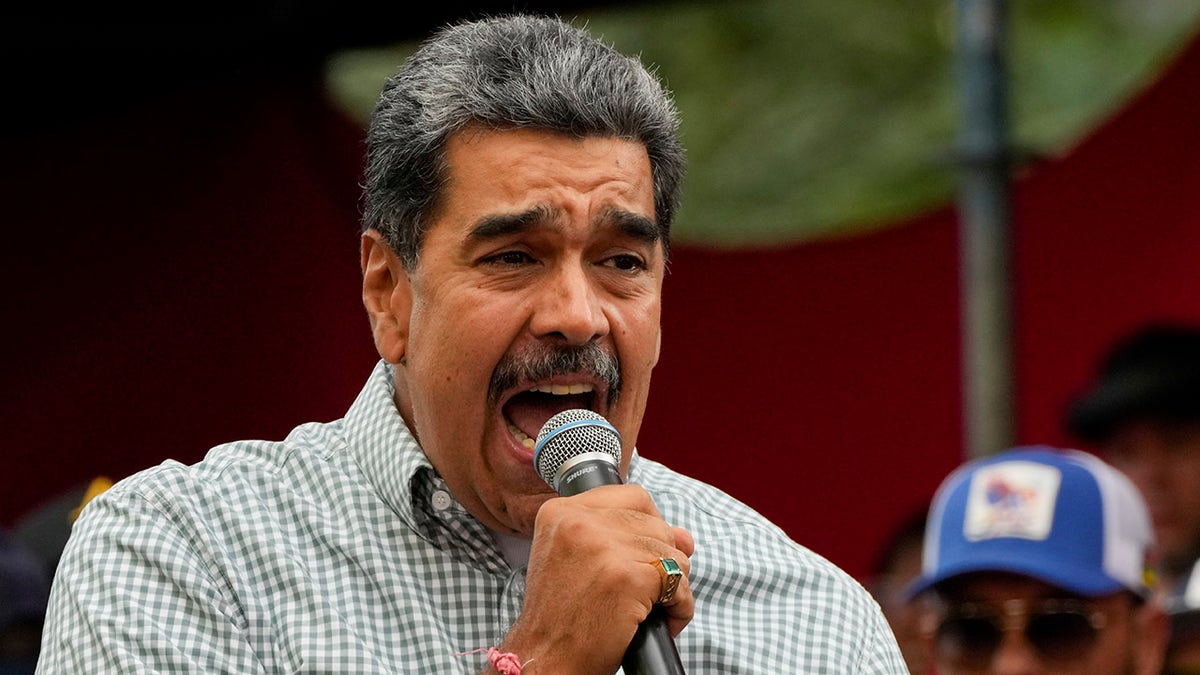
Venezuelan President Nicolas Maduro has not yet publicly commented on the strike. (Ariana Cubillos/AP Photo)
“The humanitarian toll is catastrophic,” he added, “more than 30% of the Venezuelan population has been forcibly displaced. Hunger has been used as a tool of social control, amounting to a war crime under international law. Despite the enormous scale of these crimes, many United Nations Member States continue to recognize and collaborate with this illegitimate regime, perpetuating its impunity. The inability to confront this crisis is decisively creating a coalition of adversaries, state and non-state actors alike, to project power dangerously close to U.S. territory.”
For now, Washington’s sanctions campaign continues to limit Venezuela’s oil lifelines. In March 2025, Reuters reported that US threats to impose tariffs on countries buying Venezuelan crude caused a temporary disruption in shipments to China. Beijing has dismissed the measures as “illegal extraterritorial actions” and pledged to continue cooperation – but has not revealed how it will enforce the new tariff-free pact.
CLICK HERE TO DOWNLOAD THE FOX NEWS APP
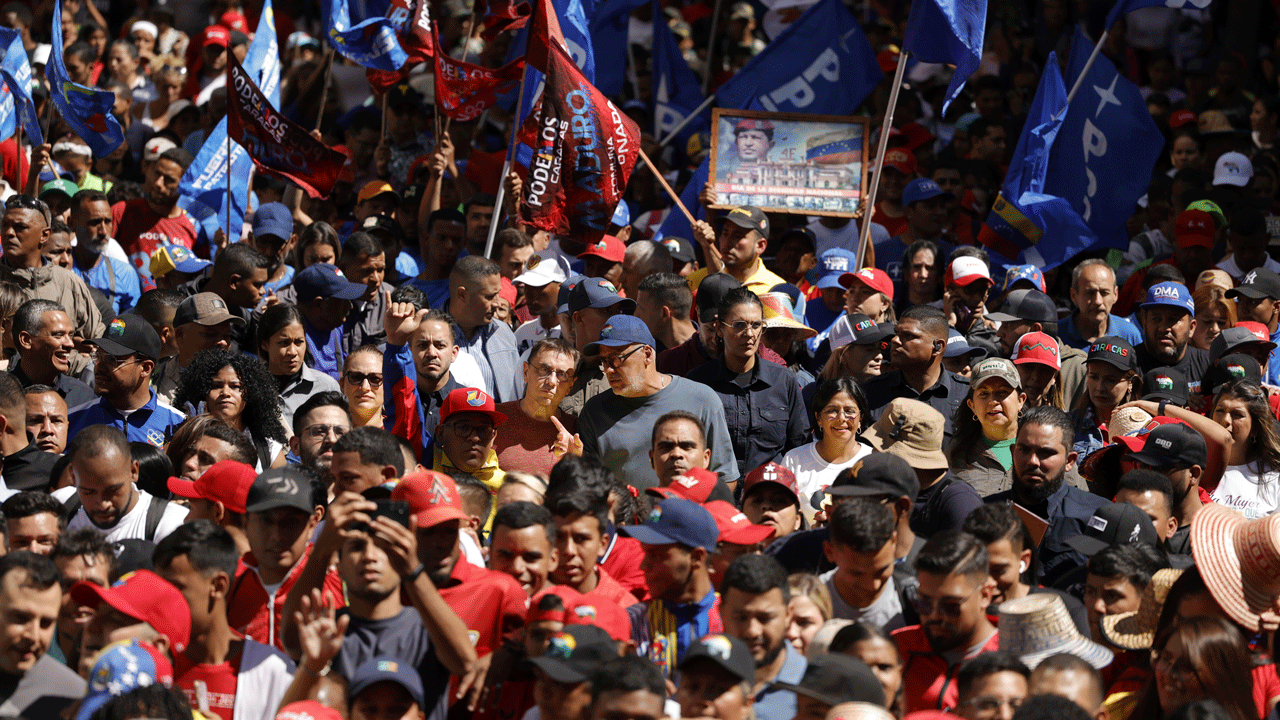
The Maduro administration is trying to rally government supporters amid a sagging economy and a refugee crisis. (Jesus Vargas/AP Photo)
Chang said the underlying reality has not changed: China cannot protect Caracas from US hard power.
“It can certainly launch a propaganda blitz,” he said, “but it cannot project military force into the region. It’s really up to what President Trump does. China does not have the military strength to resist a US intervention if that is what Trump decides.”
Medina agreed that the stakes extend beyond the economy. “Just three hours from American shores, this narco-terrorist regime has become the operational convergence of organized crime, drug trafficking, money laundering and human rights atrocities,” he said, urging a Western response that “combines diplomatic isolation, targeted sanctions and, if necessary, defensive engagement.”
