



EXCLUSIVE: Yemen’s Southern Transitional Council (STC) claims its forces now control all eight southern governorates and are prepared to serve as Washington’s frontline partner against the Iran-backed Houthis, al-Qaeda affiliates and Muslim Brotherhood factions.
The STC has emerged as the dominant power in southern Yemen and is reportedly backed by significant Emirati financial and military support. Founded in April 2017, it unites factions seeking to restore an independent South Yemen – reviving the state that existed from 1967 until unification in 1990. Last week, the head of Yemen’s internationally recognized government called on the STC to withdraw from areas they recently captured in the southeastern parts of the country, The Associated Press reported.
THE US military carries out successful air strikes against Houthi rebels in Yemen
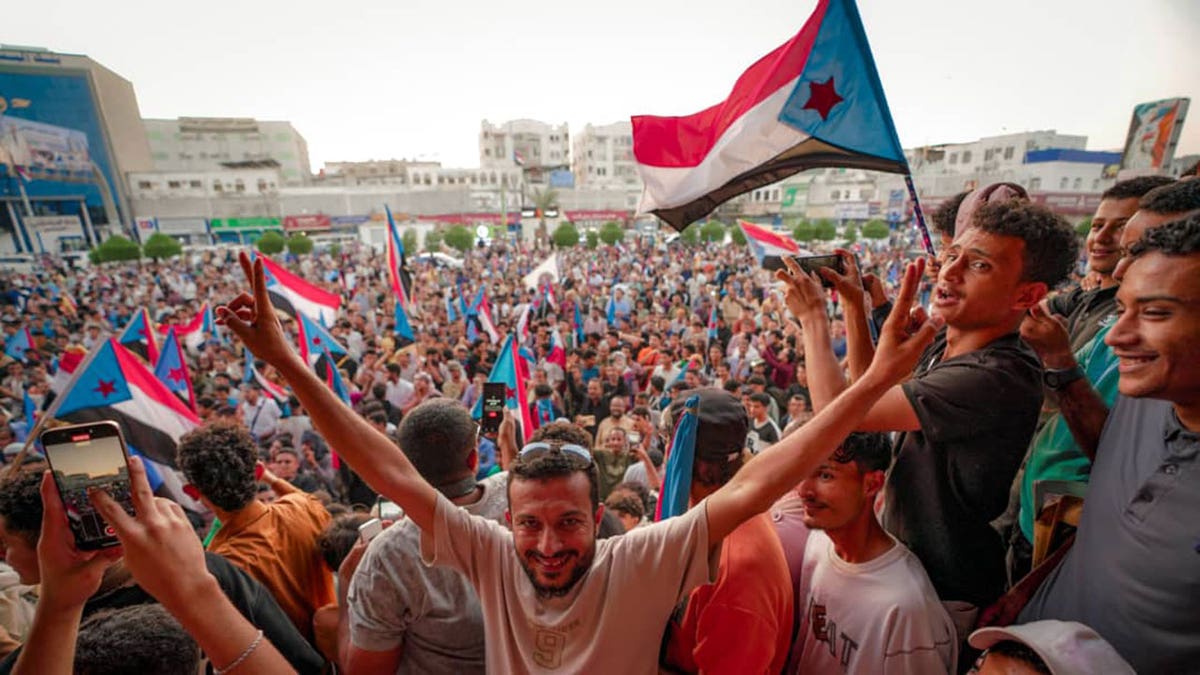
Crowds in South Yemen gathering for independence in December 2025. (AIC Aden)
On Wednesday, UN Secretary-General António Guterres warned that Yemen is facing a dangerous new escalation following recent advances by STC-affiliated forces in the eastern governorates of Hadramawt and al-Mahra. Guterres said such unilateral actions risk widening divisions, hardening positions and accelerating fragmentation, with potential spillover effects on regional security, including the Red Sea, the Gulf of Aden and the Horn of Africa.
Country divided in two
The war in Yemen has divided the country for a long time. In the north, the Houthis rule Sanaa and much of western Yemen, with support from Iran and ties to Hezbollah. In the south, STC forces dominate Aden, the temporary capital, and a belt of land and coastal areas including Lahj, Abyan, Shabwa, Hadramout and al-Mahra.
The internationally recognized Yemeni government, which the United States continues to support, is formally based in Aden but remains fragmented. The Saudi-backed Presidential Leadership Council serves as the recognized authority and has relied heavily on a coalition of competing factions, including the STC, to govern and confront the Houthis and maintain control on the ground.
Toomey said: “The government has faced serious economic, oversight and capacity challenges and has struggled to deliver basic services, a situation exacerbated by the ongoing fight against the Houthis and the broader humanitarian crisis in Yemen.”
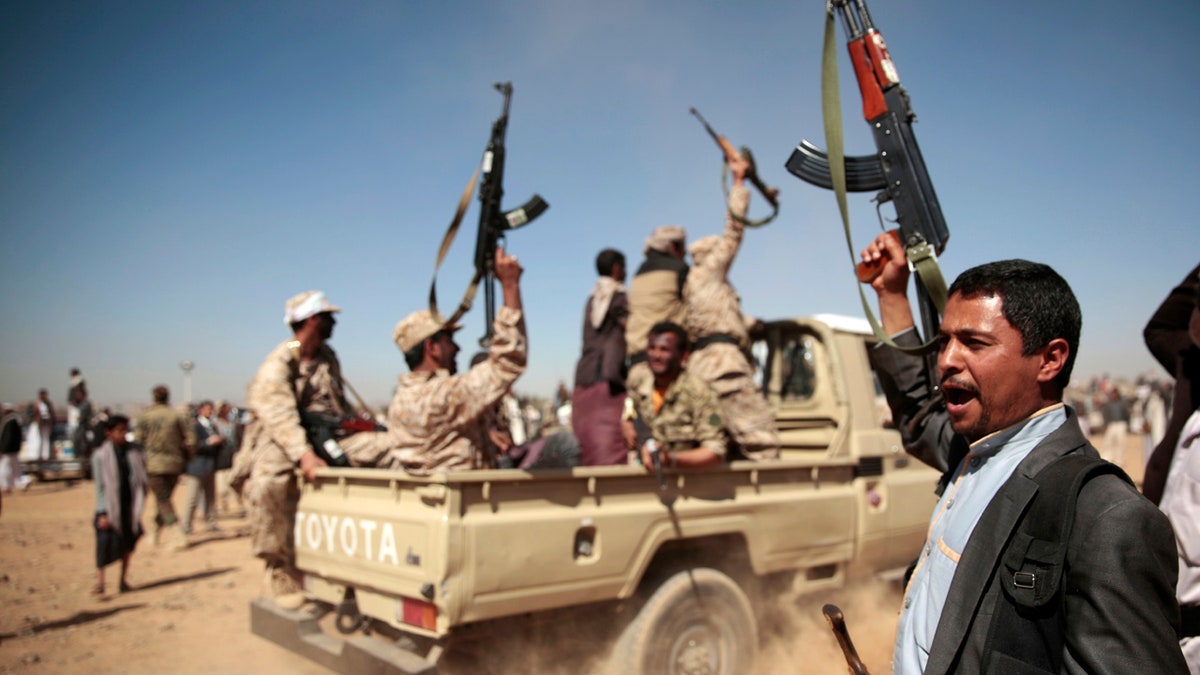
In this Jan. 3, 2017, file photo, tribesmen loyal to the Houthi rebels chant slogans during a rally aimed at mobilizing more fighters to fronts to fight pro-government forces. (AP)
That trust has drawn criticism. Yemen’s internationally recognized government has accused STC-affiliated forces of carrying out deadly attacks in Hadramout and warned that the group’s recent expansion risks sparking conflict between rival factions within the anti-Houthi camp. The Associated Press reported that Yemeni officials urged the STC to withdraw from seized areas in the east, warning that unilateral steps could undermine the political process and destabilize a fragile balance in the south.
Atef rejected that characterization, describing the Hadramout operation as a major success that demonstrated the STC’s ability to fight what he called hostile forces operating in coordination with the Houthis. He accused these forces of working with “Houthi terrorists” and said the STC’s actions strengthened rather than undermined security.
YEMEN’S CHILD SOLDIERS FACE A LONG ROAD AFTER SEXUAL, PHYSICAL ABUSE
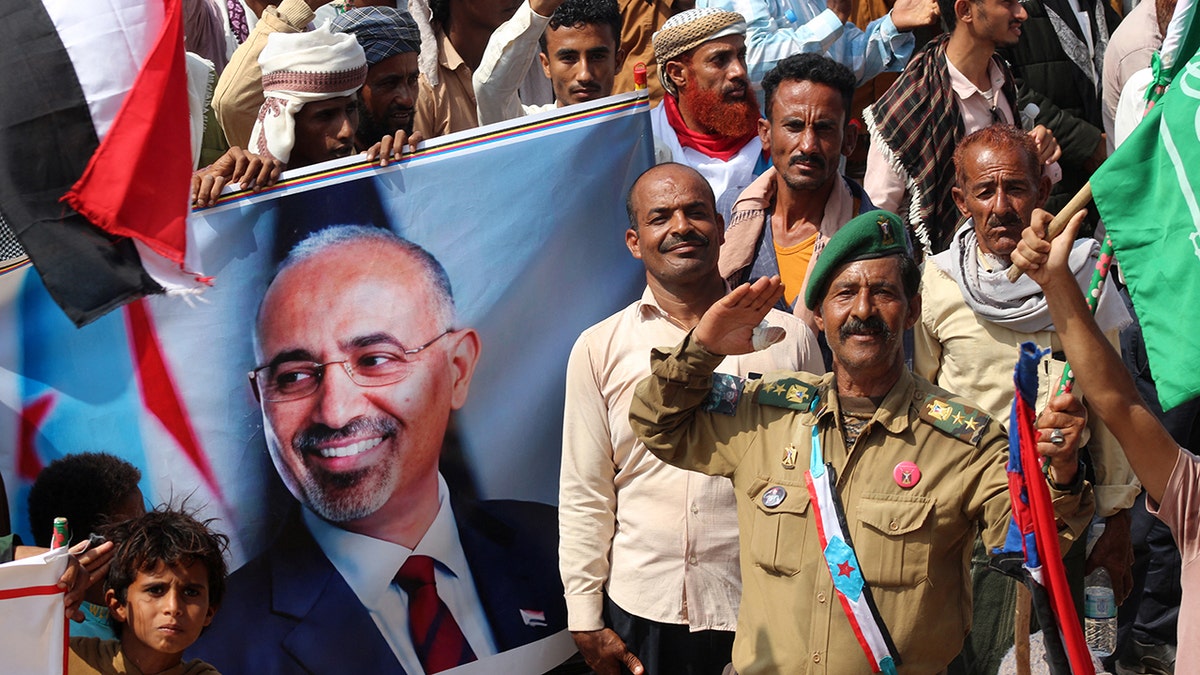
Yemenis living along the strip between the south and north of the country and supporting the Southern Transitional Council (STC) hold an image of STC leader Aidarous Al-Zubaidi during a rally in Khormaksar Square in Aden, the temporary capital of the Republic of Yemen, on December 14, 2025. (Saleh Al-Obeidi/AFP via Getty Images)
Warning: The Houthis pose a ‘regional and global’ threat
Atef described the Houthis as a destabilizing force far beyond Yemen’s borders.
“They have the slogan ‘death to America, death to Israel,’ which is really quite unacceptable,” he said. As long as the Houthis maintain control of Sanaa, he warned, they will “continue to threaten maritime traffic in the Red Sea, continue to threaten us in the south and Saudi Arabia, and continue to threaten the UAE and the Gulf region.”
He also accused Houthi factions of collaborating with external extremist groups, including Somalia’s Al-Shabab, and of receiving training and support from Iran and Hezbollah.
STC President Aidarous Al-Zubaidi has pledged assistance to northern Yemeni forces seeking to “reliberate” Sanaa, Atef said, dismissing prospects for a negotiated political settlement. “It’s impossible,” he said. “We will speak the language the Houthis understand.”
ISRAEL CONFIRMS ATTACK ON HOUTHIS IN Yemen, marks second such attack this week
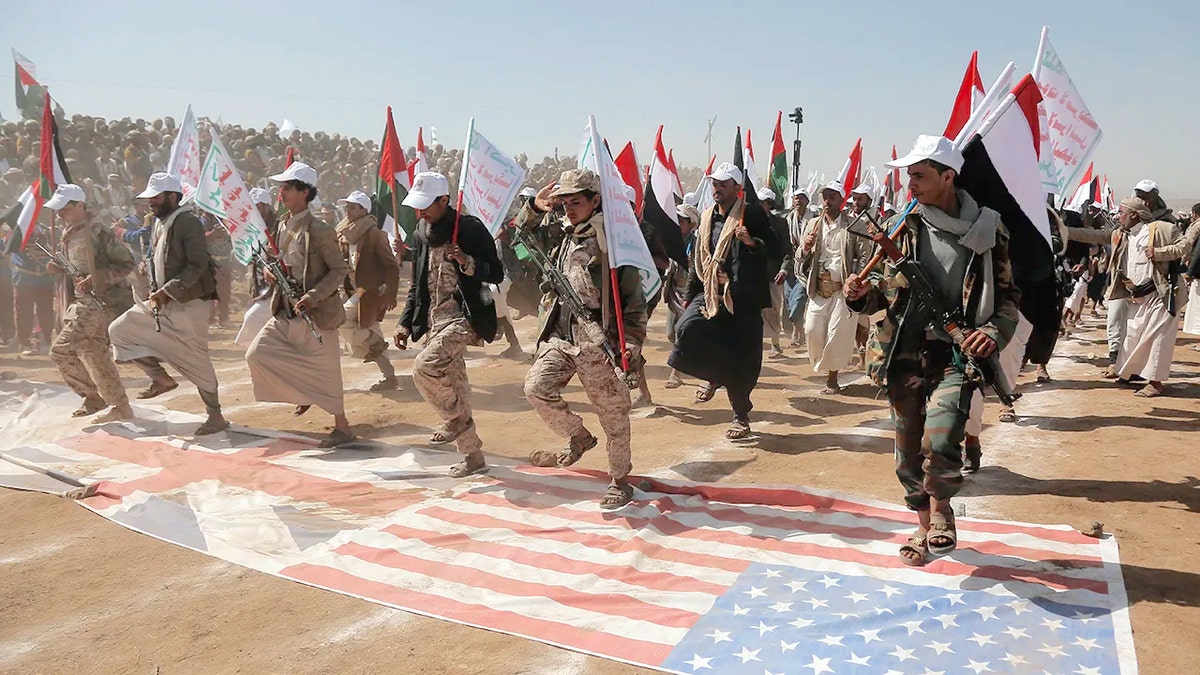
Houthi terrorists walk over British and American flags during a rally in support of Palestinians in the Gaza Strip and Houthi attacks on shipping in the Red Sea and Gulf of Aden on February 4, 2024, on the outskirts of Sana’a, Yemen. (Mohammed Hamoud/Getty Images)
Separatists seek a deeper partnership with Washington
Atef has repeatedly framed the STC as a natural U.S. partner in counterterrorism and regional stability. He praised President Donald Trump for labeling the Houthis as a foreign terrorist organization and for his efforts against branches of the Muslim Brotherhood.
“In Yemen we have the Muslim Brotherhood. We believe they are terrorists. We believe they sponsor terrorism,” Atef said, adding that he supported a recent bill to classify certain Muslim Brotherhood chapters abroad as terrorist entities, but argued that the organization “is extremist everywhere, even in the United States. Not just in these chapters.”
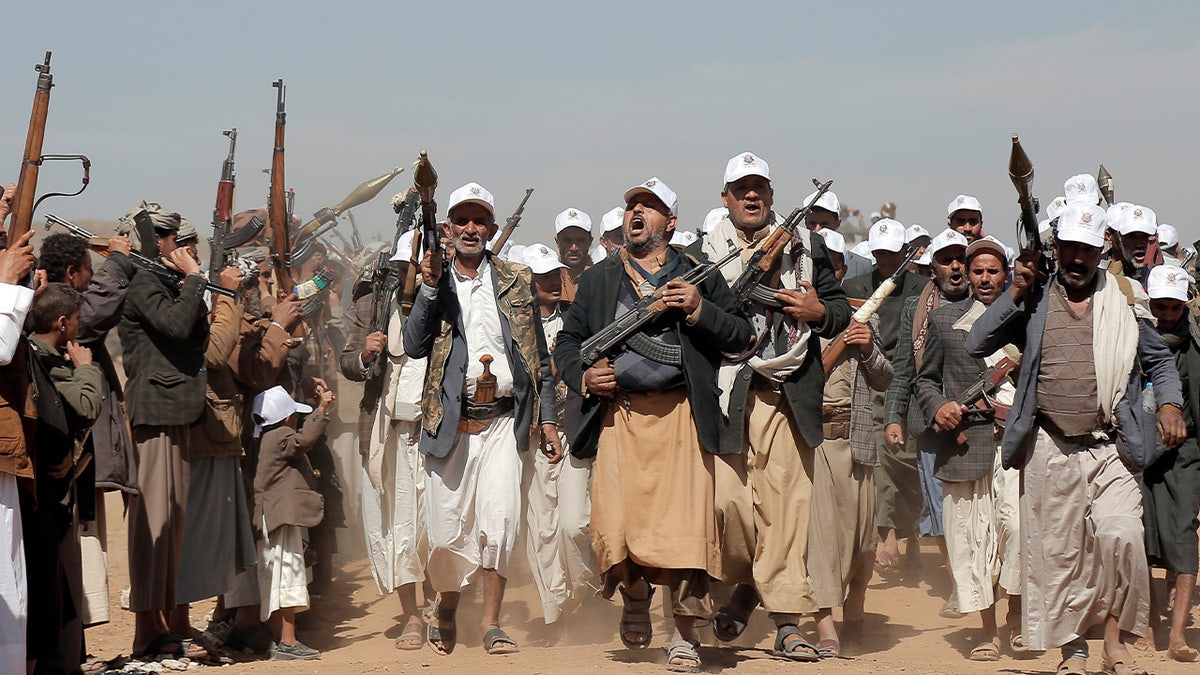
Houthi terrorists march in support of Palestinians in the Gaza Strip and against US attacks on Yemen outside Sanaa on January 22, 2024. (AP photo)
Atef also said the STC plans to open South Yemen’s oil, agriculture, fishing and tourism industries to U.S. companies as a path to long-term self-sufficiency. “We invite American companies to come and explore the oil fields and help us generate revenue to develop our people,” he said.
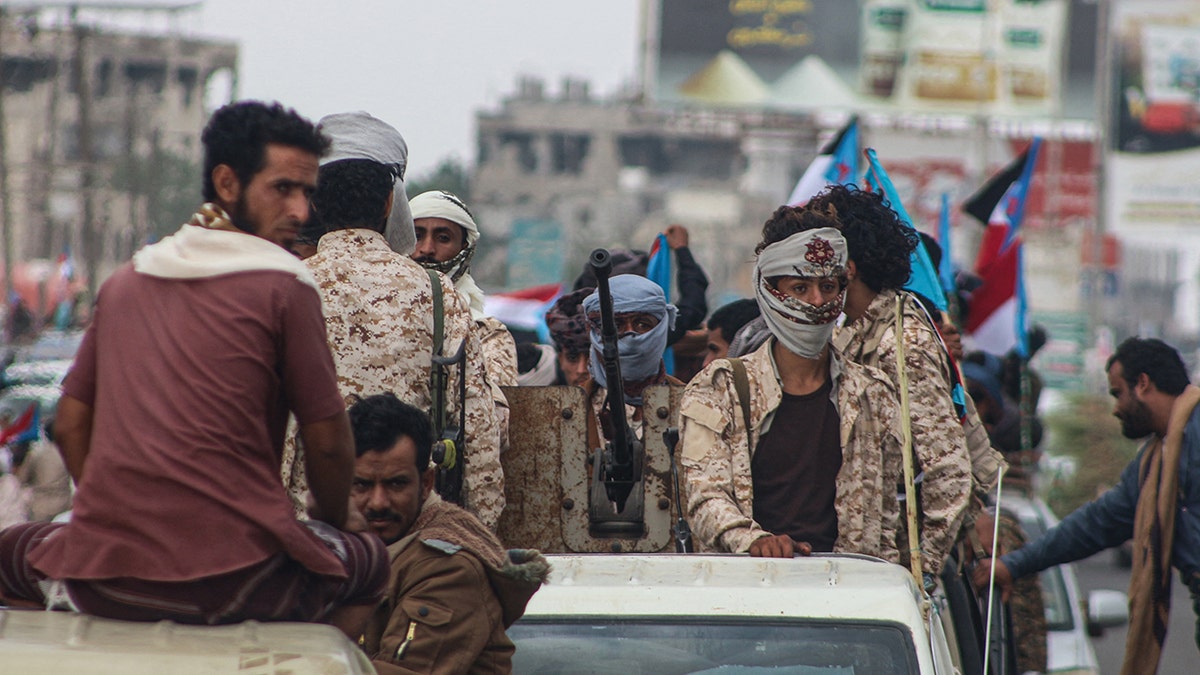
Yemenis express their support for the Southern Transitional Council (STC), which aims to revive an independent South Yemen, in Aden, the temporary capital of the Republic of Yemen, on December 14, 2025. (Saleh Al-Obeidi/AFP via Getty Images)
A new front in the region’s balance of power
The STC’s ultimate goal, Atef emphasized, is an independent, pro-western South Yemen that can secure its territory while helping to counter Iran’s regional influence.
CLICK HERE TO DOWNLOAD THE FOX NEWS APP
“Once we strengthen and encourage this front against the Houthis with the support of the international community and the United States,” he said, “it will greatly help us on the ground to continue our fight and bring stability and peace to the region.”
The Associated Press contributed to this report.
