



Gerrymandering has been an important part of the Republic since the beginning. The practice has such a rich tradition that it is named after Elbridge Gerry, one of our founding fathers who served as vice president under President James Madison. For decades, leftists tried to ban partisan gerrymandering. Justice Anthony Kennedy could not decide the issue, so it languished until he retired. Fortunately for the Constitution, President Trump replaced Judge Kennedy – the Court’s decisive vote for more than twelve years – with the solid constitutionalist Judge Brett Kavanaugh. In 2019, thanks to the addition of Kavanaugh, the Court upheld partisan gerrymandering in Rucho v. Common Cause. The legislature cannot decide based on race, but it can decide based on partisanship.
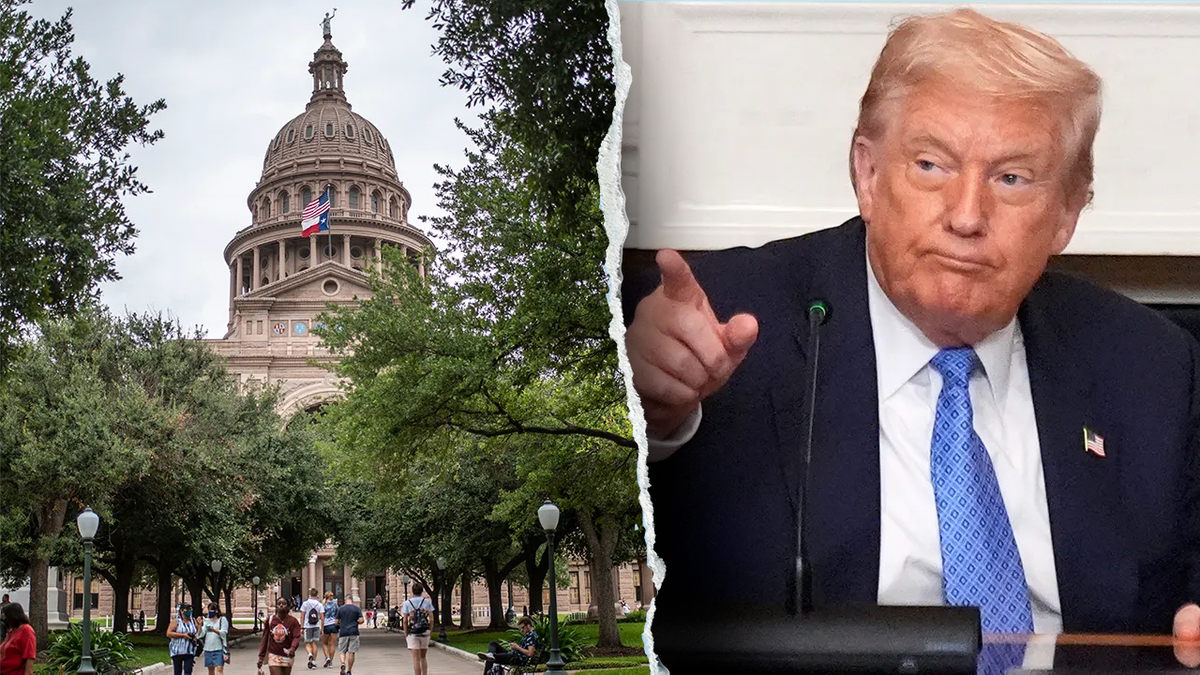
Following the return of Democratic lawmakers in Texas on Monday, President Donald Trump urged the state’s legislature to take quick action to pass a highly controversial redistricting bill, saying, “Pass this map ASAP.” (Sergio Flores/Getty; Mark Schiefelbein/AP)
Earlier this year, Texas did just that. Yet earlier this week, a three-judge panel invalidated Texas’ map and ordered that the map drawn up by the Legislature in 2021 remain in effect for the midterm elections. This ruling could cost Republicans five seats in the US House of Representatives. The ruling claims that minority votes would be diluted if the new map were to take effect. According to the ruling, it does not matter that the lawmakers who voted for redistricting never supported discrimination on the basis of race. Texas Governor Greg Abbott and Attorney General Ken Paxton immediately appealed to the Supreme Court. The 2-1 ruling was shockingly written by Texas U.S. District Judge Jeffrey Brown — handpicked by U.S. Sen. Ted Cruz in 2019. Judge Jerry Smith, the adult on the three-judge panel, disagreed.
It is imperative that the judges suspend judgment using the emergency docket, a tool that allows the Court to suspend judgments without full briefing and oral arguments when extraordinary circumstances make this necessary. Here the problem lies in the way courts have misapplied the Voting Rights Act of 1965 for decades. The current system allows for DEI districts; that is, current law mandates majority-minority districts, with redistricting explicitly requiring racial discrimination. The justices considered the proper interpretation of this statute in Louisiana v. Callais. Even though there was a time when such a plan was permissible at the height of segregation when the Voting Rights Act was passed, that period has long since passed. Kavanaugh focused on this point during oral arguments in Callais. Of course, it would be ideal if the court ruled that the plan was never permissible, as Justices Clarence Thomas, Samuel Alito and Neil Gorsuch suggested during the oral argument. Whatever the case, the justices should announce the Callais decision promptly so that the legislature can respond in time for the midterms.

Texas Governor Greg Abbott is seen on November 14, 2025 in Midlothian, Texas. (Ron Jenkins/Getty Images)
It is almost certain that the judges have decided on Callais and are the majority, with concurring and dissenting opinions. That decision will undoubtedly influence how the Texas case is decided. If the justices know they are going to shorten the Voting Rights Act to end mandatory majority-minority districting, they should not let the lower court’s ruling stand. In other words, Texas should not be forced to create districts that, if the court rules under the Constitution, are illegal.
FEDERAL JUDGES BLOCK TEXAS FROM USE OF REDESIGNED CONGRESSIONAL MAP
There is a separate reason why the justices should stay the lower court’s ruling. In Purcell v. Gonzalez (2006), the court ruled that federal courts should not normally interfere with elections when the election is about to take place. Based on this principle, the justices upheld a ruling similar to that of Texas in 2022. In Merrill v. Milligan, the court addressed a district court ruling from a three-judge panel that had ordered the implementation of Alabama’s new congressional map. The panel had made its ruling about two months before the start of absentee voting in the Alabama primary. In agreeing to grant the stay of that ruling, Kavanaugh emphasized the proximity of the election, citing the decision in the Purcell case.
The Texas case shows a similar time crisis. The primaries will take place in March, with absentee voting beginning weeks before that. Military personnel abroad need extra time to cast their votes, as many are stationed in remote locations thousands of miles away, and others are in the middle of the ocean on ships or submarines. The filing deadline for the primaries is December 8, just three weeks away. The lower court’s ruling has caused great damage; candidates had planned their runs based on the newly drawn districts. The justices must restore order to this chaotic mess the lower court has created.
CLICK HERE TO DOWNLOAD THE FOX NEWS APP
Another important point deserves emphasis. Again, one of the two judges who invalidated the card is Brown. He invalidated a map involving Galveston County in 2024 on similar grounds. The Fifth Circuit, which included all 17 judges (formally called en banc), reversed its decision in Petteway v. Galveston County. Brown is yet another Ted Cruz pick. Presidents must choose district judges based on the recommendations of home state senators. These senators exercise veto power through an outdated tradition called the blue slip. Electing quality district judges is virtually impossible in blue states, where left-leaning senators will veto excellent candidates. Senators in red states, especially deep red states like Texas, must ensure that the highest quality candidates are recommended for appointment. Brown was a clear miss by Ted Cruz.
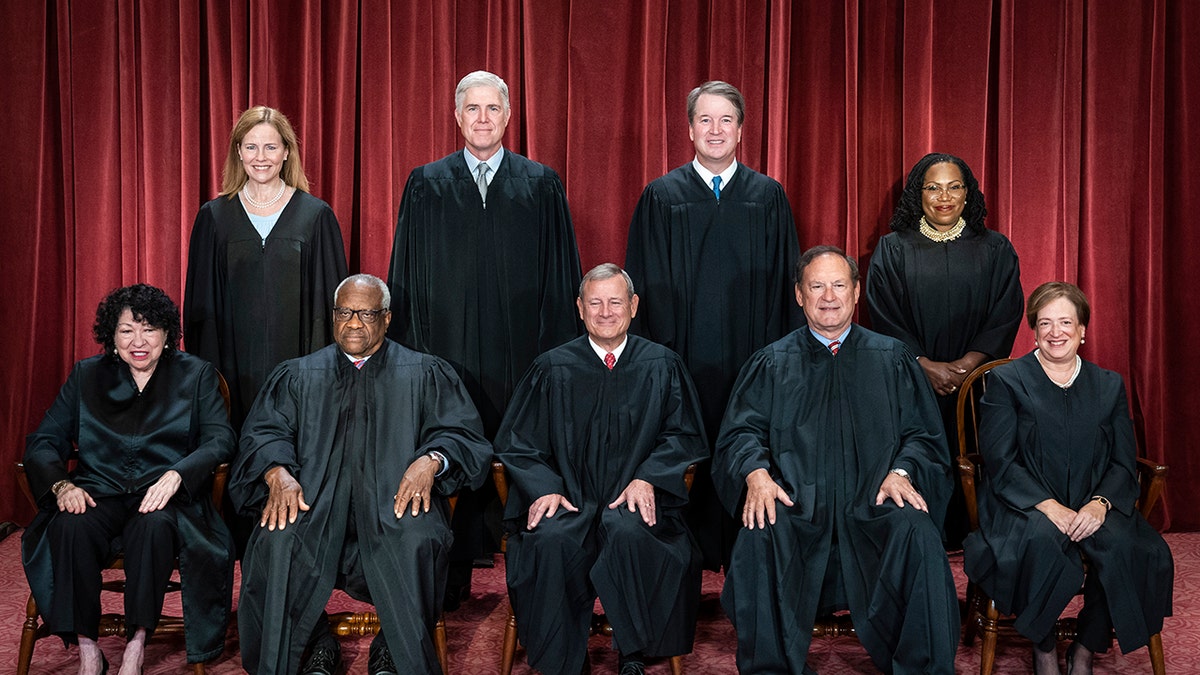
Members of the Supreme Court take a group photo after the recent addition of Associate Justice Ketanji Brown Jackson, at the Supreme Court Building on Capitol Hill on Friday, October 7, 2022 in Washington, DC. Bottom row, from left: Associate Justice Sonia Sotomayor, Associate Justice Clarence Thomas, Chief Justice of the United States John Roberts, Associate Justice Samuel Alito and Associate Justice Elena Kagan. Top row, from left: Associate Justice Amy Coney Barrett, Associate Justice Neil Gorsuch, Associate Justice Brett Kavanaugh and Associate Justice Ketanji Brown Jackson. (Jabin Botsford/The Washington Post via Getty Images)
In light of the upcoming filing deadline, time is incredibly short. The Supreme Court must quickly rescind this erroneous order and restore the legal map that was passed and signed earlier this year. The justices should also rule against the continuation of the practice of DEI districts by restoring sanity to the jurisprudence on voting rights. This decision should also be made quickly so that legislatures across the country have time to redistrict before the midterm elections. There is no place for racial discrimination in elections, and there is no place for improper judicial interference in elections. The Supreme Court must put an end to this now.
CLICK HERE FOR MORE FOX NEWS ADVICE
