Every year around this time, Jews read the ancient Scroll of Esther and think of a Persian courtier named Haman who plotted to destroy, kill and destroy “all the Jews” of the empire in one day. The story feels less like distant history and more like a chilling parallel to our current reality, as a regime in Persia – today’s Islamic Republic of Iran – once again openly dreams of destruction and domination, with Jews as the central target, but far from the only ones.
The holiday of Purim is often presented as a children’s story about costumes and noisemakers, but at its core there is a political battle between good and evil. A powerful ideologue identifies a people as an intolerable obstacle to his vision, secures state power behind his hatred, and issues a bureaucratic death sentence. It will take courage, unity and the willingness to fight back to stop this brutal plot. Replace the scroll and signet ring with missiles and proxies, and you have the current Iranian regime’s worldview vis-à-vis Israel, the United States, and now several neighboring Persian Gulf states.
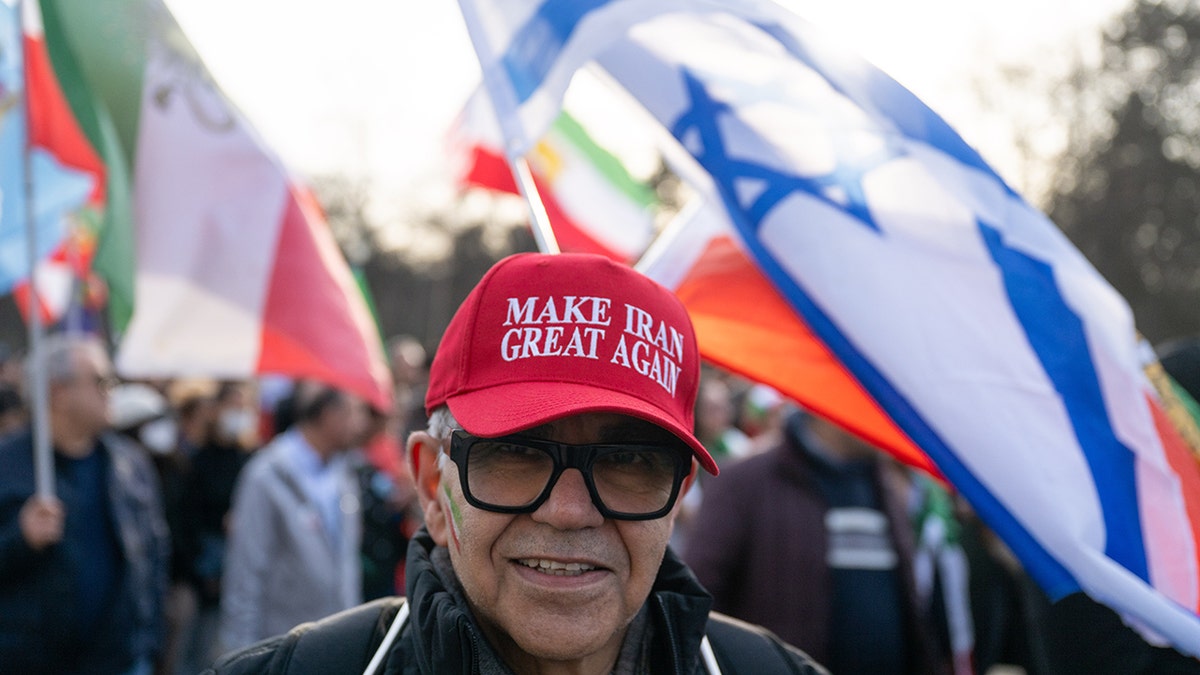
A man wears a cap with the slogan ‘Make Iran Great Again’ in Berlin, Germany, on February 28, 2026. (Christophe Gateau/Photo Alliance via Getty Images)
When Hamas stormed Israeli communities and murdered, raped and kidnapped civilians on October 7, it did not act in an ideological vacuum. Hamas has long relied on the Iranian regime for training, financing and supply of weapons.
The terrorist group is part of a broader “axis of resistance” that Tehran has painstakingly built around Israel and across the region. Whether or not Tehran signed off on the exact timing, the regime has spent decades forging a regional “ring of fire,” including Hamas in Gaza, Hezbollah in Lebanon, militias in Syria and Iraq, the Houthis in Yemen, explicitly to fulfill its promise that Israel is a “cancer” that must be removed and that American power in the Middle East must be driven out.
But in the 21st century, the Iranian regime’s war is not only against the Jews and is not only fought with missiles and drones. It is being fought with code, cameras and carefully constructed narratives, targeting Israelis, Arabs, Americans, Europeans, dissident Iranians and anyone who stands in the way of the regime’s revolutionary project. The regime has developed a sophisticated influence apparatus that uses botnets, fake personas, and social media influencers to shape how the global public understands the conflict and how free societies see themselves.

Jewish men read the Scroll of Esther as they celebrate Purim in an underground parking garage as a precaution against possible Iranian missile attacks in Tel Aviv, Israel, Monday, March 2, 2026. (Ohad Zwigenberg/AP Photo)
Research has uncovered networks of inauthentic accounts on X, Facebook, Instagram and Telegram that widely spread divisive and demoralizing content. In one documented campaign, bots flooded Hebrew discourse with tens of thousands of messages in less than two days, deepening internal Israeli divisions and sowing panic over the fate of the hostages. Other operations have impersonated Israelis, Americans and Europeans online, pushing narratives calling for Western withdrawal, civil conflict and the abandonment of Israel’s allies to Ukraine.
SIGN UP FOR THE NEWSLETTER ON ANTISEMITISM
This isn’t the random trolling we’ve been seeing for years. It is a state-directed information war designed to achieve strategic goals including weakening Israeli morale, crushing the Iranian opposition, crushing Western support, and turning victim and aggressor in the eyes of the world. When regime-linked operations amplify inflammatory content about “Zionist control,” repackage anti-Jewish conspiracy theories as anti-Israel “anti-colonialism” while smearing Iranian dissidents as foreign agents, they target anyone who challenges Tehran’s ambitions.
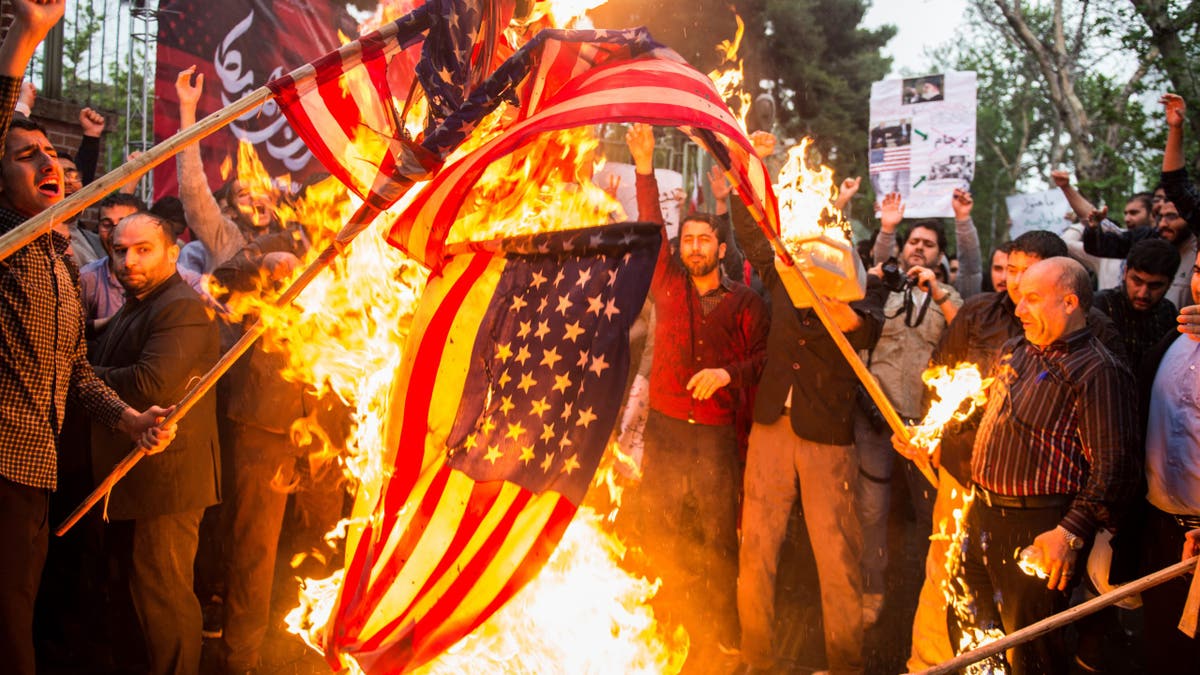
Iranians burn American flags during an anti-American demonstration outside the former U.S. Embassy headquarters in Tehran on May 9, 2018. (Ali Mohammadi/Bloomberg via Getty Images)
The West should recognize how a hostile regime uses every tool, including terror proxies abroad, repression at home, campus activism in the West, and hacking of algorithms online to delegitimize democratic allies and normalize violence against minorities and dissidents. The same regime that arms Hamas and Hezbollah also shoots women taking off their headscarves in Tehran, supplies drones to Russia for use in Ukraine, and threatens Persian Gulf Arab states that dare openly cooperate with Israel. The ideological hatred that inspired Haman has simply been updated and made universal.
CLICK HERE FOR MORE FOX NEWS ADVICE
That is why we can all think of this Purim as the Jews being in the regime’s crosshairs, in that the story requires a vulnerable minority singled out by a power that cannot tolerate their existence, and ordered to bow down and disappear for the sake of someone else’s totalizing ideology. Standing with Israel after October 7 does not mean ignoring other victims of the Iranian regime; we must understand that the same system that dreams of erasing the Jewish state also dreams of crushing Americans, Europeans, Sunni Arabs, women in the streets of Mashhad, Shiraz or Esfahan, and students on Western campuses who refuse to chant its slogans.
Purim ends with the intended victims rising up, fighting back and surviving. If Israel and the Islamic Republic’s other targets today want to do the same, free nations must be prepared to confront the regime on all fronts: downgrade its military capabilities, defeat its terror proxies on the battlefield, support its domestic dissidents, harden our information space against manipulation, and deny Tehran the impunity it has enjoyed for far too long. The lesson of the Scroll of Esther is not parochial. The fact is that when a regime builds its identity around destruction, indifference is complicity, and by the time the decree reaches your own door, it may be too late.
CLICK HERE TO DOWNLOAD THE FOX NEWS APP
Related article