



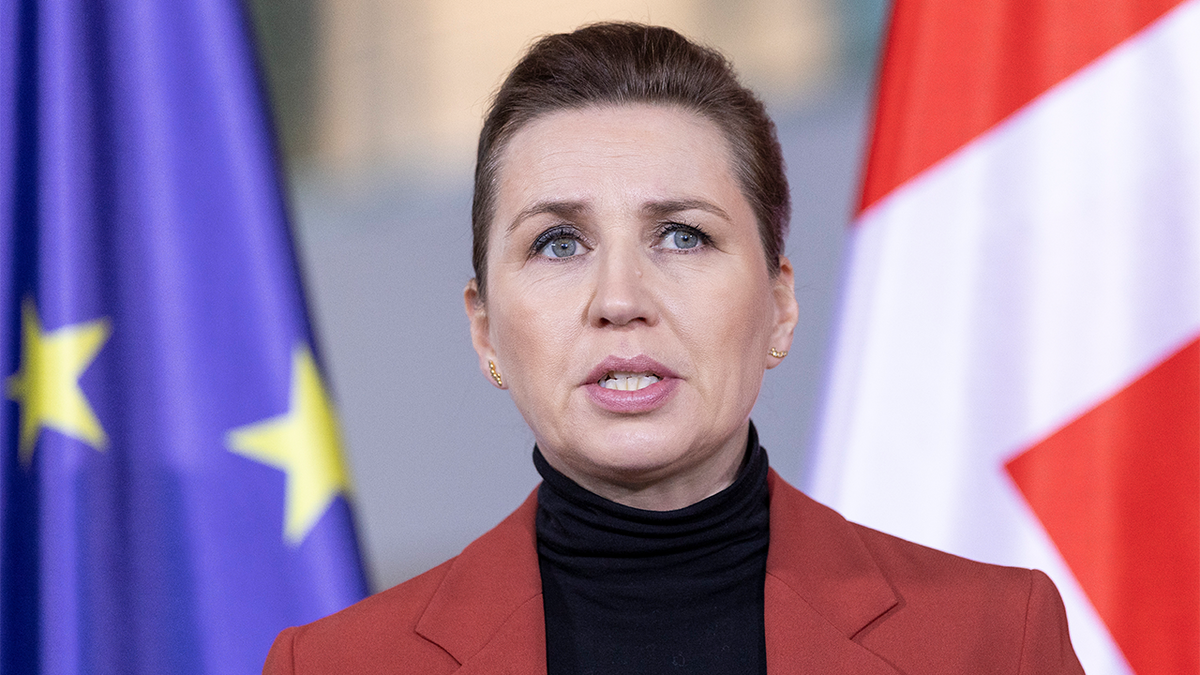
Denmark goes to the polls on March 24 after Prime Minister Mette Frederiksen called early parliamentary elections, a move widely seen as an attempt to consolidate growing public support related to her handling of tensions with President Donald Trump over Greenland.
Frederiksen announced the early vote on Wednesday, arguing that Denmark needs political clarity at a time of increasing geopolitical pressure. According to Reuters, she said the country is facing “a serious foreign policy situation,” adding that voters should have a say in how Denmark navigates it.
Her centre-left Social Democratic government has seen a rise in opinion polls in recent weeks after taking a strong stance that Greenland is not for sale and that Danish sovereignty is non-negotiable.
The dispute with Washington has reshaped the domestic political conversation, pushing Arctic security and national sovereignty to the forefront of Danish politics.
Danish Prime Minister Mette Frederiksen speaks to the media after talks with German Chancellor Olaf Scholz (not seen) at the Chancellery on January 28, 2025 in Berlin, Germany. (Maja Hitij/Getty Images)
Frederiksen, who has led Denmark since mid-2019, has spent much of the past year managing the fallout from Trump’s renewed bid to acquire Greenland, the vast Arctic island that is an autonomous territory within the Kingdom of Denmark. Tensions escalated sharply last month when Trump threatened to impose new tariffs on Denmark and several other European Union countries.
Trump has argued that the United States needs control of the North Atlantic island for national security reasons, citing increased activity by Russia and China in the Arctic. The region has grown in strategic importance as melting ice opens shipping lanes and access to natural resources, increasing competition among great powers.
The impasse appeared to ease after Trump announced that a framework agreement to strengthen security in the Arctic had been reached in talks with NATO Secretary General Mark Rutte on the sidelines of the World Economic Forum in Davos. Following that announcement, U.S., Danish and Greenland officials began technical discussions on implementing the arrangement, focusing on security coordination rather than any change in sovereignty.
Throughout the crisis, Frederiksen and other senior Danish officials have repeatedly emphasized that Greenland’s status is non-negotiable. Speaking at the Munich Security Conference earlier in February, Frederiksen warned she did not believe the crisis was completely over and suggested Washington could still harbor ambitions to annex the island.
RUSSIA AND CHINA Squeeze US Arctic Defense Zone While Trump Eyes Greenland

Danish soldiers land at Nuuk Airport in Greenland on January 19, 2026. (Mads Claus Rasmussen/Ritzau Scanpix/via Reuters)
According to The Guardian, Danish commentators have described the prime minister’s election boost as a “Greenland revival”, reflecting growing domestic approval of her firm stance on Washington.
Frederiksen’s decision to call early elections seems aimed at converting that wave into a renewed mandate. Denmark’s next general election was not scheduled until later this year, but the prime minister argued that the current security climate justified seeking new support from voters.
Greenland, home to approximately 56,000 people, has long been strategically important due to its location between North America and Europe. The United States has a military presence there at Pituffik Space Base, formerly known as Thule Air Base. Any suggestion of a US takeover is historically sensitive in both Copenhagen and Nuuk, the capital of Greenland.
Euronews reported that Frederiksen’s government has emphasized cooperation with allies while firmly rejecting any negotiations over Greenland’s sovereignty. European leaders have expressed support for Denmark, reinforcing the view that stability in the Arctic is increasingly important to NATO and EU planning.
CLICK HERE TO DOWNLOAD THE FOX NEWS APP

People protest in the presence of the US against Trump’s policy towards Greenland. consulate in Nuuk, Greenland, January 17, 2026. (AP Photo/Evgeni Maloletka)
Opposition parties have criticized the timing of the snap elections, arguing that Frederiksen is looking for a political advantage at a time of heightened nationalism. Others, however, have largely supported the government’s position on Greenland, suggesting the sovereignty issue could transcend traditional party differences.
The March 24 vote will determine whether Frederiksen can strengthen her coalition or whether voters can shift the parliamentary balance. It will also serve as a broader test of how Danes believe their country should manage its relationship with Washington as Arctic security becomes a defining issue of global competition.
Related article

