



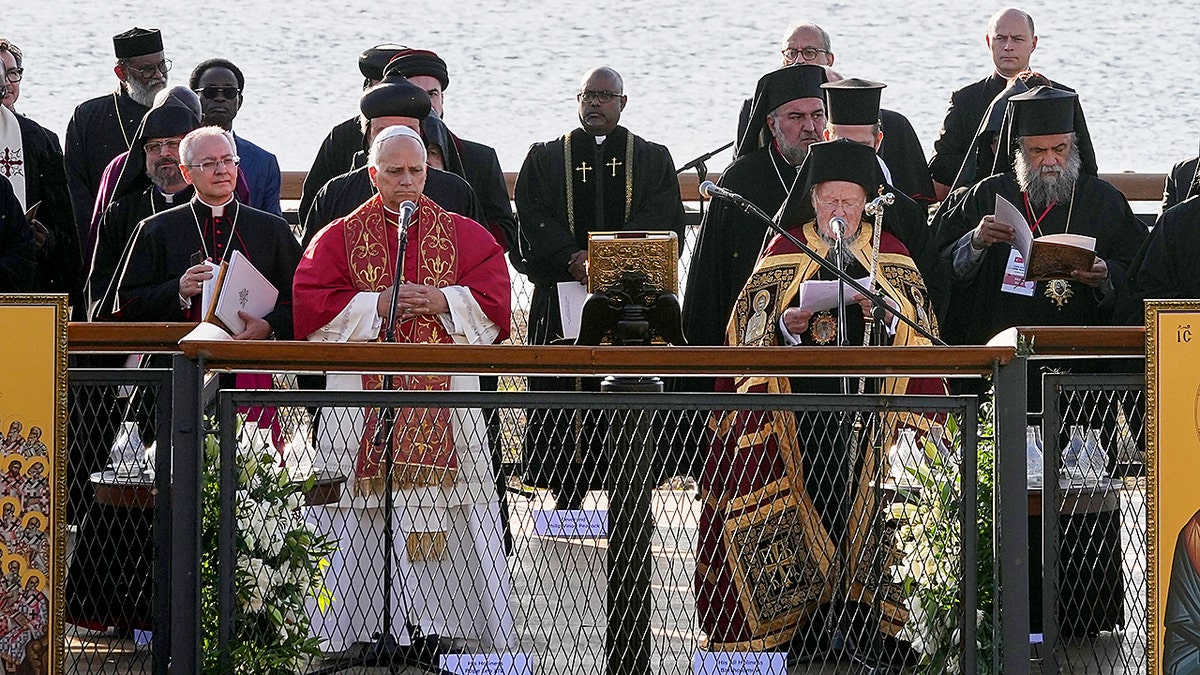
Pope Leo XIV joined Eastern and Western patriarchs and priests on Friday in commemorating an important anniversary in Christian history. He gathered at the site in Turkey of an unprecedented meeting of bishops in 325 AD. to pray that Christians may be united again.
Leo, Ecumenical Patriarch Bartholomew I and other Christian leaders met on the shores of Lake Iznik, the site where the Council of Nicaea produced a statement of faith or creed that is still recited by millions of Christians today.
Standing above the ruins of the site, the men recited the Creed, which Leo said was “fundamental in the journey that Christians make toward full communion.”
“In this way, we are all invited to overcome the scandal of division that unfortunately still exists and to cherish the desire for unity for which the Lord Jesus prayed and gave his life,” he said.
The prayer marked the highlight of Leo’s visit to Turkey and the main reason for his trip, the first of his pontificate.
POPE LEO
Religious leaders lead an ecumenical prayer service near the archaeological excavations of the ancient Basilica of Saint Neophytos in Iznik, Turkey, on November 28, 2025. (AP Photo/Domenico Stinellis)
A crucial moment in Christianity
The Nicaea meeting took place at a time when the Eastern and Western churches were still united. They parted ways during the Great Schism of 1054, a rift caused largely by disagreements over papal primacy. But even today, Catholic, Orthodox, and most historic Protestant groups accept the Nicene Creed, making it a point of agreement and the most widely accepted belief in Christianity.
As a result, celebrating its origins at the site of its founding with the spiritual leaders of the Catholic and Orthodox Churches and other Christian representatives marked a historic moment in the centuries-old quest to reunite all Christians.
“The Nicene Creed serves as a seed for our entire Christian existence. It is not a symbol of an absolute minimum; it is a symbol of the whole,” said Bartholomew, spiritual leader of the world’s Orthodox Christians.
At the beginning of the prayer service, he told the men that they were not gathering just to remember the past.
“We are here to bear living witness to the same faith expressed by the Nicene fathers. We return to this source of the Christian faith to move forward,” he said.
A prayer for unity
The Roman Emperor Constantine had called the meeting of bishops from across the Roman Empire after consolidating control following years of civil war and political intrigue.
Constantine would not formally convert to Christianity until the end of his life, in 337. But by 325 he had already shown tolerance and favor toward a Christian sect that had emerged from the last great wave of Roman persecution.
The version of the creed that emerged from the council and is recited by Catholics today begins: “I believe in one God, the Father Almighty…”
The memorial service, with alternating Catholic and Orthodox hymns, took place at the archaeological excavations on the lake of the ancient Basilica of Saint Neophytos. The basilica’s stone foundations, recently exposed by the receding waters of the lake, are believed to be on the site of an earlier church where the council took place 1,700 years ago.
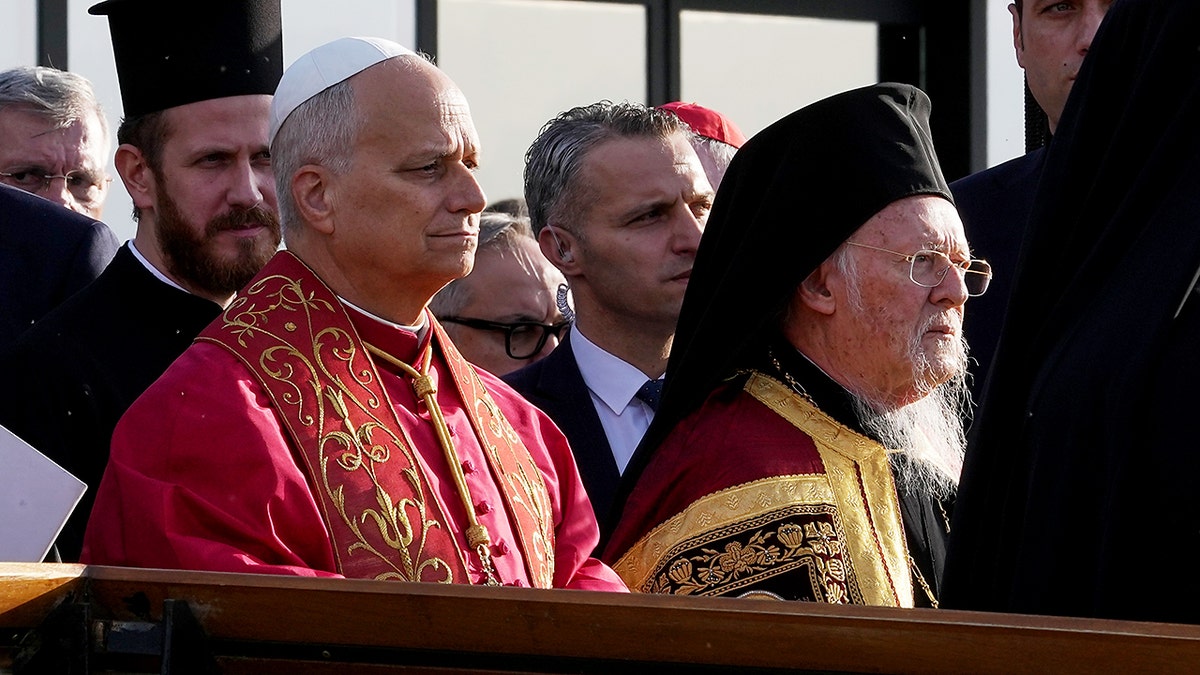
Senior clerics attend an outdoor religious ceremony in Turkey on November 28, 2025. (AP Photo/Domenico Stinellis)
LGBTQ CATHOLICS MARCH THROUGH ST. PETER’S BASILICA IN JUBILEE RITUAL AS AN ENTRANCE TO THE VATICAN CALENDAR INCREASES CONTROVERSY
In addition to Leo and Bartholomew, participants in the memorial service also included priests, patriarchs and bishops from the Orthodox Greek, Syrian, Coptic, Malankarese, Armenian, Protestant and Anglican churches.
In his remarks to the men, Leo said all Christians must firmly reject the use of religion to justify war, violence “or any form of fundamentalism or fanaticism.”
“Instead, the paths we must follow are those of fraternal encounter, dialogue and cooperation,” he said.
A brief protest before Leo arrived
Christians are a minority in predominantly Sunni Muslim Turkey, and before the Iznik prayers, about 20 members of a small Turkish-Islamic party staged a brief protest. They said the meeting threatened Turkey’s sovereignty and national identity.
Under a heavy police presence, Mehmet Kaygusuz, a member of the New Welfare Party, read out a statement denouncing attempts to establish a “Vatican-like Greek Orthodox state” in Turkey. The group dispersed peacefully shortly afterwards.
Suleyman Bulut, 35, a resident of Iznik, recognized the deep historical and spiritual significance of his city for Christians and said he had no problem with them coming to honor their heritage.
“Muslims should (also) visit places that are ours in the rest of the world, in Europe,” he said.
But Hasan Maral, a 41-year-old shopkeeper, said the visit made him feel uncomfortable. “The Pope coming here feels contradictory to my faith,” he said.
A boost for the small Catholic community in Turkey
Leo started his first full day in Istanbul by encouraging the small Catholic community in Turkey to find strength in their small numbers. According to Vatican statistics, there are about 33,000 Catholics in a country of 85 million, most of whom are Sunni Muslims.
He received a raucous reception at the Cathedral of the Holy Spirit, where he was greeted with cries of “Papa Leo” and “Viva il Papa” (Long live the Pope).
“The logic of smallness is the true strength of the church,” Leo told them in English. “The significant presence of migrants and refugees in this country challenges the Church to welcome and serve some of the most vulnerable.”
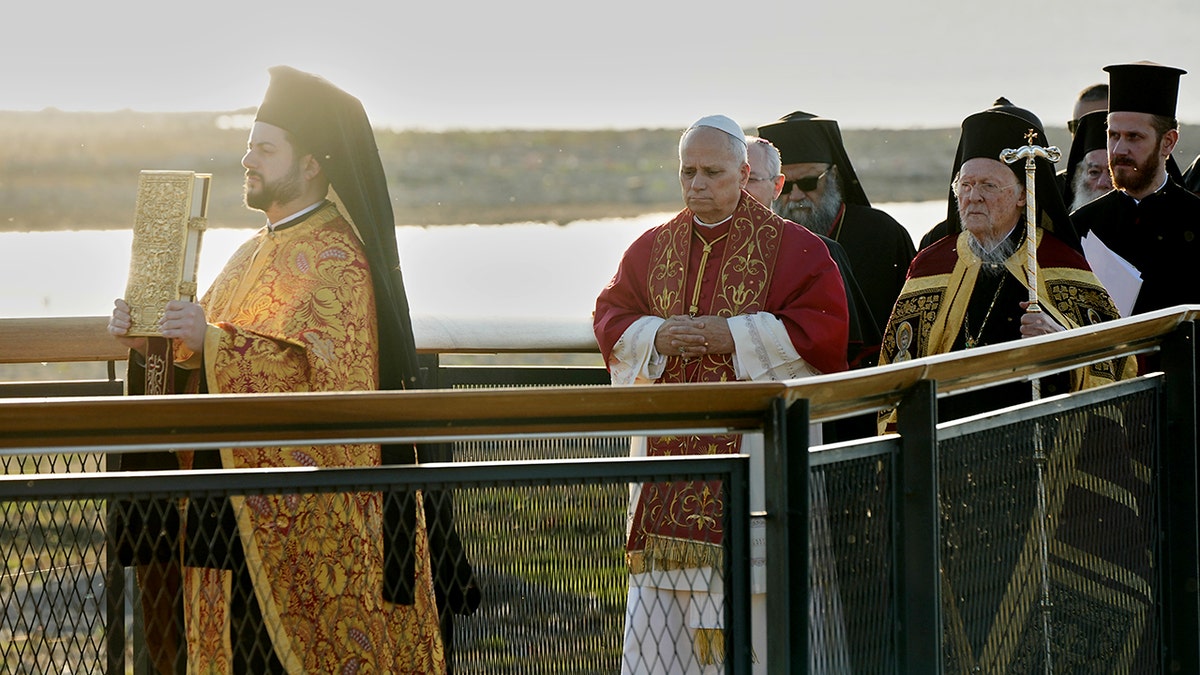
Clergy walk in a religious procession during an ecumenical prayer service in Iznik, Turkey, on November 28, 2025. (AP Photo/Domenico Stinellis)
Leo later visited a group of nuns, the Little Sisters of the Poor, who run a nursing home in Istanbul.
“He was so simple. We just felt at home. He felt very comfortable. Everyone got what they expected: a blessing, a kind word. It’s just huge,” said Sister Margret of the Little Sisters of the Poor Nursing Home.
CLICK HERE TO DOWNLOAD THE FOX NEWS APP
On Saturday, Leo continues his ecumenical focus, meeting Bartholomew and other Christian leaders. But he will also visit the Sultan Ahmed Mosque, known as the Blue Mosque, and celebrate a late afternoon mass at Istanbul’s Volkswagen Arena.
Leo leaves for Lebanon on Sunday for the second and final part of his trip.
