



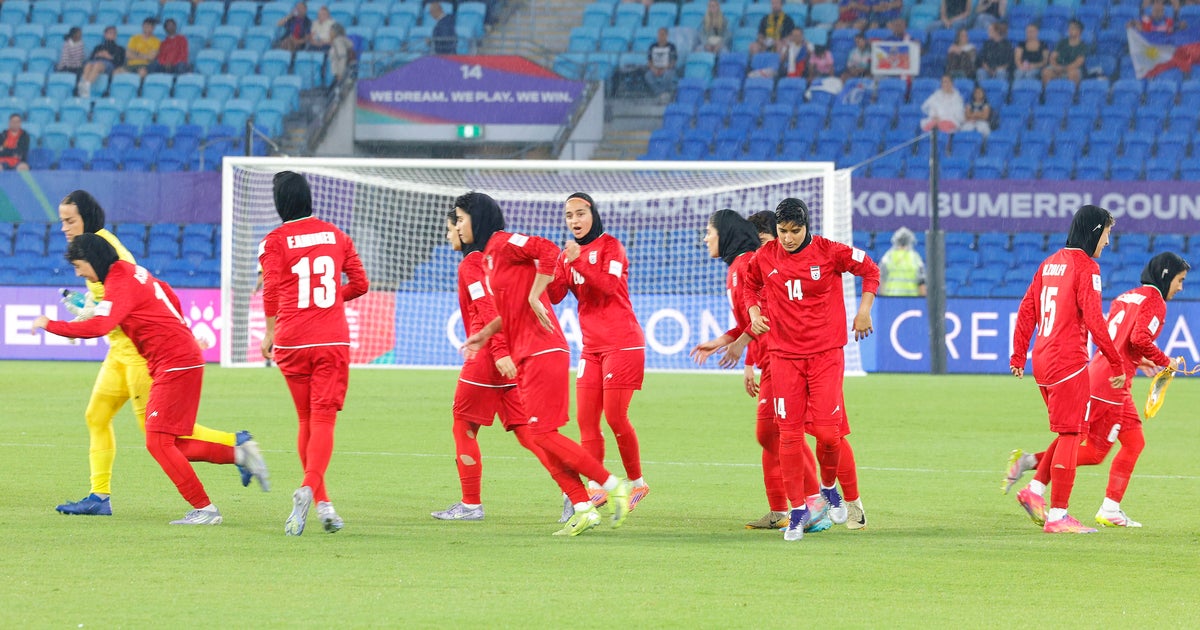
KUALA LUMPUR, Malaysia (AP) — Iran’s women’s soccer team will leave Malaysia on Monday evening, ending days of uncertainty after most of the seven team members who caused a diplomatic furore by seeking asylum in Australia reversed their decisions and rejoined the team in Kuala Lumpur.
Asian Football Confederation general secretary Windsor John told The Associated Press that the team’s departure had been arranged by the Iranian embassy on Monday evening. He said the AFC, which is supporting the Iranian team in Kuala Lumpur, was told they are flying to Oman but that is not their final destination. He said he was not aware of their full travel plans.
Asked whether the confederation is confident the women will be back in Iran safely, Windsor said both the AFC and FIFA will regularly check on them with the Iranian Football Federation “as they are also our girls.”
Asylum claims and changes of heart
The squad flew from Sydney to Kuala Lumpur on March 10 after being eliminated from the Women’s Asian Cup in Australia, initially leaving behind six players and a support staff member who had accepted protection visas.
Four players and the staffer have since rejoined the team in Kuala Lumpur, with the last arriving on Monday. No reasons have been given for the changes of heart. The Iranian diaspora in Australia blames pressure from Tehran.
Windsor earlier said at a news conference that his confederation had received no direct complaints from players about returning home, despite media reports that their families in Iran could face retaliation against the team. not sing their national anthem before the opening match.
The silence during the national anthem was variously reported as an act of defiance or a show of mourning. The team made no clarification and sang at the opening of a later match.
“We couldn’t verify anything. We asked them and they said, ‘No, it’s OK,'” he said. “They’re actually in good spirits… they didn’t look scared.”
Two players remain in Australia
Iranian authorities have welcomed the women’s decision to reject asylum as a victory over Australia and the US president Donald Trump.
The Iranian squad had arrived in Australia for the tournament shortly before the war in the Middle East began on February 28, complicating travel arrangements.
Assistant Immigration Minister Matt Thistlethwaite described the situation of women in Australia as a “very complex situation”.
“These are deeply personal decisions, and the government respects the decisions of those who have chosen to return. And we continue to provide support to the two who remain,” Thistlethwaite said.
Those who remained in Australia have been moved to an undisclosed secure location and are receiving assistance from the government and the Iranian diaspora community, he said.
A ‘propaganda war’
Kylie Moore Gilberta political scientist at Macquarie University in Sydney who spent more than two years in Iranian prisons from 2018 to 2020 on espionage charges, said “winning the propaganda war” had overshadowed the women’s welfare.
“The high stakes, in my opinion, made the Iranian regime sit up and take notice and try to force a response in response,” Moore-Gilbert said.
“I think in this case, if these women had quietly applied for asylum without the publicity surrounding them, it is possible that the Islamic Republic officials would have done this, as they have done in the past in the cases of other Iranian athletes who have defected… that they just let that happen,” she added.
Iran’s Tasnim News Agency said the players who left Australia “returned to the warm embrace of their families and homelands”, describing their return as a failure of what it called a US-Australian political effort.
Concerns about the team’s safety in Iran increased when the players did not sing the Iranian national anthem.
The Australian government was urged by Iranian groups in Australia and by Trump to help the women.
The embassy in the national capital Canberra remains staffed, despite the Australian government the expulsion of the ambassador last year.
Australian Prime Minister Anthony Albanese broke off diplomatic ties with Iran in August after announcing that intelligence officials had concluded that the Revolutionary Guards had targeted a kosher food company in Sydney and its Melbourne factory. Adass Israel Synagogue in 2024.
Australian-Iranian Society of Victoria vice-president Kambiz Razmara said the women who had accepted asylum were under pressure from the regime in Tehran.
“They have had to make decisions on the spur of the moment based on very little information and they have had to react to the circumstances,” Razmara said. “I’m surprised they decided to go, but I’m actually not surprised because I appreciate the pressure they’re experiencing.”
McGuirk reported from Melbourne, Australia.
