



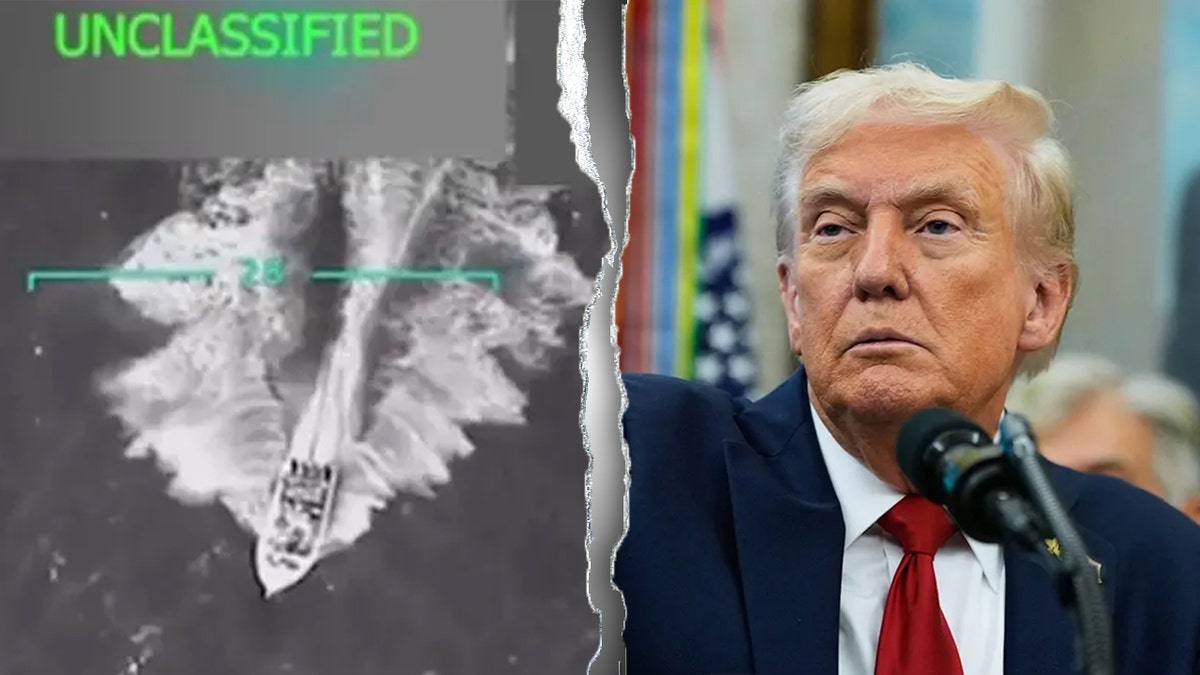
Whatever President Donald Trump plans to do to Venezuelan dictator Nicholas Maduro, it will happen without the explicit authorization from Congress that some would like but is also unnecessary.
People who have actually read and studied the major precedents on the scope of all presidents’ powers in foreign affairs under Article II of the Constitution should know that such actions will be considered constitutional unless proven otherwise by a successful impeachment or a SCOTUS ruling. Neither is very likely, since the country’s constitutional order became reality decades ago — and even centuries ago — on presidential power.
The first dramatic and perhaps still most extensive use of presidential power was the Louisiana Purchase.
TRUMP DEMONSTRATES PEACE IN EUROPE, PRESSURE IN AMERICA – WITHIN THE GAMBLE OF TWO FRONTS
The brief summary of the President’s powers set forth in Article II states: “The Executive Power shall be vested in a President of the United States of America… The President shall be Commander in Chief of the Army and Navy of the United States, and of the Militia of the several States, when called into the actual Service of the United States…”
That short excerpt from the Constitution defines the power of each sovereign in just a few words.
The first evidence of how much authority these short sentences convey was, as noted above, President Thomas Jefferson’s purchase of the Louisiana Territory, for which Jefferson himself believed he had no authority.
Jefferson acted despite his beliefs because it was in the best interest of the country and the need to act was immediate. From that sweeping exercise of untold power by the president to act as sovereign power in the new country flowed a long series of presidential actions that sometimes upset modern pundits who don’t like the president in the Oval Office.
Trump has the same enormous power as Jefferson. President Barack Obama had it for his approximately 540 drone strikes and his war in Libya, as did President Bill Clinton for ordering the US military to participate in the 1994 war in Bosnia and the 1999 war in Serbia.
Many “con law experts” have popped up on X in recent days, and they have many opinions on President Trump’s decision to order strikes on drug boats. Some are excellent lawyers and people of great knowledge and experience, such as Andrew C. McCarthy and Ed Whelan. Others are part of the permanent left-wing law faculties or NGO activists.
But the new understudy for the role of the people behind “Russia, Russia, Russia” is the hilariously self-proclaimed “The Former JAGs Working Group” – people who apparently missed the collapse in credibility of such efforts following the release of the “Public Statement on the Hunter Biden Emails by” 51 former intelligence officials.
Yes. Try your luck at convincing anyone of anything, “former JAGS task force.” You’re just like the take-home pregnancy tests for TDS patients. Anyone who quotes you is confessing to TDS. Thank you for your service.
But unlike that “working group,” some serious people fear that President Trump will escalate “kinetic actions” against Maduro, cartels and other narco-states. They try to convince that President Trump is violating “international law,” but they are “not showing what they are doing” regarding a basic, neutral understanding of Article II’s grant of power to the president – all presidents, those they love and cheer and those they hate and revile.
The Constitution does not change when presidents leave and arrive. President Trump’s authority is the same as that of President Washington, Lincoln, FDR, Ike, etc., as well as all failed presidencies and those in between. The powers of presidents are the same.
Some experts on Con law rely on Judge Jackson’s key opinion in the Steel Seizure cases. Good. It is common to all relevant opinions, but all SCOTUS opinions on this matter matter when it comes to any exercise of unilateral presidential action abroad. If an “X expert” or talking head hasn’t even referenced those important opinions, of which Jackson’s is one, maybe mute the account and skip booking that talking head.
Very few “X-experts in Con Law” appear to be aware of or concerned about the decision in United States v. Curtiss-Wright Export Corp. (1936), in which SCOTUS ruled that ‘[a] Political society cannot survive without a supreme will somewhere. Sovereignty is never in doubt.”
Curtiss-Wright is often the first case presented to a law student in the Con jurisprudence textbooks when Article II is addressed, and the discussion of presidential powers remains an excellent and highly relevant commentary. (Quick summary: the president’s power over foreign affairs is enormous.)
Dames & Moore v. Regan (1981) involved a massive exercise of presidential power used to free our hostages in Iran. I emphasize enormous because the Court has set aside the property and due process rights of many citizens, denied them the benefits of our legal system and the guarantees of our Constitution, and sent them and their claims to The Hague. (It denied it did this, but it did.)
Dames & Moore, written by Judge Rehnquist (not yet the Chief), begins: “The questions raised in this case fundamentally concern how our Republic should be governed.”
That’s a bright red arrow pointing to this view as fundamental to our understanding of the scope of presidential power when acting in foreign affairs.
Judge Rehnquist explicitly states early on that the decision should be viewed as limited (although it is not):
“We are not attempting to establish general ‘guidelines’ that cover other situations not addressed here, and are seeking to limit opinion only to those questions necessary to decide the case.” (Modesty that is appropriate, but also misleading.)
CLICK HERE FOR MORE FOX NEWS ADVICE
Citing the opinions of both Curtiss-Wright and Justice Jackson in the Steel Seizure cases, Judge Rehnquist notes: “As we now turn to the factual and legal issues in this case, we freely confess that we are clearly deciding just one more episode in the never-ending tension between the President who exercises executive authority in a world that presents every day a new challenge to confront him, and the Constitution under which we all live and which is not challenged by anyone, and which provides a kind of system of checks and balances. balances.’
That “never-ending tension” does not yet appear in President Trump’s directives to use military force against narco-states and the cartels that operate with their support or at least acquiescence. At this point, he is not even at the “Panama Invasion” level of use of the Article II power that George HW Bush used when he ordered the invasion of Panama on December 20, 1989, officially called “Operation Just Cause.”
CLICK HERE TO DOWNLOAD THE FOX NEWS APP
If and when Congress directs the president to stop attacking drug boats, the constitutional question would arise. Until then, the key is from 89 years ago in Curtiss-Wright, when SCOTUS summed up the president’s enormous power when he declared that “political society cannot continue without a supreme will somewhere,” adding, “[s]ownership is never held in tension.”
The reality of all these cases (and the pending decision in the tariff case) is that each POTUS has enormous powers in foreign affairs, and courts (and especially experts) do not. The criminal nations that are poisoning our people need to know this and cannot rely on the “X experts” who say otherwise.
CLICK HERE TO HUGH HEWITT
