



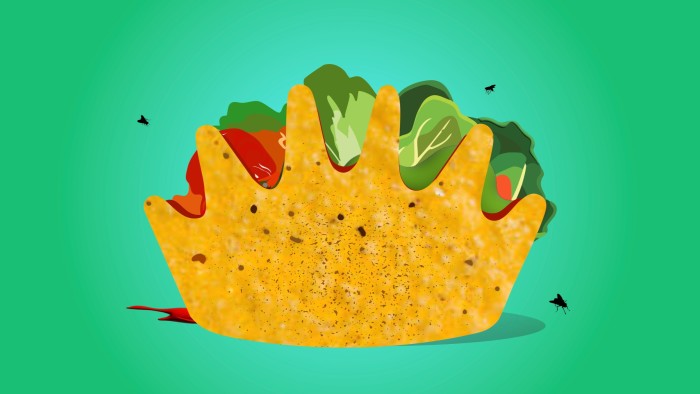
How do you say ‘Taco’ – as in ‘Trump Always Chickens Out’ – in Portuguese? It’s a question that some Brazilians might now ask with a smile.
Four months ago, US President Donald Trump announced additional 40 percent tariffs on Brazilian imports (raising a total of 50 percent duties) as he was angered by the country’s legal investigation into Jair Bolsonaro, the former president, and its crackdown on US Big Tech.
But President Luiz Inácio Lula da Silva defiantly hit back at the bullying – boosting his domestic popularity – and defended the courts. A Brazilian judge has now sent Bolsonaro to prison.
And those rates? Last week, Trump declared that “certain agricultural imports from Brazil should no longer be subject to the additional regime [40 per cent surcharge]In plain English: Lula won.
There are at least three lessons here. The first is that the White House appears to be growing more nervous about cost-of-living pressures. No wonder: recent surveys show that consumer confidence is collapsing together with Trump’s approval rating. His team is trying to find ways to lower food prices – and lowering agricultural tariffs is an obvious step.
The second lesson is that bullies often respond to force. Yes, cowardly flattery can work sometimes; Switzerland cut its own tariffs by sending gift-laden, obsequious executives to Trump. But China has followed a path of belligerence, with remarkable results. And Brazil’s resistance suggests others are learning from Beijing. If anything, this suggests that anyone dealing with Trump should start by assessing how he can exploit his weaknesses.
Third, it pays to distinguish between tactics and goals when looking at the White House. That may not sound obvious, as Trump often seems to fall woefully short of a clear strategy. His positions on Brazil, Ukraine and the Jeffrey Epstein case – to name just a few issues – have been so erratic that unpredictability may be the only predictable quality.
And – not surprisingly – many critics interpret these erratic policies as a sign of gross incompetence or personality disorders, or both; like a Tudor king, Trump’s narcissistic whims seem to drive his “court.”
But I think a more useful framework is to borrow advice given to new recruits at some US investment banks, which is to identify a hierarchy of ‘goals’, ‘strategies’ and ‘tactics’ in every action.
For while Trump is not operating with clearly stated policy objectives of the kind a banker might recognize, he is certainly driven by strong instincts. Most notably, his “Make America Great Again” tag reflects a consistent desire to achieve extreme economic and political dominance, both for the country and for his inner circle. (As befits a quasi-king, the two often seem intertwined.)
Moreover, this instinct is converted into strategies by advisors. These can be contradictory, in part because of fighting between factions in the White House. Their leitmotif, however, is ‘geoeconomic’ policymaking, that is, a desire to use economic policy to strengthen hegemonic power, in a way that rejects both the neoliberal thinking of the late 20th century and the collaborative post-war Bretton Woods approach.
And this strategy doesn’t just use networks to fight for dominance, as political scientists say Grégoire Mallard and Jin Sun have observed, but also conflates economic, political, cultural, technical, military and individual grievances. Hence Trump’s attempt to use tariffs to force Brazil to release Bolsonaro, or his ally’s threat to impose tariffs on Norway after the Caterpillar sovereign wealth fund was divested.
This also includes tactics. These reflect the method Trump made deals in the corporate world: bullying, threats, melodrama, policy shifts, cronyism and “flood the zone” announcements, to quote the president’s former strategist Steve Bannon.
These aggressive tactics attract attention; indeed, they intend to do so. But striking or not, they should not be confused with goals or strategies. The goal is to gain influence over rivals in a transactional world.
These tools don’t always work. Hence the “Taco” joke, which arose because Trump has often played down tariff threats. But precisely because these melodramatic moves are often tactics—and not deeply held ideological goals—the White House feels able to unblushingly pivot and cast aside moves when they backfire or when larger priorities arise. That’s why Brazil’s tariffs suddenly disappeared last week, and why Trump just embraced Zohran Mamdani, the newly elected mayor of New York, after viciously attacking him.
Of course, some observers might dismiss this analysis as mere “sanitary washing,” an attempt to make the White House team appear more logical than they actually are. Reasonable; I wouldn’t deny Trump’s erratic nature.
But the key point is this: Even if you make fun of Trump, it pays to separate the signal from the noise. In this sense, Lula’s triumph has sent some clearly encouraging signals to Europeans and others. Kings are rarely as omnipotent as they seem.
