



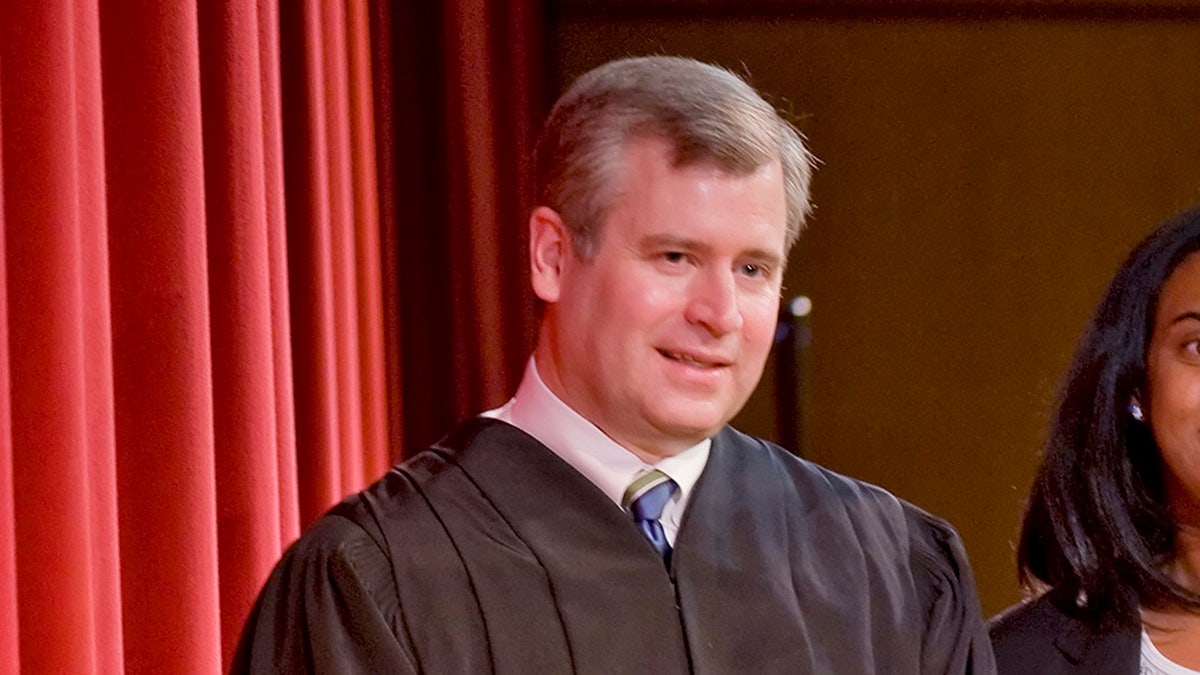
Patrick Schiltz is Chief Judge of the United States District Court for the District of Minnesota. Schiltz has presided over several litigation cases involving Operation Metro Surge in Minneapolis. For example, he recently became embroiled in the battle over the proposed arrest of Don Lemon after he and his anti-ICE friends allegedly stormed a St. Paul church. Schiltz absurdly delayed ruling on whether a magistrate judge’s decision not to issue a warrant for Lemon’s arrest would be overturned, claiming he would rule on the magistrate’s quashing within a week. Fortunately, Attorney General Pam Bondi has now secured an indictment against Lemon from a grand jury, but Schiltz made things more difficult for no particularly good reason.
Federal Judge Patrick J. Schiltz after taking the oath of citizenship. (David Brewster/Star Tribune via Getty Images)
Another clash almost occurred this week involving Schiltz and acting ICE Director Todd Lyons. Schiltz was furious that an inmate had not been released and ordered Lyons to appear for a hearing on Friday with the possibility of a contempt charge. “The Court’s patience has run out,” Schiltz wrote ominously. The detainee is now free, so Friday’s confrontation is no longer possible. It is easy to see how future conflicts could arise, and Schiltz should not preside over certain immigration-related cases.
However, there is a crucial distinction between the two organizations. MILC doesn’t just ensure immigrants are represented in court. It also argues for and against various immigration policies. For example, in a January 24, 2025 press release, it labeled President Trump’s early executive orders on immigration as “cruel and inhumane.” Suppose one of those executive orders came before Schiltz in a case in which an immigrant challenged its legality.

U.S. Immigration and Customs Enforcement (ICE) agents continue to conduct immigration enforcement operations in Minneapolis, Minnesota on Thursday, January 28, 2026. (Madison Thorn/Anadolu via Getty Images)
The standard for judicial denial is codified in 28 USC § 455. A judge must, among other things, be guilty of an appearance of impropriety. In other words, a recusal is required if a reasonable person, aware of all the relevant facts, would question the judge’s ability to be fair and impartial. This standard also appears in Canon 3(C) of the Code of Conduct for Judges in the United States. That is absolutely the case here. Just as a judge who has donated money to the Equal Rights Campaign has no business overseeing gay lawsuits, a judge who has donated money to an organization dedicated to open borders has no business overseeing immigration cases.
Furthermore, Schiltz and his fellow district judges would not even be allowed to preside over immigration detention cases because they are prohibited from doing so by law. The Immigration and Nationality Act of 1965 requires immigrants to litigate their removal proceedings in immigration courts. District courts have no jurisdiction to decide removal issues. The Third Circuit recently reversed a left-wing New Jersey judge’s intervention in the case of Hamas supporter Mahmoud Khalil, a student at Columbia University. The district judge had ordered Khalil’s deportation, but the Third Circuit correctly ruled that the district courts lacked jurisdiction in these cases.
CLICK HERE TO DOWNLOAD THE FOX NEWS APP
If Schiltz were to take this position, he wouldn’t have to worry about denial because of his MILC donations. He and all other district judges should stop intervening in deportation cases where jurisdiction is improper. In the meantime, Schiltz should recuse himself from such and other cases involving President Trump’s executive orders that the group he has allied with for many years has characterized as “cruel and inhumane.” If he doesn’t, higher courts will have to step in to uphold the integrity of the judicial process.
