



As protests spread across Iran and the government responds with deadly force amid mounting reports claiming thousands have been killed, a growing question is being asked by analysts and Iranians alike: Is the Islamic Republic facing its gravest threat since the 1979 revolution, or does it still have sufficient coercive power to survive?
For Mehdi Ghadimi, an Iranian journalist who spent decades protesting the regime before being forced to leave the country, this moment feels fundamentally different from anything that has come before.
EXILED Iranian CROWN PRINCE APPEALS TO TRUMP AS IRAN PROTESTS MARK ‘CERTAIN’ MOMENT
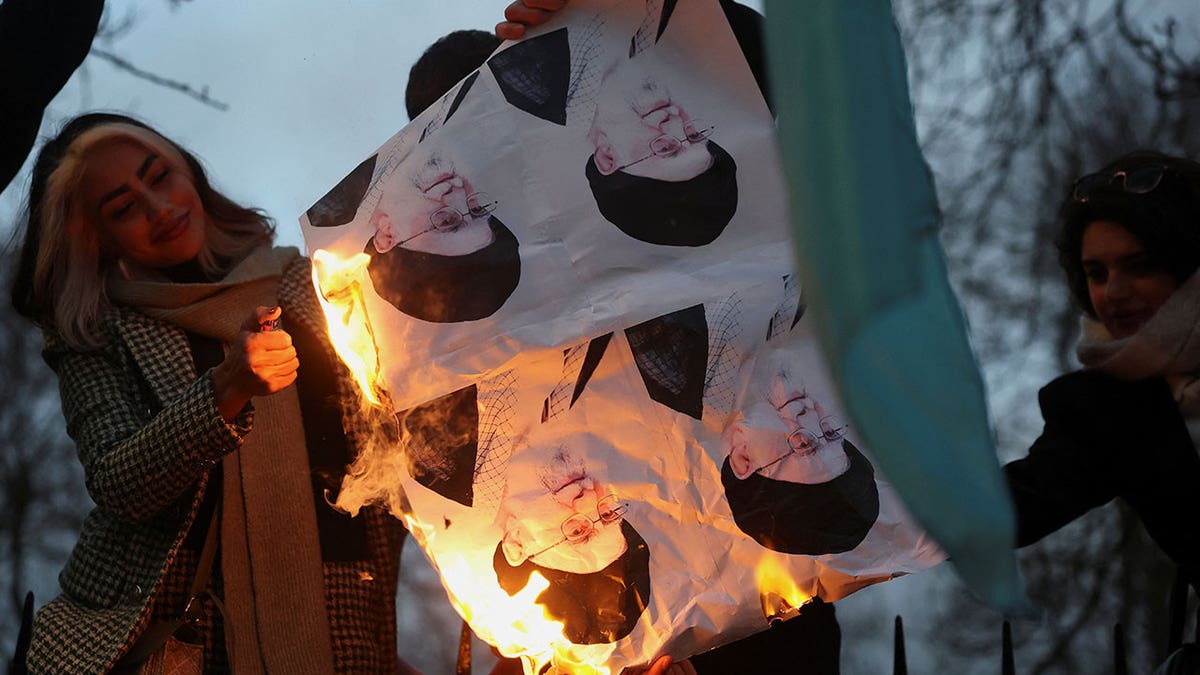
Protesters burn photos of Iranian Supreme Leader Ayatollah Ali Khamenei outside the Iranian embassy during a rally in support of nationwide protests in Iran, in London, Britain, January 12, 2026. (Toby Melville/Reuters)
According to Ghadimi, that realization gradually spread throughout Iranian society, culminating in what he describes as a decisive shift in the current unrest.
“For the first time in the 47 years of struggle of the Iranian people against the Islamic Republic, the idea of returning to the period before January 1979 became the only demand and the central point of unity among the people,” he said. “As a result, we witnessed the most widespread presence of people from all cities and towns of Iran on the streets, on a scale unprecedented in previous protests.”
Ghadimi claimed that the chants on the streets reflected that shift. Instead of demanding economic aid or changes in dress codes, demonstrators openly called for the fall of the Islamic Republic and the return of the Pahlavi dynasty.
“At that point it no longer seemed like we were just protesting,” he said. “We were essentially carrying out a revolution.”
IRAN’S KHAMENEI ISSUES DIRECT WARNING TO UNITED STATES IN RUSSIAN-LANGUAGE POSTS
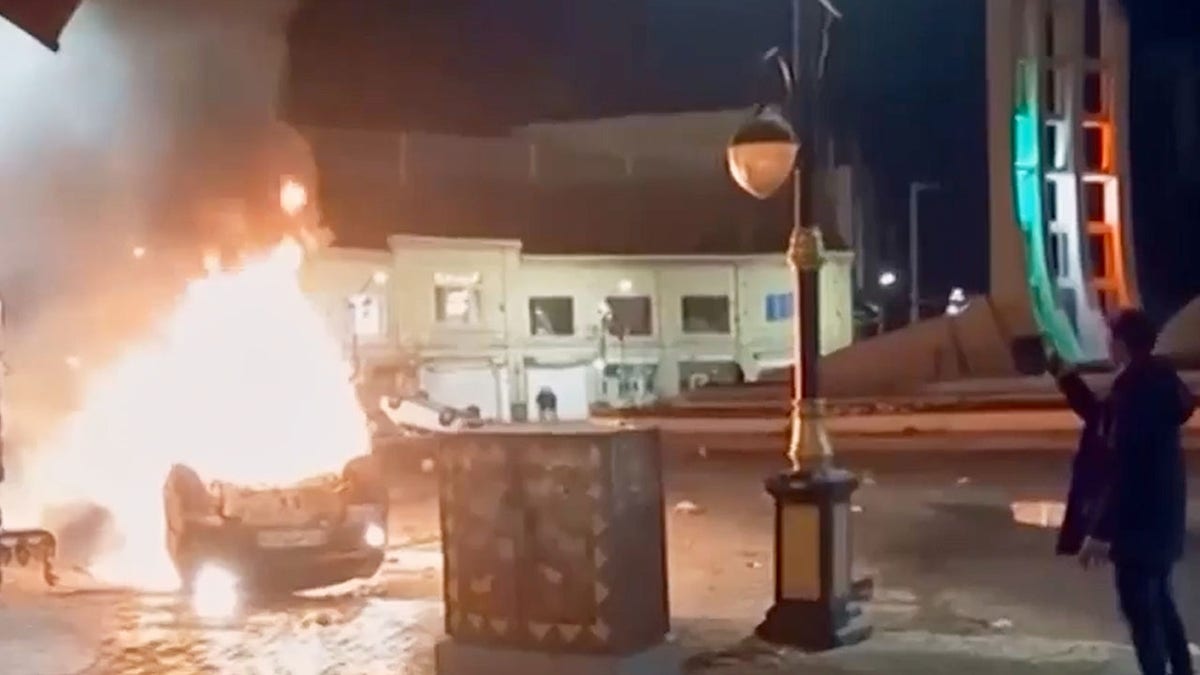
This frame shot from a video released Friday, January 9, 2026, by Iranian state television shows a man holding a device to document burning vehicles during a night of mass protests in Zanjan, Iran. (Iranian state television via AP)
Yet Ghadimi was clear about what he believes is preventing the regime’s collapse.
“The answer is very clear,” he said. “The government sets no limits for itself when it comes to killing its own people.”
He added that Tehran appears reassured by the lack of consequences for its actions. “The behavior of other countries has also reassured us that if the country manages to survive, it will not be punished for these blatant crimes against humanity,” he said. “The doors of diplomacy will always remain open to them, even if their hands are stained with blood.”
Ghadimi described how the regime cut off internet access to disrupt coordination between protesters and opposition leaders abroad. He said that once connectivity was lost, the reach of video messages from exiled Prince Reza Pahlavi dropped dramatically.
As Iranian voices describe a revolutionary moment, security and policy experts warn that structural realities still favor the regime.
Javed Ali, an associate professor at the Gerald R. Ford School of Public Policy, said the Islamic Republic faces far more serious threats to its grip on power than in recent years, driven by a convergence of military, regional, economic and diplomatic pressure.
THE IRAN REGIME WILL RELEASE HEZBOLLAH AND IRAQI MILITIES AS THE UPRISING SPREADS
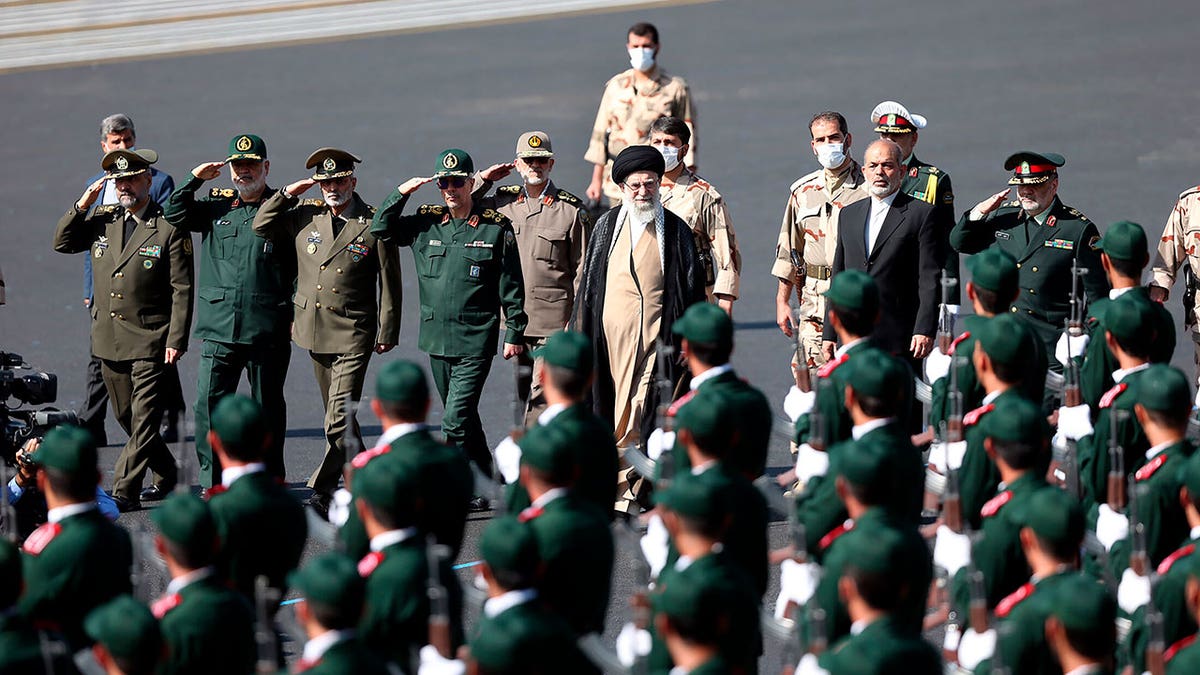
In this photo released by the official website of the Iranian Supreme Leader’s Office, Supreme Leader Ayatollah Ali Khamenei, center, views a group of Armed Forces cadets during their graduation ceremony, accompanied by Armed Forces commanders, at the Police Academy in Tehran, Iran, Monday, October 3, 2022. (Office of the Iranian Supreme Leader via AP)
“The IRGC is in a much weaker position after the 12-day war with Israel last summer,” Ali said, citing “removals of leadership, ballistic missile and drone capabilities that were used or damaged, and an air and radar defense network that has been significantly compromised.”
Ali said Iran’s regional deterrent has also been deeply eroded. “The so-called Axis of Resistance has been significantly weakened across the region,” he said, pointing to the setbacks of Hamas, Hezbollah, the Houthis and Shiite militias linked to Tehran.
Internally, Ali said demographic pressures are adding to the challenge. “Iran’s younger population is even more frustrated than before by deteriorating economic conditions, persistent social and cultural restrictions, and repeated violent crackdowns on dissent,” he said.
American hostages in Iran are at greater risk as protests spread; experts say the number held could be higher than estimates
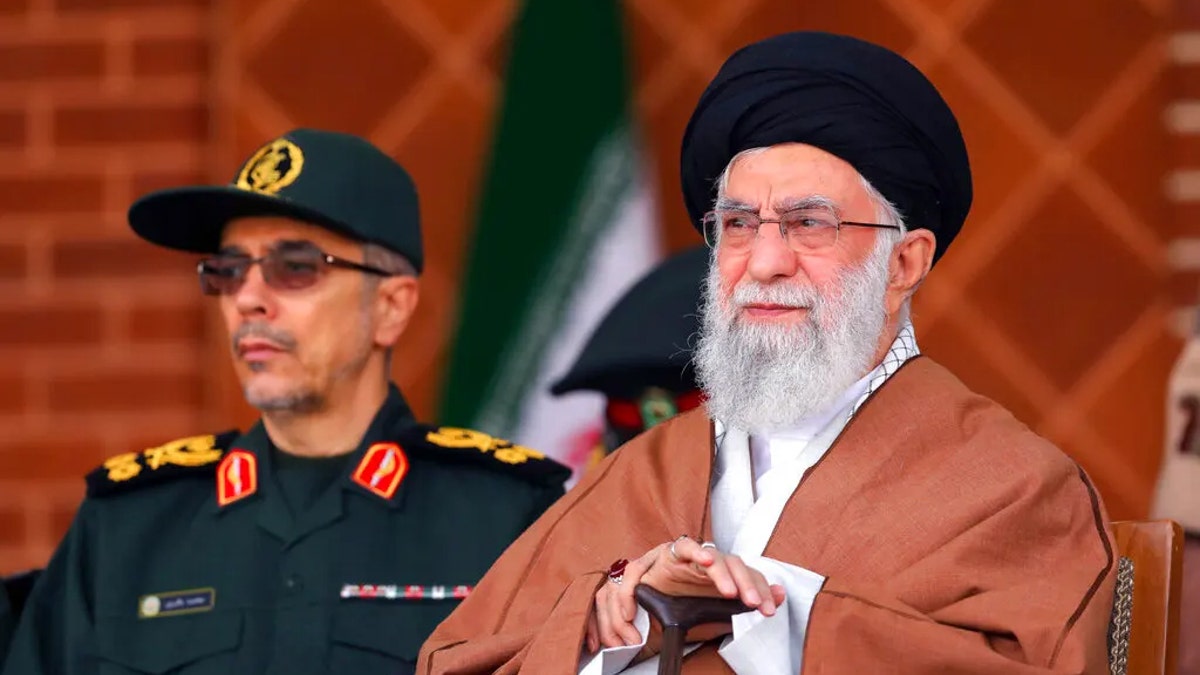
Iran’s Supreme Leader Ayatollah Ali Khamenei sits next to a senior military official in Iran. (Getty Images)
Ali also pointed to changing external dynamics that limit Tehran’s room for maneuver, including what he described as a stronger US-Israel relationship tied to the Netanyahu-Trump alliance. He added that “possible joint operations are already underway to support the protest movement in Iran.”
Israeli security sources, speaking on the background, said Israel has little interest in intervening in a way that would allow Tehran to direct its domestic unrest outward.
“Everyone understands that it is better to wait quietly and not turn the heat on Israel,” said a source. “The regime would like to make this about Israel and the Zionist enemy and start a new war to suppress internal protests.”
“It’s not Israel versus Iran,” the source added. “We recognize that the regime has an interest in provoking us, and we do not want to contribute to that.”
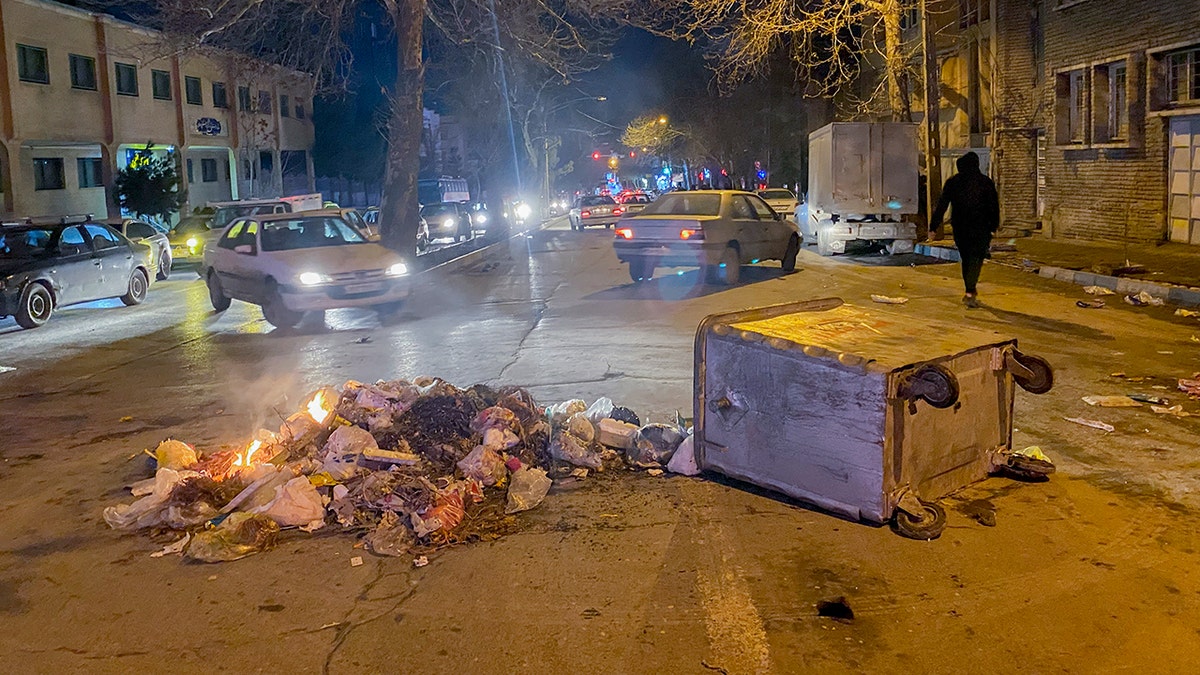
Burning debris lies next to an overturned waste container in the middle of a street during unrest amid demonstrations in Hamedan, Iran, on January 1, 2026. The demonstrations broke out after shopkeepers in Tehran’s Grand Bazaar closed their businesses to protest the sharp fall of Iran’s currency and deteriorating economic conditions. Clashes were reported in several provinces and Iranian media and rights groups said several people were killed in the violence. This marked the largest protests to ever hit the Islamic Republic. three years. (Mobina/Middle East Images/AFP via Getty Images)
The source said a collapse of the Islamic Republic would have far-reaching consequences. “If the regime falls, it will affect the entire Middle East,” the official said. “It could open a new era.”
Ali said Iran is becoming increasingly isolated diplomatically. “There is growing isolation from the Gulf monarchies, the fall of Assad in Syria and only moderate support from China and Russia,” he said.
Despite this pressure, Ali warned that Iran’s coercive institutions remain loyal.
“I think the IRGC, including paramilitary Basiji elements, together with the Ministry of Intelligence, are still loyal to the regime out of a mix of ideology, religion and self-interest,” he said, citing “power, money and influence.”
Whether fears of a collapse could prompt insiders to defect remains unclear. “Whether there are insiders willing to switch because of the sense of an impending collapse of the administrative structure is difficult to say,” Ali said.
TRUMP SAYS IRAN ‘STARTING TO CROSS US RED LINES AS PROTESTERS DIE IN GOVERNMENT CRACKDOWN
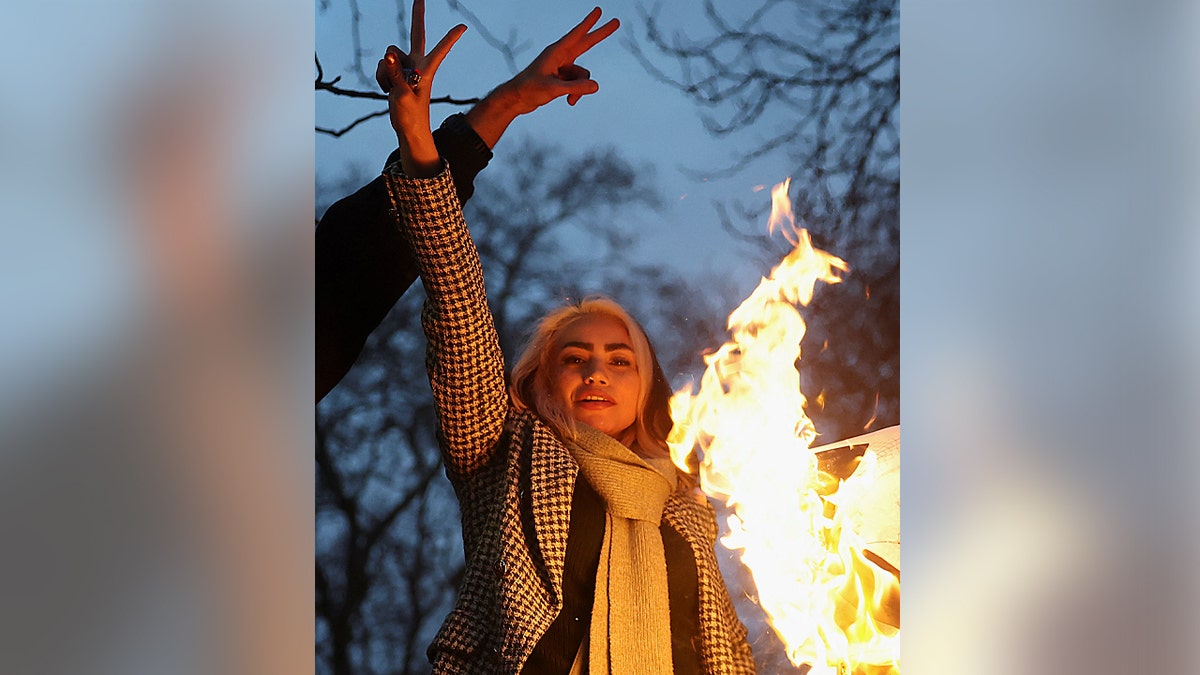
A protester gestures outside the Iranian embassy during a rally in support of nationwide protests in Iran, in London, Britain, January 12, 2026. (Toby Melville/Reuters)
He estimated the chance of an internal regime collapse at “25% or less,” calling it “possible, but much less likely.”
For now, Iran appears caught between two realities: a population increasingly united around the rejection of the Islamic Republic, and a security apparatus still willing to use overwhelming force to preserve it.
As Ali noted, pressure alone does not bring down regimes. The decisive moment will only come when those tasked with enforcing the repression decide that it is no longer in their interests to do so.
Despite the scale of the unrest, Ghadimi warned that the outcome remains uncertain.
“After these four hellish days, without even knowing the fate of our friends and loved ones who took to the streets, and whether they were alive or not, it is really difficult for me to give you a clear judgment and say whether our revolution is on the way to victory or not,” he said.
He recalled a message he heard repeatedly before leaving Iran, across cities and social classes.
CLICK HERE TO DOWNLOAD THE FOX NEWS APP
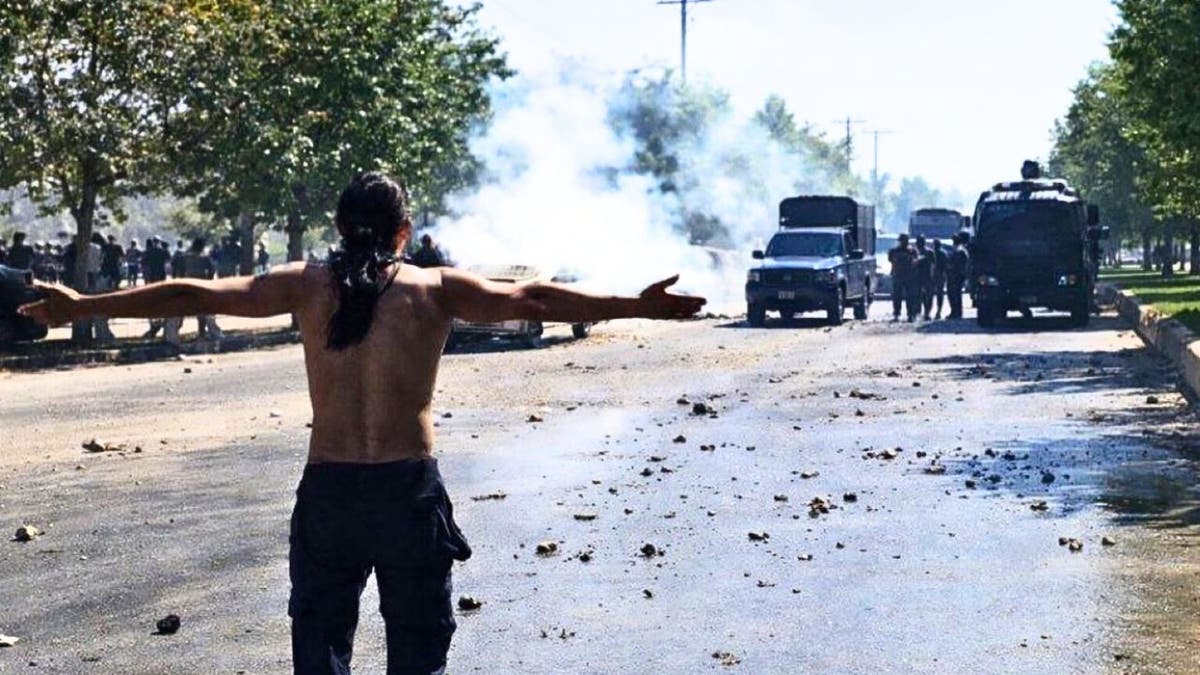
A protester is confronted by Iranian security forces during clashes amid nationwide unrest, according to images released by Iranian opposition group National Council of Resistance of Iran (NCRI) (NCRI)
“The only thing I heard consistently was this: ‘We have nothing left to lose, and even at the cost of our lives we will not retreat a step from our demand for the fall of the Islamic Republic,’” Ghadimi said. “They asked me to promise that now that I am outside Iran, I would be their voice.”
“That spirit still gives my heart hope for victory,” he added. “But my mind tells me that when mass killings carry no punishment, and when the government has enough bullets, weapons and determination to suppress it, even if it means killing millions, victory requires a miracle.”
