



In this period of reflection, it is awe-inspiring to think how much remains beyond our scientific understanding – from the big questions about the origins of the universe and life, to the more mundane.
Scientists have long been admirably pursuing the hugely important work of curing many diseases, but they still have a long way to go. They don’t know what causes aging at a fundamental level and whether it can be reversed.
Scientists only partially understand what causes intelligence or consciousness. They have a limited understanding of why people sleepwalk, talk in their sleep, dream, often cannot remember dreams or sometimes experiences déjà vu. They do not fully understand how memories are stored, retrieved, modified and deleted, or how memory works at the molecular level.
Scientists have many theories, but aren’t entirely sure why people hiccup, yawn, blush, laugh or cry tears. Why, for example, when we find something funny, we express it physically expel air rhythmically? It’s funny when you think about it.
THE FIRST SUNDAY OF ADVENT REMINDS US THAT HOPE IS OUR CALLING, EVEN IN THE DARKEST TIMES
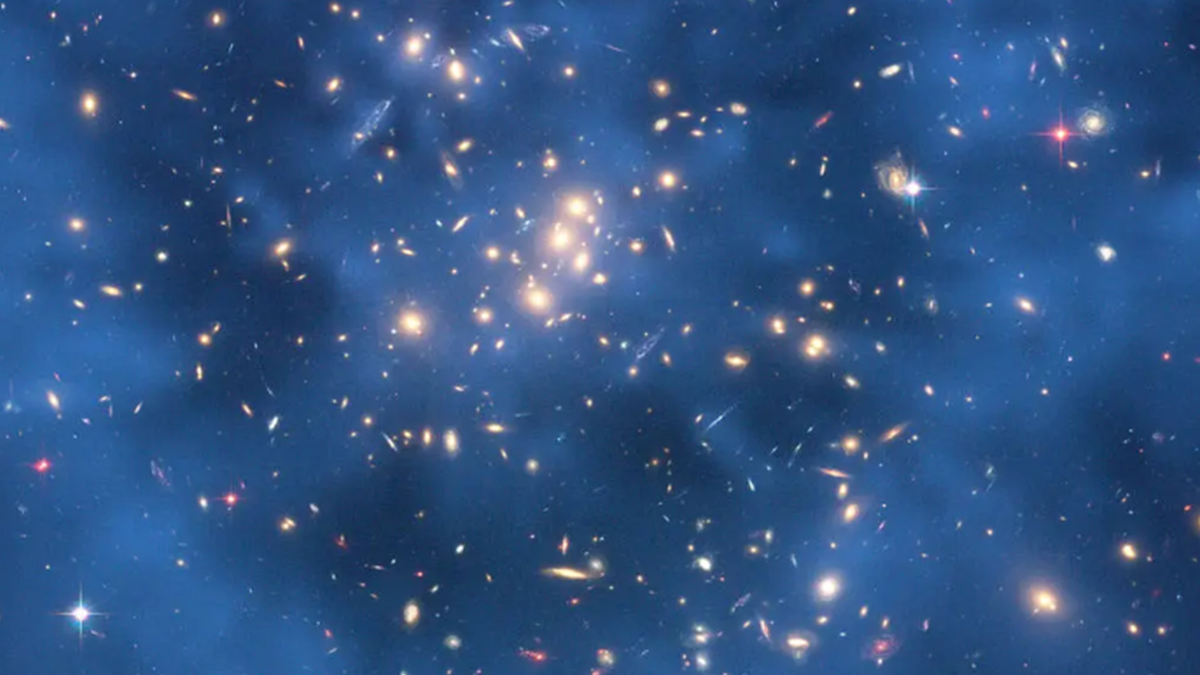
Although dark matter is not visible to the naked eye, it is believed to comprise much of the universe. (NASA)
We haven’t yet determined exactly why placebos work, even though people know they are getting a placebo. Or why we get songs in our heads. And much more.
On a larger, planetary scale, we don’t know what causes Earth’s magnetic field to reverse approximately every 250,000 years – with the north and south magnetic poles switching places. (We know that swirling liquid iron in our planet’s core generates magnetic fields, but we don’t understand what triggers the polar reversal.)
Some scientific questions are truly enormous and difficult to understand. Obviously, we don’t know if the universe is infinite, or if we are alone here. We don’t know what happened before the Big Bang (which is compatible with religious creation stories) and whether dimensions beyond space and time exist.
SCIENTISTS DISCOVER HOW SOME 80-YEAR-OLDS HAVE THE MEMORY OF 50-YEAR-OLDS
In fact, scientists are still figuring out most of the universe. They estimate that about 70% of the entire universe exists is “dark energy,” a mysterious form of energy that appears to be accelerating the expansion of the universe over time rather than slowing it down. A repulsive force that counteracts gravity, dark energy is invisible and everywhere. “The nature of dark energy is still not well understood,” Britannica explains.
Also mind-boggling is that about 85% of all matter in the universe is ‘dark matter’: invisible particles that scientists have yet to identify. Dark matter is also invisible because it does not emit, absorb or reflect light. We know it exists because of the way it affects things we can see: stars spin around galaxies too fast for the visible mass to keep them flying apart, so there’s an invisible mass at work. One candidate particle is the small axion, a particle with one ten trillionth the mass of an electron.
We don’t know how the universe will end, but the most widely supported theory is ‘The Big Freeze’, in which it expands forever, with stars burning out, matter decaying and the universe becoming cold, dark and empty. Or it could collapse or be torn apart.
HARVARD PHYSICIST SAYS MASSIVE INTERSTELLAR OBJECT MAY BE ALIEN PROBE ON ‘EXPLORATION MISSION’
One of the biggest unresolved questions in theoretical physics is whether there is a unified theory, sometimes called ‘A Theory of Everything’, that combines quantum mechanics (think atoms, particles and electromagnetism) and general relativity (Albert Einstein’s theory of gravity).
Suffice it to say that despite all our knowledge, the humble human still has much to discover. We have yet to see what level of intelligence machines will reach and how far we can go in creating new life forms. No matter how many times we’ve explored our planet, scientists estimate that there are probably six to ten million species undiscovered – far more species than have been discovered.
.CLICK HERE FOR MORE FOX NEWS ADVICE
Some scientific questions are truly enormous and difficult to understand. Obviously, we don’t know if the universe is infinite, or if we are alone here.
Not only do people have many unanswered scientific questions, but science cannot answer big questions that go beyond observable reality, such as: why is there something and not nothing? Why does the universe have its specific laws of nature? Do we have free will? What is the meaning of life?
Contemplating creation, the infinite and the invisible, energy and mass, and our own consciousness, inspires awe and humility.
CLICK HERE TO DOWNLOAD THE FOX NEWS APP
For some, the answer to this wonder is worship.
David says in Psalm 19:1, NIV, “The heavens declare the glory of God; the heavens declare the work of his hands.” And as 1 Corinthians 13:12 puts it, “For now we see through a glass darkly; but face to face: now I know in part: but then shall I know, even as I also am known.”
