



Saudi Crown Prince Mohammed bin Salman arrives in Washington on Tuesday for his first visit to the White House in seven years. This marks a pivotal moment to rebuild U.S.-Saudi ties and strengthen a partnership that remains central to U.S. security and energy interests.
Before the meeting, a group of September 11 survivors, first responders and victims’ families urged President Donald Trump to hold Saudi Arabia accountable for its alleged role in the 2001 attacks. This follows the ruling by a United States federal district court judge, George B. Daniels against Saudi Arabia’s efforts to dismiss a lawsuit filed against the country by the families of September 11 victims, alleging that the country was a party to the attacks.
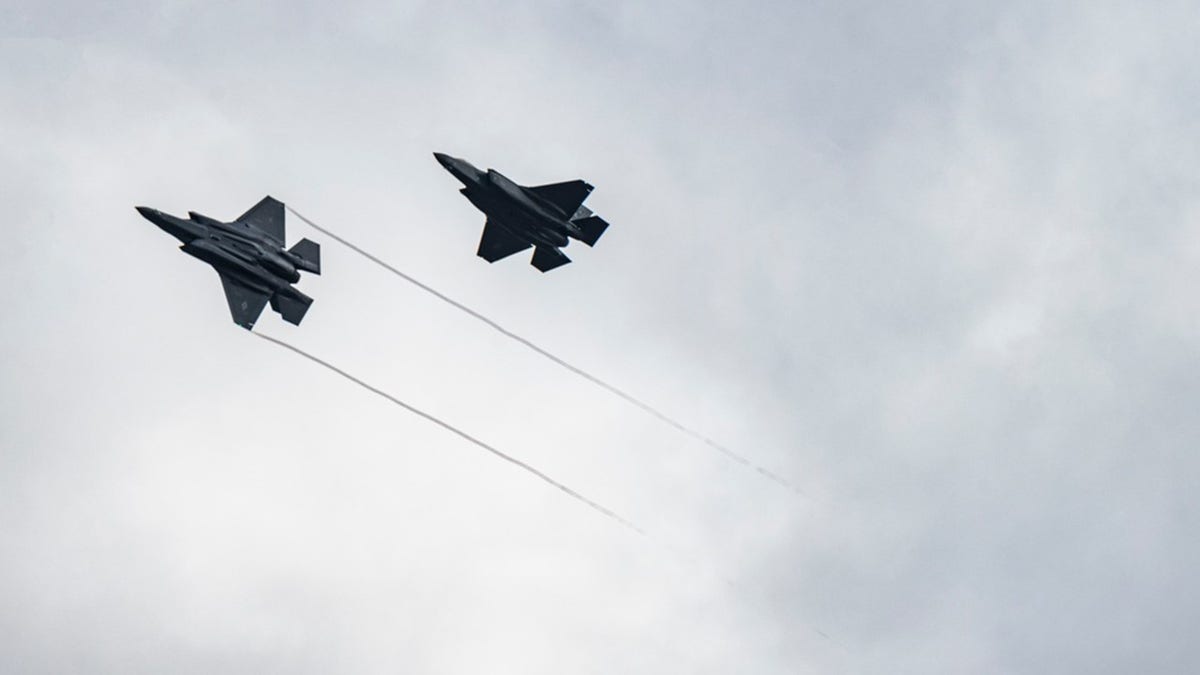
The visit comes as Trump has publicly confirmed that the United States will sell F-35 fighter jets to Saudi Arabia, telling reporters on Monday: “I will say we will do that. We will sell the F-35s,” a move that immediately puts Israel’s qualitative military edge and the region’s future defense architecture at the center of the conversation.
September 11 Families Urge TRUMP to Press Saudis for Accountability Ahead of MBS Visit to DC: ‘OVERWHELMING EVIDENCE’
On Monday, President Donald Trump confirmed that the US will sell F-35s to Saudi Arabia. (U.S. Air Force photo by Senior Airman Ali Stewart)
The official added that the visit will also focus on fulfilling the Saudis’ $600 billion investment pledge through dozens of targeted investments in key U.S. sectors.
In Saudi Arabia the visit is seen as historic. Aziz Alghashian, a lecturer in international relations at Naif Arab University in Riyadh, said there is “a lot of excitement. The Saudis have said they are not isolated in the region… this is back through open doors and back to the front door.” He said this moment reflects a broader shift in the way Saudis understand their country’s place in the world. According to Alghashian, Trump’s repeated warm comments about the crown prince and the kingdom also contribute to the feeling that Riyadh is re-entering Washington on a strong basis.
MBS’s visit will be his first appearance at the White House since the 2018 killing of journalist Jamal Khashoggi, which US intelligence said was cleared, an accusation he denies.
At the heart of the visit is the emerging US-Saudi security pact. Alghashian described its purpose in three words: “elevate, facilitate and consolidate.”
According to him, the agreement is intended “to take the Saudi-US relationship to the next level,” transforming it from what he called a “strategic partnership” to a more formalized security alignment. Although not a full-fledged treaty, as Riyadh had previously sought, the pact would still mark the most significant improvement in the relationship in decades. He said the shift also has a domestic political rationale in Washington, arguing that inclusion in the “alliance” category “makes Saudi Arabia more of a bipartisan issue, and not necessarily a Trump legacy.”
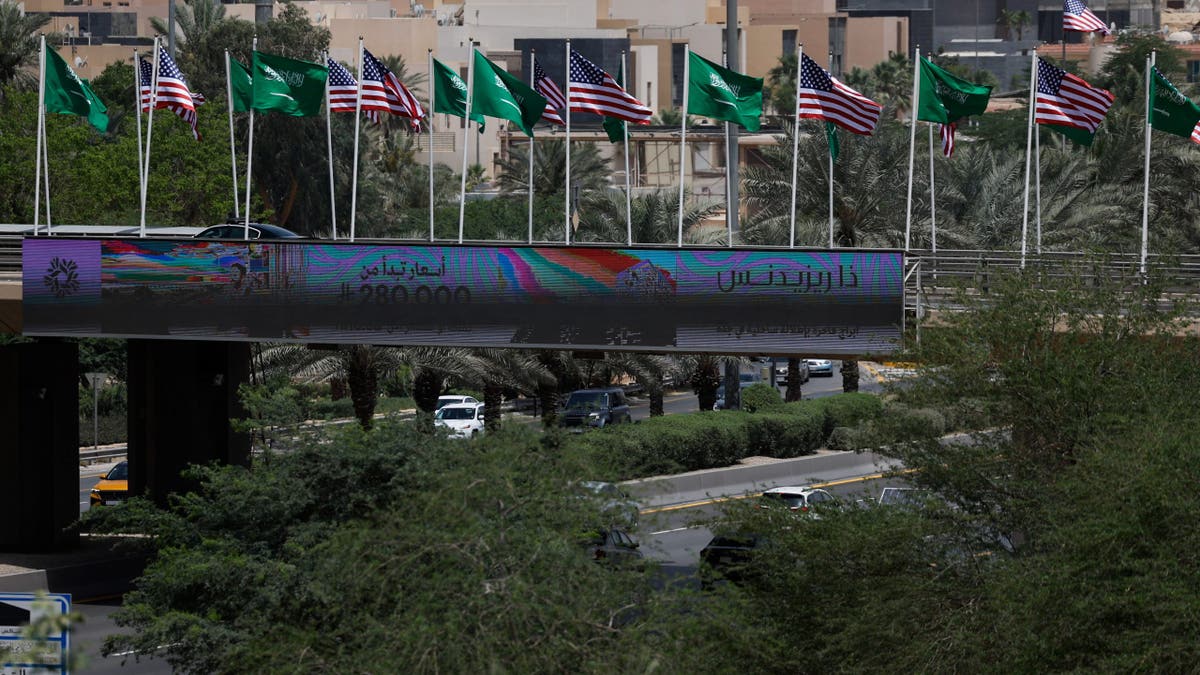
American and Saudi flags fly on Riyadh’s main highways ahead of US President Donald Trump’s arrival in Riyadh, Saudi Arabia, on May 12, 2025. (Hamad I Mohammed/Reuters)
Alghashian added that Saudi Arabia now wants to complete as much as possible. “The Saudis feel an urgency to get as much as they can from the Trump administration before these deals become complicated in the next administration,” he said.
That urgency extends to nuclear cooperation, where Saudi Arabia has made clear that while China and South Korea exist as alternatives, the country prefers an American program. “Saudi Arabia really wants US nuclear cooperation because it adds more security,” he said, adding that Riyadh will not “wait forever” if conditions become too restrictive, but sees the current US position as an opening.
UN SECURITY COUNCIL SUPPORTS TRUMP’S PEACE PLAN IN GAZA AFTER WALTZ CALLS TERRITORY ‘HELL ON EARTH’
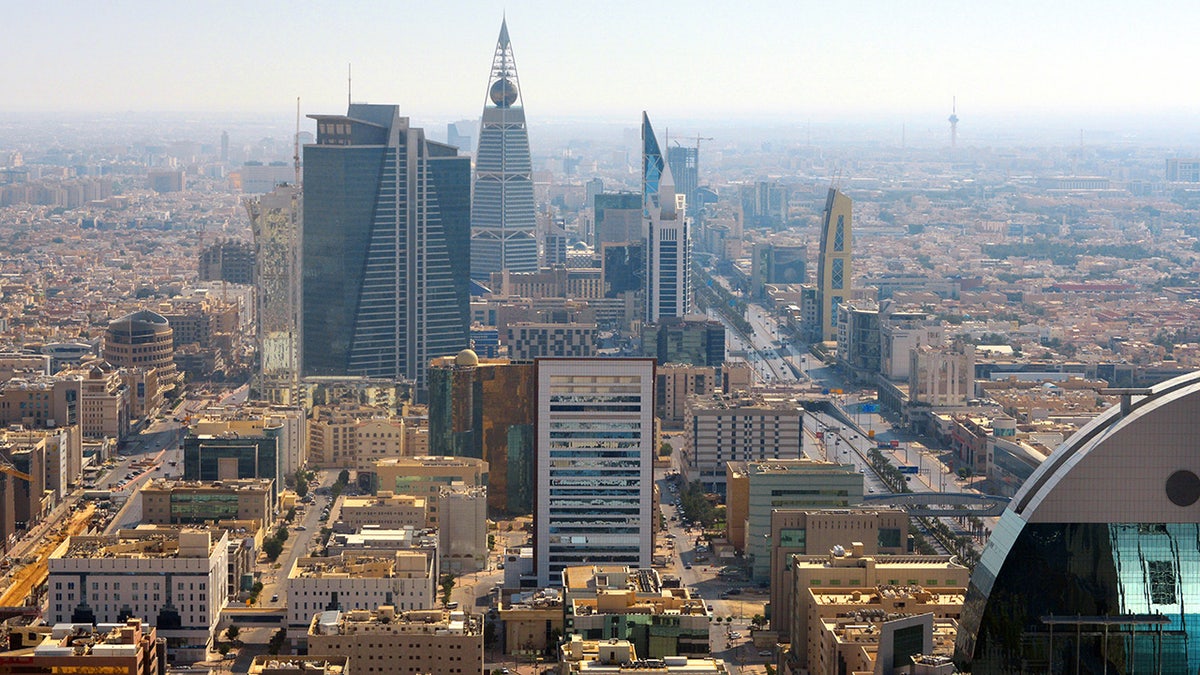
Riyadh, Saudi Arabia: view over the business district along King Fahd Road, with Olaya Street on the left – skyline with skyscrapers, Olaya Towers, Al Faisaliah Tower, Marriot, Hamad Tower. (Getty Images)
Olidort said Saudi Arabia has been “very categorical” in what it expects in a changed Middle East: a defense pact and a move for a Palestinian state. He recalled recently hearing a senior Saudi official say that “there will be no regional integration without a Palestinian state,” a line that reflects the kingdom’s long-standing public position that recognition of Israel will only come after a credible path to a Palestinian state has been established.
Still, Olidort said full normalization between Saudi Arabia and Israel may not be necessary at this time to advance U.S. priorities. He said normalization “need not be the immediate priority” and suggested that “further deepening cooperation, but without full normalization” could be possible if both sides see the value of closer security integration.
TRUMP SIGNS DEALS WITH 3 MIDDLE EAST NATIONS IN FIRST MAJOR TRIP OF SECOND TERM
That perspective is especially relevant given the war in Gaza and Riyadh’s position on reconstruction. As Alghashian noted, Saudi Arabia has said it “will not rebuild unless Hamas is gone and Israel withdraws,” a position that puts the kingdom at odds with any hasty post-war plan and, in his view, leaves the region “in no man’s land.”
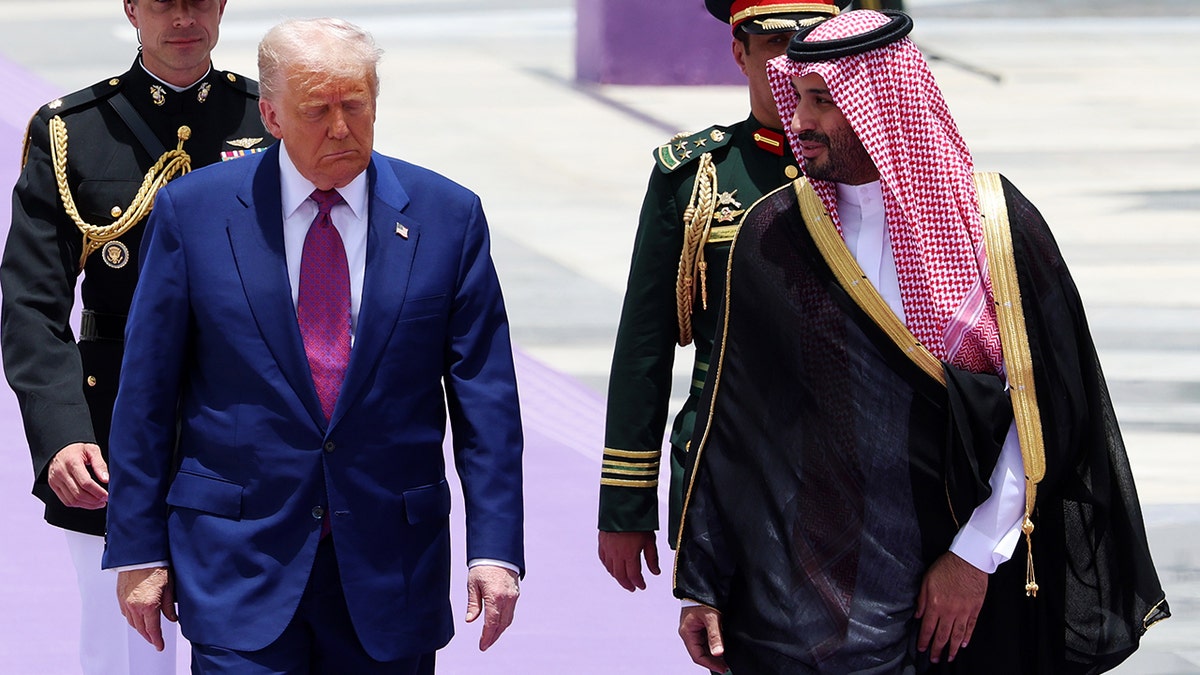
U.S. President Donald Trump walks with Saudi Crown Prince Mohammed bin Salman during an official state arrival ceremony at the Saudi Royal Court on May 13, 2025 in Riyadh, Saudi Arabia. (Win McNamee/Getty Images)
Trump’s decision to approve the sale of F-35s to Saudi Arabia adds another layer. Saudi Arabia has formally requested up to 48 fifth-generation aircraft, making it the largest potential F-35 buyer outside NATO and the first Arab state after the United Arab Emirates to receive them. The move would test Washington’s commitment to maintaining Israel’s qualitative military edge.
However, Olidort argued that the sale does not automatically endanger Israel’s superiority. “I don’t know if this will mean Israel loses its air superiority,” he said, noting that Israel’s defense and space sectors are “world-class” and that the sale could “potentially deepen cooperation between Israel and Saudi Arabia and make each of our partners … more effective.”
In addition to defense, the visit is also anchored in technology. Saudi Arabia is pushing for access to advanced US AI chips and positioning itself as a global data and energy hub.
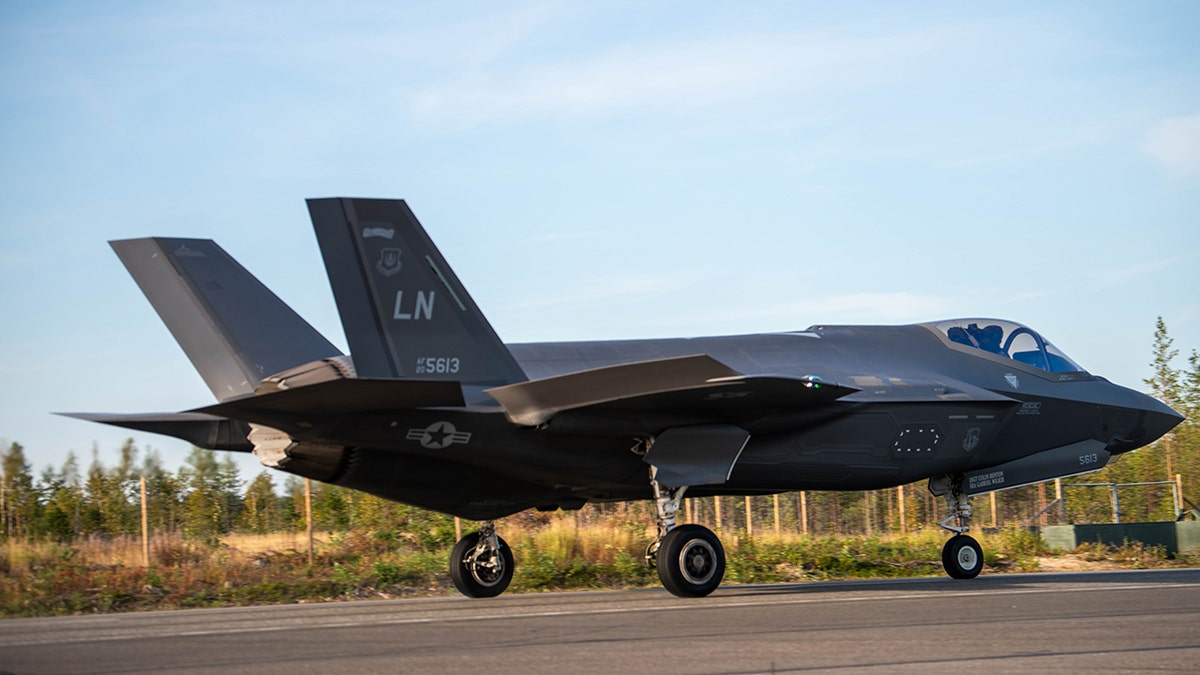
A U.S. Air Force F-35 Lightning II assigned to the 48th Fighter Wing RAF, Lakenheath, UK, lands on the Hosio Highway strip during exercise BAANA 2024, Ranua, Finland, September 4, 2024. (U.S. Air Force photo by Airman 1st Class Tabatha Chapman)
CLICK HERE TO DOWNLOAD THE FOX NEWS APP
Olidort put the issue bluntly, saying that AI cooperation with Saudi Arabia is a strategic priority for Washington because “the United States is in a ‘race’ with China” and warning that “if we don’t get there, we will end up in a Chinese-dominated AI space.” This view reflects the broader US assessment that the future of artificial intelligence – from data center capacity to semiconductor access – is inextricably linked to great power competition.
