



NEW YORK (AP) — Paul Tagliabue, who helped bring labor peace and wealth to the N.F.L during his 17 years as commissioner, but was criticized for not taking stronger action on concussions, died Sunday of heart failure. He was 84.
NFL spokesman Brian McCarthy said Tagliabue’s family notified the league of his death in Chevy Chase, Maryland.
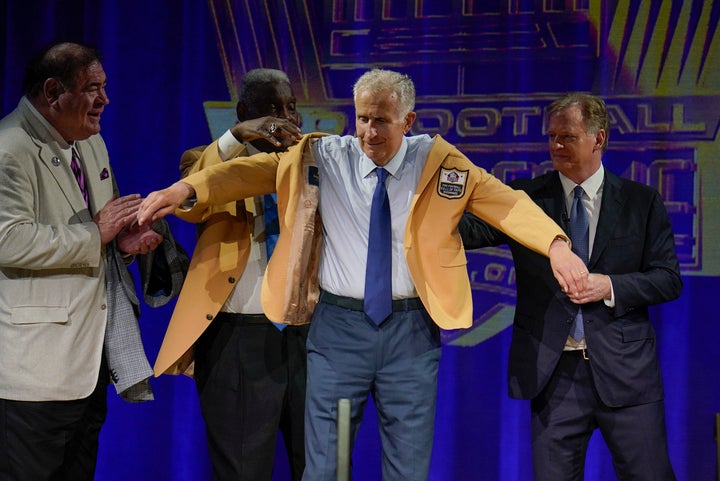
Tagliabue, who had developed Parkinson’s disease, served as commissioner after Pete Rozelle from 1989 to 2006. He was elected to the Pro Football Hall of Fame in 2020 as part of a special centennial class. Roger Goodell succeeded Tagliabue.
“Paul was the ultimate steward of the game – tall in stature, humble in presence and decisive in his loyalty to the NFL,” Goodell said in a statement. “I am forever grateful and proud to have Paul as my friend and mentor. I cherished the countless hours we spent together as he helped shape me as an executive, as well as a man, husband and father.”
Tagliabue oversaw numerous new stadiums and negotiated television contracts that added billions of dollars to the league’s bank account. There were no labor disruptions under him.
During his time, Los Angeles lost two teams and Cleveland another, migrating to Baltimore before being replaced by an expansion franchise.
Tagliabue instituted a substance abuse policy that was considered the strongest in all major sports. He also instituted the “Rooney Rule,” in which all teams with coaching vacancies must interview minority candidates. It has since expanded to include front office and leadership positions across the league.
When he took office in 1989, the NFL had just gotten the first black head coach of the modern era. By the time Tagliabue resigned in 2006, there were seven minority head coaches in the league.
In one of his pivotal moments, Tagliabue called off NFL games the weekend after the September 11, 2001, terrorist attacks. It was one of the few times the crowd compared him favorably to Rozelle, who continued the matches on the Sunday after John Kennedy was assassinated in 1963. A key presidential aide had advised Rozelle that the NFL should play, a decision the commissioner deeply regretted.
Tagliabue certainly had his detractors, mainly due to concussions. The problem has plagued the NFL for decades, though team owners played a major role in the lack of progress in dealing with head trauma.
In 2017, Tagliabue apologized for comments he made decades ago about concussions in football, acknowledging that he did not have the correct data at the time in 1994. He called concussions “one of those issues in journalism” and claimed that the number of concussions is “relatively small; the problem is the journalism issue.”
“Obviously,” he said on Talk of Fame Network, “I regret those comments. Looking back, it was not a sensible language to express my thoughts at the time. My language was intemperate and it led to serious misunderstandings.”
“My intention at the time was to make a point that could have been made quite easily: that there was a need for better data. There was a need for more reliable information about concussions and for uniformity in terms of how they were defined in terms of severity.”
While concussion recognition, research and treatment lagged behind for much of Tagliabue’s tenure, his work on the labor front was exemplary.
As one of his first decisions, Tagliabue contacted the players’ union, which was then led by Gene Upshaw, a Hall of Fame player and former star of Al Davis’ Raiders. Tagliabue had insisted that he would be directly involved in all labor negotiations, effectively rendering the Board of Directors of club directors, who had performed such duties for almost twenty years, useless.
“When Paul was named commissioner after that seven-month search in 1989, the league got back on track,” said Joe Browne, who spent 50 years as an NFL executive and was a confidant of Rozelle and Tagliabue.
“Paul had insisted during his negotiations that ultimate control over things like labor and all commercial business dealings should be in the commissioner’s office. The owners agreed and that was a big step forward toward the tremendous revival we had as a league – an expanded league – in the ’90s and beyond.”
Tagliabue built a solid relationship with Upshaw. Breaking away from the contentious dealings between the league and the NFL Players Association, Tagliabue and Upshaw kept negotiations respectful and focused on what would benefit both parties. Compromise was the key, Upshaw always said – although the union was often criticized for being too accommodating.
Tagliabue had been the NFL’s lawyer in Washington, a partner at the prestigious firm of Covington and Burling. He was elected commissioner over New Orleans general manager Jim Finks in October 1989 after a bitter fight that highlighted the differences between the NFL’s old guard and the newer owners.
But during his reign as commissioner, which ended in the spring of 2006 after he pushed through a highly contentious labor deal, he managed to unite the divided owners and actually relied more on the old-timers who supported him than on Jerry Jones and many of the younger owners.
Tagliabue was born on November 24, 1940 in Jersey City, New Jersey. He was the 6-foot-2 captain of the Georgetown basketball team and graduated in 1962 as one of the school’s then-best rebounders – his career average later falling just below that of Patrick Ewing. He was president of his class and a Rhodes Scholar finalist. Three years later, he graduated from NYU Law School and then worked as an attorney in the Department of Defense before joining Covington & Burling.
He eventually took over the NFL account and built a close relationship with Rozelle and other NFL officials during a series of legal actions in the 1970s and 1980s.
Tagliabue was naturally reserved, which sometimes led to coolness toward the media, which had embraced Rozelle, an affable former PR man. Even after leaving office, Tagliabue couldn’t match Goodell, who started his NFL career in the public relations department, in that regard.
But after September 11, Tagliabue showed a different side, especially to league employees who had lost loved ones in the attacks. He accompanied Ed Tighe, an attorney for the NFL Management Council whose wife died that day, to Mass at St. Patrick’s Cathedral, a few blocks from the NFL offices.
Art Shell, a Hall of Fame player, became the NFL’s first modern black head coach with the Raiders. He saw Tagliabue up close and found him extremely suitable for his work.
“After my coaching career was over, I had the privilege of working directly with Paul in the league office,” Shell said. “His philosophy on almost every problem was, ‘If it’s broken, fix it. And if it’s not broken, fix it anyway.’
“He always challenged us to find better ways to do things. Paul never lost sight of his responsibility to do what was right for the game. He was the perfect choice as NFL commissioner.”
Tagliabue is survived by his wife Chandler, son Drew and daughter Emily.
AP N.F.L.: https://apnews.com/hub/nfl
