



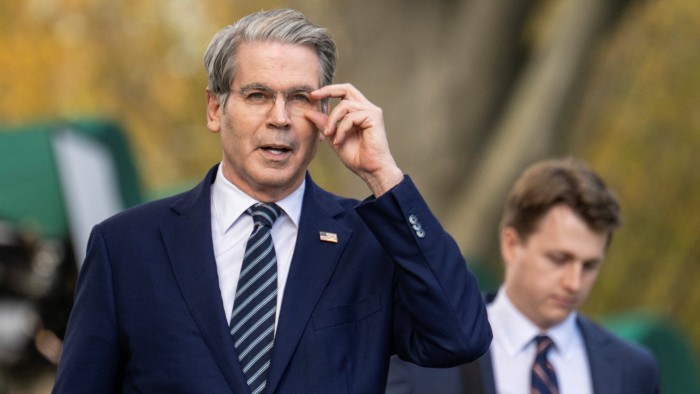
Beijing “has made a real mistake” by threatening to halt exports of its rare earths, US Treasury Secretary Scott Bessent said, insisting the US would secure alternative supplies within two years.
Speaking after Donald Trump and Xi Jinping met in South Korea, Bessent told the FT that US and Chinese leaders had reached a “balance” but warned that China would not be able to continue using its crucial minerals as a coercive tool.
“I don’t think they can do that now because we have countervailing measures,” he said, adding that Chinese influence over the US in rare earths would not last more than 12 to 24 months.
“China has made everyone aware of the danger. They have made a real mistake,” Bessent said. “It’s one thing to put the gun on the table. It’s another to fire shots in the air.”
The summit between Xi and Trump came six months after the leaders imposed extraordinary reciprocal tariffs that Bessent described at the time as tantamount to a trade embargo. After reaching a ceasefire, tensions flared this month when China responded to new US export controls with sweeping controls on rare earths.
The move threatened the ceasefire and the first meeting between Trump and Xi since 2019, and also caused widespread disruption around the world.
“I think China’s leaders were somewhat alarmed by the global reaction to their export controls,” Bessent said.
Bessent held triage negotiations with Chinese Vice Premier He Lifeng in Malaysia last week, saving the trade deal and the summit. “There is agreement that, ceteris paribus, we have reached an equilibrium and that we can operate within that equilibrium over the next 12 months,” Bessent said.
As leaders sat across the table at Gimhae Air Base, Bessent said it was clear they respected each other. He said Xi expressed concerns but clearly wanted to “find areas where he could work with President Trump.”
“They were both looking forward to being in the room and moving things forward, rather than the unsettled situation we have been in since the spring,” Bessent said. “They realized that stability between the two countries is important, for both economies and for the global economy.”
He said a lighter moment occurred when they discussed Trump visiting Beijing. “President Trump said, ‘I believe you want me to come at the beginning of the year,’ and President Xi said, ‘It’s very cold in January and February, why don’t we push it back to April?’”
Under the one-year deal, China agreed to delay implementation of its rare earths regime, buy large quantities of US soybeans and let US investors take control of TikTok in the US. On TikTok, Bessent said: “Everything is in place as far as permissions are concerned, and we should see a transaction very soon.”
The US responded by delaying a measure that would put thousands of Chinese groups on a trade blacklist. Trump also agreed to cut tariffs on fentanyl from 20 percent to 10 percent after Xi vowed to crack down on exports of chemicals used to make the deadly opioid.
“Fentanyl took up a big part of the discussion in Busan,” Bessent said. “It’s obviously very important for the president, very important for this administration, very important for the grassroots and for all Americans.”
Some observers say the US and China have just ceased hostilities and will struggle to make fundamental changes in relations.
Bessent disputed the idea that the US could no longer pressure China to implement structural reforms to address problems such as overcapacity. He said he had warned Europeans and others that Chinese exports would flow elsewhere after the US “raised the tariff wall.”
“The global south cannot absorb them, so they come to the EU, Britain, Australia, Canada and Japan, for example,” he said, adding that others had imposed tariffs on China or were planning to do so.
“We have set a standard and I wouldn’t be surprised if the rest of the world doesn’t follow that,” he said. “Our trade deficit with China has fallen by 25 percent this year. Chinese manufacturing activity has now contracted for seven straight months. Perhaps they will make the decision themselves.”
The Treasury Secretary said Trump’s successful trip to Asia, including the deals he struck to make America the “leading destination for capital and investment,” underlined a crucial US advantage.
“The US has the world’s most important military, strongest economy and financial center, with the dollar as the world’s reserve currency, and leads the world in technology and innovation,” he said. “President Trump is amplifying and expanding these strengths, and the Chinese know this.”
Bessent said the US and China would sign the deal in the coming week and was confident it would hold up. “Of course there will be some bumps… but I think we have much better communication channels now.”
