



Nvidia CEO Jensen Huang joins ‘The Sunday Briefing’ to discuss the new US-made Blackwell AI chip wafer, how Trump-era tariffs helped boost domestic production and efforts to expand manufacturing in America.
Nvidia on Wednesday became the first company in history to reach a market valuation of $5 trillion, marking rapid growth driven by the global artificial intelligence (AI) boom.
Shares of the leading AI chipmaker rose 3% to $207.04 on Wednesday, giving the company a market value of $5.03 trillion. This milestone highlights Nvidia’s rise from a video game graphics company to a force behind the AI revolution.
According to Reuters, the California-based company’s shares have risen twelvefold since ChatGPT’s launch in 2022.
NVIDIA LAUNCHES HUGE AI PUSH WITH MAJOR PARTNERSHIPS IN MULTIPLE INDUSTRIES
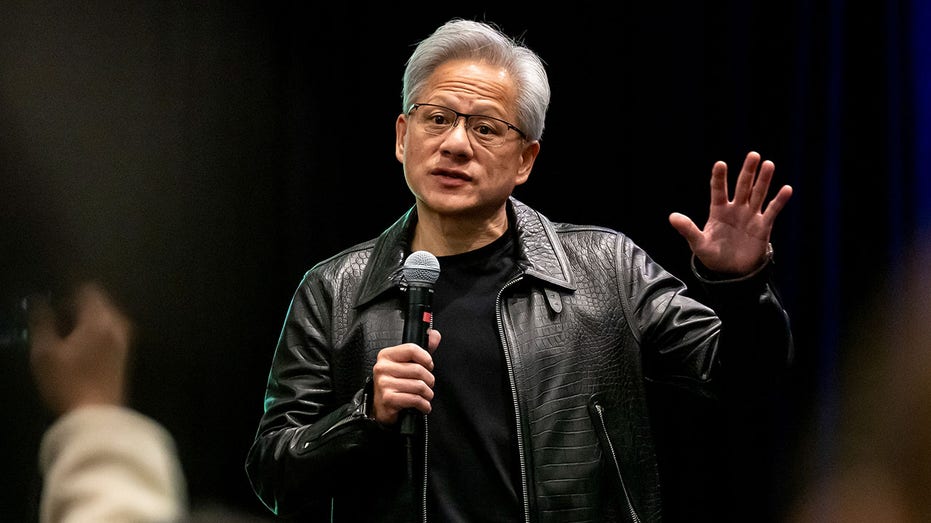
Jensen Huang, co-founder and CEO of Nvidia Corp., speaks during a press conference at the Nvidia GPU Technology Conference (GTC) in San Jose, California, on March 19, 2025. (David Paul Morris/Bloomberg via Getty Images/Getty Images)
The record valuation came just a day after Huang unveiled an extensive range of new AI initiatives and partnerships. The company announced on Tuesday that it had won $500 billion in orders for AI chips and would build seven supercomputers for the US government, Reuters reported.
Nvidia also announced on Tuesday that it would pay $1 billion for a stake in Nokia, according to Reuters.
The $5 trillion valuation comes just three months after Nvidia hit the $4 trillion mark, putting the company well ahead of other tech giants. Only Apple and Microsoft have previously crossed the $4 trillion threshold.
Founded in 1993 by electrical engineers Jensen Huang, Chris Malachowsky and Curtis Priem, Nvidia started as a modest startup that spun out of a Denny’s in California’s Bay Area.
The founders initially focused on the gaming market as a way to generate revenue while tackling complex computing problems that could drive future growth.
A few years after its launch, Nvidia fell on hard times after a setback in the development of the graphics card for the Sega Dreamcast video game platform. It had little financial space and laid off more than half of its employees. An investment from Sega America CEO Shoichiro Irimajiri provided a lifeline that allowed it to refocus on a new line of graphics products.
NVIDIA INVESTS UP TO $100 BILLION IN OPENAI
The Nvidia headquarters in Santa Clara, California, on August 28, 2024. (Loren Elliott/Bloomberg via Getty Images/Getty Images)
NVIDIA CEO SAYS HE IS TALKING TO TRUMP ADMIN ABOUT SELLING BLACKWELL CHIP TO CHINA
In 1999, the company launched what it called the graphics processing unit (GPU), which revolutionized the computer industry. Nvidia went public that year and its shares traded below $1 per share until early 2000.
In 2006, Nvidia developed the CUDA software platform and API that allows programmers to get more computing power from their GPUs. In the following years, AI research teams began using large amounts of GPUs to accelerate deep neural networks, which Nvidia calls the “Big Bang of modern AI.”
The adoption of GPUs accelerated deep learning by a factor of 50 over a three-year period toward the end of 2015. By the end of that year, Nvidia’s stock was trading at $8.24 per share, and the company continued to develop more advanced GPUs.
Nvidia released its groundbreaking RTX GPU in 2018, pushing the company’s stock above $60 per share.
The following years saw further advances in GPUs and AI chips, leading to Nvidia contributing to the creation of the metaverse. The stock price topped $100 per share throughout 2022 and began rising the following year amid the rise of AI.
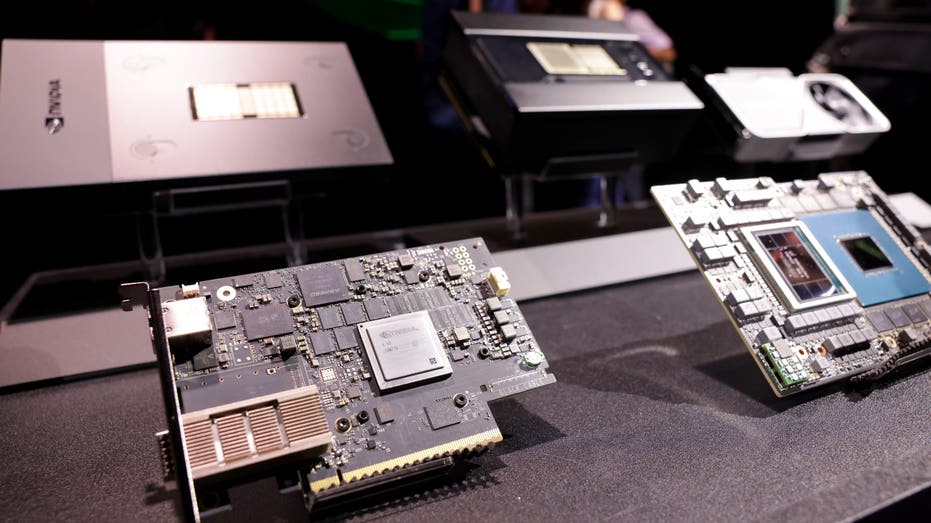
Nvidia Corp. chips during the Taipei Computex expo in Taipei, Taiwan, on May 29, 2023. (I-Hwa Cheng/Bloomberg via Getty Images)
Nvidia introduced its Grace Hopper superchip in 2023, and by the end of the year its stock price was just under $500 per share.
Further developments in 2024, including the announcement of Blackwell, the next-generation AI chip that served as Grace Hopper’s successor, pushed the stock even higher.
In March this year, Huang announced plans to invest hundreds of billions of dollars in the U.S. supply chain over the next four years. A month later, he unveiled plans to produce Nvidia’s AI supercomputers entirely in the US for the first time.
“This all started when President Trump wanted to reindustrialize the United States,” Huang said during “The Sunday Briefing” earlier this month. His tariffs were critical in making this possible at the speed we are doing now, and now, just after less than a year, we are now producing the most advanced chips for AI here in the United States. This is just the beginning.”
CLICK HERE TO GET FOX BUSINESS ON THE GO
A spokesperson for Nvidia declined to comment.
